B Wood
asked on January 17, 2024
Wave speed on a string calculation
How to calculate the speed of a wave on a string?
Need Help?
Hire one of our expert Physics tutor online. 24/7 Service. Available now.
Expert Answer
Answered on April 11, 2024 by EXPERT TUTOR
Nothing Found
Dear B Wood,
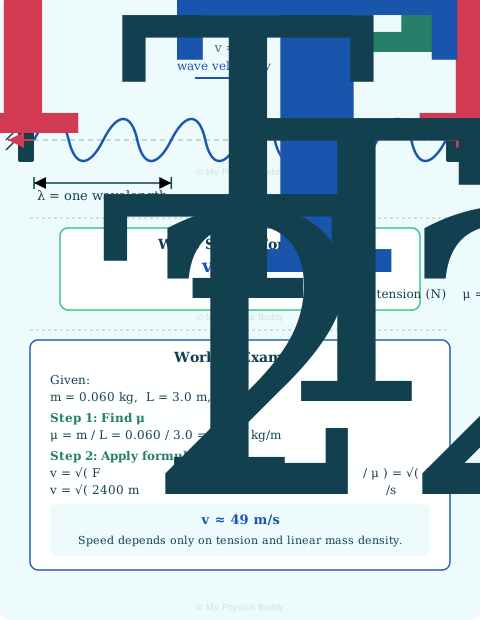
The speed of a wave on a string is calculated using the formula v = √(FT / μ), where FT is the tension in the string and μ is the linear mass density. According to expert tutors at My Physics Buddy, this relationship shows that a tighter or lighter string always carries waves faster.
Understanding Wave Speed on a String: The Physics Behind the Formula
Think about plucking a guitar string. The moment you release it, a disturbance travels along the string — that travelling disturbance is the wave. The question of how fast it travels depends on two competing physical properties of the string: how strongly it resists being stretched (tension) and how much inertia it has per unit length (linear mass density).
This is a core topic in AP Physics 1, and once you understand the intuition, the formula becomes obvious rather than something to memorise blindly.
The Key Formula
The wave speed on a string is given by:
v = √(FT / μ)
- v — wave speed (m/s)
- FT — tension in the string (N, Newtons)
- μ (mu) — linear mass density of the string (kg/m), which is the mass per unit length: μ = m / L
The tension is in the numerator — greater tension means faster wave propagation. Linear mass density is in the denominator — a heavier string per unit length moves more sluggishly and slows the wave down. As a University Gold Medalist in MSc Physics, I always tell students to reason through the formula first before plugging in numbers. Ask yourself: if I double the tension, what happens to speed? It increases by a factor of √2, not 2. That square root trips many students up on exam day.
Everyday Analogy
Imagine a long row of people holding hands. If everyone is alert and gripping tightly (high tension), a nudge at one end travels down the row very quickly. But if everyone is heavy and sluggish (high μ), the nudge moves slowly. The string wave works exactly the same way — tension drives the restoring force, and linear mass density resists the motion.
Where Linear Mass Density Comes From
You will often be given the total mass m of a string and its total length L. Calculate μ first:
μ = m / L
For example, a string of mass 0.060 kg and length 3.0 m has μ = 0.060 / 3.0 = 0.020 kg/m.
Worked Example
A string of mass 0.060 kg and length 3.0 m is held under a tension of 48 N. Calculate the speed of a wave travelling along it.
Step 1 — Find μ:
μ = m / L = 0.060 kg / 3.0 m = 0.020 kg/m
Step 2 — Apply the formula:
v = √(FT / μ)
v = √(48 N / 0.020 kg/m)
v = √(2400 m²/s²)
v = 48.99 m/s ≈ 49 m/s
Notice how the units work out: N / (kg/m) = (kg·m/s²) / (kg/m) = m²/s², and the square root gives m/s. Always track your units — AP Physics 1 free-response graders reward correct unit handling.
It is also worth knowing that wave speed on a string is independent of frequency and amplitude. The frequency of the wave is set by whatever is vibrating the string (your finger, a speaker), and the amplitude depends on how hard you pluck it. But the speed is determined purely by the string’s physical properties. This is a surprisingly common misconception I see even among well-prepared students. For more on how wave properties relate to each other, the Physics Classroom’s guide on wave speed is an excellent reference.
Once you know the wave speed, you can connect it to frequency and wavelength through the universal wave equation: v = f λ, where f is frequency (Hz) and λ is wavelength (m). This connects mechanical wave behaviour on strings to broader wave physics covered across AP Physics courses.
Common Mistakes
✗ Mistake: Using total mass instead of linear mass density directly in the formula — writing v = √(FT / m) without dividing by length first.
✓ Fix: Always calculate μ = m / L before substituting. The formula requires mass per metre, not total mass.✗ Mistake: Assuming that increasing the frequency increases the wave speed on the string.
✓ Fix: Wave speed on a string depends only on tension and linear mass density. Frequency changes the wavelength, not the speed.✗ Mistake: Forgetting to take the square root and reporting v = FT / μ as the final answer.
✓ Fix: The formula has a square root over the entire fraction. After dividing, always apply √ to get the correct speed in m/s.
Exam Relevance: Wave speed on a string appears in AP Physics 1 (Unit 10: Mechanical Waves), IB Physics HL/SL, and A-Level Physics. Expect both multiple-choice questions testing conceptual reasoning and free-response questions requiring full calculations with unit tracking.
Pro Tip from Christi J: When tension doubles, speed increases by only √2 ≈ 1.41 times. Sketch a quick ratio before calculating — it catches errors instantly on multiple-choice questions.
Related Questions
How to answer 9702 Paper 5 planning questions effectively?
How does electromagnetic induction work and what is Faraday’s law?
What is the difference between nuclear fission and fusion in A Level?
How to calculate specific heat capacity from experimental data?
What is simple harmonic motion and how to derive its equations?
How to solve problems involving circular motion and centripetal force?
What are the common mistakes in 9702 Paper 2 structured questions?
How to interpret and draw electric field line diagrams?