Hoda K
asked on December 27, 2025
Young modulus from stress-strain graph
How to calculate Young modulus from a stress-strain graph?
Need Help?
Hire one of our expert Physics tutor online. 24/7 Service. Available now.
Expert Answer
Answered on December 29, 2025 by EXPERT TUTOR
Nothing Found
Dear Hoda K,
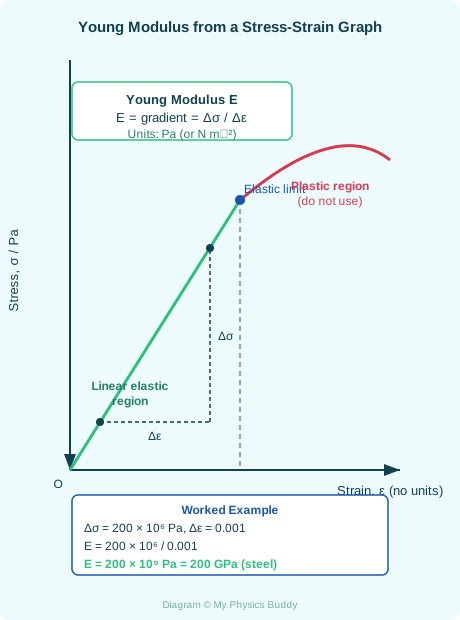
To calculate the Young modulus from a stress-strain graph, you find the gradient of the straight linear region — the slope equals stress divided by strain, giving you the Young modulus in pascals (Pa). According to expert tutors at My Physics Buddy, this gradient represents the stiffness of the material. The steeper the slope, the stiffer the material.
Understanding the Young Modulus and How to Read It from a Stress-Strain Graph
The Young modulus (E) is a measure of a material’s stiffness — specifically, how much stress is needed to produce a given strain. It tells you how reluctant a material is to deform elastically under load. In A/AS Level Physics (9702), this is one of those topics where the graph does all the heavy lifting, and knowing exactly what to measure — and where — is the key exam skill.
The Core Formula
The Young modulus is defined as:
E = stress / strain
Where:
- Stress (σ) = Force / Cross-sectional area, measured in pascals (Pa) or N m⁻²
- Strain (ε) = Extension / Original length — a dimensionless ratio (no units)
- Young modulus (E) is therefore measured in pascals (Pa)
On a stress-strain graph, stress (σ) is plotted on the y-axis and strain (ε) on the x-axis. In the initial straight-line portion of the graph — known as the linear elastic region — the material obeys Hooke’s Law, meaning stress is directly proportional to strain. The Young modulus is simply the gradient (slope) of this straight section.
Step-by-Step: How to Calculate the Gradient
Here is the method you should follow every time you encounter this type of question:
- Identify the linear region. Look for the straight portion of the graph that passes through the origin. Do not use any curved section — this would be beyond the elastic limit.
- Choose two well-separated points on the straight line. Do not read from the curve. Use points directly on the drawn line, not plotted data points, and pick them as far apart as possible for accuracy.
- Calculate the gradient. Use: gradient = Δσ / Δε = (σ₂ − σ₁) / (ε₂ − ε₁)
- State the units. Since strain has no units, E has the same units as stress: Pa or N m⁻².
Worked Example
Suppose a stress-strain graph shows a linear region passing through the origin. You pick two points on this straight line:
- Point A: σ = 0 Pa, ε = 0
- Point B: σ = 200 × 10⁶ Pa, ε = 0.001
Then:
E = Δσ / Δε = (200 × 10⁶ − 0) / (0.001 − 0) = 200 × 10⁹ Pa = 200 GPa
This is actually very close to the accepted Young modulus of steel (~200 GPa), which is a useful sanity check. For comparison, rubber has a Young modulus of roughly 0.01–0.1 GPa — its stress-strain graph has a much gentler gradient, reflecting how easily it stretches.
The Everyday Analogy
Think of the gradient on the stress-strain graph like the stiffness of a spring in everyday life. A stiff steel spring needs a lot of force for a tiny stretch — steep graph, high E. A soft rubber band stretches easily with little force — shallow graph, low E. The gradient is literally telling you how “hard to stretch” the material is at a molecular level.
Key Regions of the Graph to Know
| Region | Description | Young Modulus Applicable? |
|---|---|---|
| Linear elastic region | Straight line through origin; Hooke’s Law obeyed | Yes — use gradient here |
| Beyond elastic limit | Curve begins; permanent deformation starts | No — do not use this region |
| Plastic region | Large strain with little extra stress increase | No |
As an IBDP & A-Level Physics Specialist, I can tell you that one of the most consistent struggles I see is students drawing their gradient triangle in the wrong section of the graph. The elastic region is the only place where E is defined, and examiners will penalise you for using a curved portion. For more on how material properties are tested experimentally, this National Physical Laboratory guide on elastic constants is an excellent authoritative reference.
For students also exploring how stress-strain analysis extends into materials science and engineering contexts, our A/AS Level Physics (9702) resources cover all related topics in depth. You may also find it useful to check the Cambridge International 9702 syllabus to confirm exactly which skills are assessed for this topic in your paper.
Common Mistakes Students Make
✗ Mistake: Using the curved (plastic) region of the graph to draw the gradient triangle.
✓ Fix: Always identify and use only the initial straight-line section through the origin — this is the only region where E = gradient is valid.✗ Mistake: Giving strain a unit such as metres or mm, then carrying it through to give E a wrong unit.
✓ Fix: Remember strain = extension / original length, so it is dimensionless. E must come out in Pa (or N m⁻²) — same unit as stress.✗ Mistake: Reading gradient values from plotted data points rather than from the best-fit straight line.
✓ Fix: Always read Δσ and Δε from the line itself, using two clearly separated points, to minimise reading error and match examiner expectations.
Exam Relevance: This topic is directly assessed in Cambridge A/AS Level Physics (9702), Edexcel A Level Physics, and IB Physics HL/SL. Questions typically ask you to determine E from a graph or describe the experimental method used to obtain the data.
Pro Tip from Mamatha M: Draw your gradient triangle as large as possible across the full linear region — larger triangles reduce reading errors and show the examiner exactly where you’re working.
Related Questions
How to answer 9702 Paper 5 planning questions effectively?
How does electromagnetic induction work and what is Faraday’s law?
What is the difference between nuclear fission and fusion in A Level?
How to calculate specific heat capacity from experimental data?
What is simple harmonic motion and how to derive its equations?
How to solve problems involving circular motion and centripetal force?
What are the common mistakes in 9702 Paper 2 structured questions?
How to interpret and draw electric field line diagrams?