Amber Morris
asked on July 31, 2025
Internal resistance from graph method
How to determine internal resistance of a cell using a graph?
Need Help?
Hire one of our expert Physics tutor online. 24/7 Service. Available now.
Expert Answer
Answered on August 23, 2025 by EXPERT TUTOR

Dear Amber Morris,
To determine the internal resistance of a cell using a graph, you plot terminal voltage V against current I, fit a straight line, and read off the gradient and intercept. According to expert tutors at My Physics Buddy, this graphical method is one of the most reliable and examinable techniques in A/AS Level Physics (9702).
Understanding Internal Resistance and the V–I Graph Method
Every real cell behaves like an ideal source of electromotive force (e.m.f.) in series with a small resistance. That small resistance is called the internal resistance, symbol r, and it is a property of the cell itself — not the external circuit. Think of it like a water pump that has a narrow section inside it: even if the pump is powerful, that constriction wastes some of the pressure before the water ever reaches the pipes outside. In the same way, the internal resistance “wastes” some of the cell’s e.m.f. as a voltage drop inside the cell whenever current flows.
The Key Equation
The governing equation for a cell driving a current I through an external resistance R is:
ε = V + Ir
Rearranging to make V the subject:
V = ε − Ir
Where:
- ε = electromotive force of the cell (V) — the total energy per unit charge the cell can supply
- V = terminal p.d. (V) — the voltage you actually measure across the cell’s terminals
- I = current in the circuit (A)
- r = internal resistance of the cell (Ω)
This equation has exactly the form y = mx + c, the equation of a straight line. If you plot V on the y-axis and I on the x-axis, you get:
- y-intercept = ε (the e.m.f., read where the line crosses the V-axis when I = 0)
- gradient = −r (the slope is negative, so internal resistance = magnitude of the gradient)
Setting Up the Experiment
The standard circuit used in A/AS Level Physics (9702) experiments connects the cell to a variable resistor (rheostat) in series, with a voltmeter across the cell terminals and an ammeter in series. By adjusting the rheostat you change the current, and you record several paired values of V and I. Using at least 6 data points spread across a good range of current values gives a reliable best-fit line.
Plotting and Interpreting the Graph
Once you have your data table, plot V (y-axis, in volts) against I (x-axis, in amperes). Draw a straight best-fit line through the points. The line will slope downward from left to right because as current increases, more voltage is lost inside the cell.
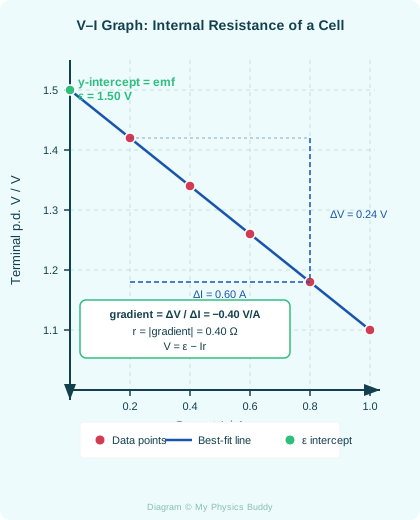
Reading the e.m.f.: Extend the best-fit line to the y-axis (where I = 0). The value of V at that intercept equals the e.m.f. ε. Physically, this is the terminal voltage when no current flows and there is no internal voltage drop.
Reading the internal resistance: Calculate the gradient of the line using two well-separated points on the line (not data points). The gradient is negative and equals −r, so:
r = −gradient = −(ΔV / ΔI)
Worked Example
Suppose your best-fit line passes through the points (0.20 A, 1.42 V) and (0.80 A, 1.18 V).
| Step | Calculation | Result |
|---|---|---|
| Calculate gradient | (1.18 − 1.42) / (0.80 − 0.20) | −0.40 V A⁻¹ |
| Internal resistance | r = −(−0.40) | r = 0.40 Ω |
| e.m.f. from y-intercept | Extrapolate line to I = 0 | ε ≈ 1.50 V |
As an IBDP Physics Facilitator and Head of Sciences with 22+ years of experience, I have noticed that students who understand why the line slopes downward — because more current means more internal voltage drop — almost never confuse the gradient with the intercept in exam conditions. That conceptual anchor is worth building firmly.
For additional depth on experimental technique and circuit analysis, the Cambridge International AS & A Level Physics (9702) syllabus page provides official guidance on the required practical skills associated with this topic.
Students studying related circuit topics will also find it helpful to explore our broader Physics resources for worked examples on e.m.f. and circuit analysis.
Common Mistakes Students Make
✗ Mistake: Reading the internal resistance directly from the y-intercept and the e.m.f. from the gradient.
✓ Fix: Remember — y-intercept gives ε and the magnitude of the gradient gives r. The gradient is negative, so always take r = |gradient|.✗ Mistake: Using actual data points to calculate the gradient instead of two points on the best-fit line.
✓ Fix: Always choose two points that lie exactly on your drawn best-fit line and are as far apart as possible to reduce percentage uncertainty in the gradient.✗ Mistake: Forgetting to extend the best-fit line back to the y-axis when the data does not start at I = 0.
✓ Fix: Extrapolate the line to the y-axis — the intercept at I = 0 is still valid and gives ε even if you have no data point there.
Exam Relevance: This topic is examined in Cambridge A/AS Level Physics (9702), Edexcel A Level Physics, and IB Physics HL/SL. It commonly appears in practical-skills questions and data-analysis paper sections requiring graph interpretation.
Pro Tip from Jiya B: Always label your axes with both the quantity and unit — examiners award a specific mark for that, and it takes two seconds to secure it.
Related Questions
What is the difference between AP Physics 1 and AP Physics 2?
How to solve Gauss’s law problems in AP Physics 2?
What is the right-hand rule and how to apply it for magnetic fields?
How to calculate electric potential and potential energy?
How does a capacitor work and how to solve RC circuit problems?
What is Bernoulli’s equation and how to apply it to fluid flow?
What is the relationship between period and frequency for oscillations?
How to calculate the speed of a wave on a string?