Mona Ibn Suleiman
asked on October 6, 2025
Drawing free body diagrams correctly
How to draw and analyze free body diagrams correctly?
Need Help?
Hire one of our expert Physics tutor online. 24/7 Service. Available now.
Expert Answer
Answered on October 14, 2025 by EXPERT TUTOR
Nothing Found
Dear Mona Ibn Suleiman,
To draw and analyze free body diagrams correctly, you isolate a single object, represent it as a point or simple shape, and draw every force acting on that object as a labeled arrow pointing in the exact physical direction. According to expert tutors at My Physics Buddy, mastering this skill is the single most reliable way to solve Newton’s second law problems without errors.
How to Draw and Analyze Free Body Diagrams: A Complete Guide
A free body diagram (FBD) is a simplified sketch that shows one object in isolation together with all the real forces acting on it. The word “free” literally means the object is freed from its surroundings on paper — you remove every other object and replace their physical influence with force vectors. This is the foundational tool of Classical (Newtonian) Mechanics, and it appears in virtually every branch of Physics that involves forces.
Think of it like this: imagine you are a doctor examining a patient. You do not examine the entire hospital — you focus on that one patient and list every symptom acting on their body. A free body diagram does exactly the same thing for a physical object. You zoom in, isolate it, and catalogue every push and pull it experiences.
Step 1 — Identify and Isolate the Object
Choose exactly which object you are analyzing. Draw it as a simple box or dot. Do not include any other objects around it. If two blocks are stacked, draw each one separately when you need to analyze both.
Step 2 — Identify Every Force Acting ON the Object
Ask yourself: what is physically touching this object, and what non-contact forces reach it? Common forces include:
- Weight (W or Fg) — gravitational pull, always pointing straight downward toward Earth’s center. W = mg, where m is mass in kg and g = 9.8 m/s² is gravitational acceleration.
- Normal force (N or FN) — perpendicular contact force from a surface, pointing away from the surface into the object.
- Friction force (f) — parallel to the surface, opposing relative motion or tendency of motion.
- Applied force (FA) — any deliberate push or pull from an external agent.
- Tension (T) — pull along a rope, string, or cable, directed away from the object toward the attachment point.
- Air resistance / drag (FD) — opposes velocity direction.
Step 3 — Draw Each Force as an Arrow
Each force arrow must start at the object (or its center of mass), point in the correct physical direction, and carry a clear label. Arrow length should roughly represent relative magnitude, though perfect scale is not always required at introductory level. Never draw forces acting away from the object unless they genuinely pull in that direction.
Step 4 — Set Up a Coordinate System
Choose x and y axes that simplify your math. For flat horizontal surfaces, x is horizontal and y is vertical. For inclined planes, tilt your axes so x runs along the slope — this reduces the number of components you need to resolve. As an MPhil Physics specialist, I can tell you that choosing the wrong axis orientation is one of the most consistent sources of algebraic errors I see in student work.
Step 5 — Resolve Forces into Components
Any force not aligned with your axes must be split into components using trigonometry. For a force F at angle θ to the horizontal:
- Fx = F cos θ (horizontal component)
- Fy = F sin θ (vertical component)
Step 6 — Apply Newton’s Second Law
Sum all force components along each axis and set them equal to ma:
ΣFx = max ΣFy = may
where ΣF is the net force (N), m is mass (kg), and a is acceleration (m/s²). If the object is in equilibrium (not accelerating), both sums equal zero.
Worked Example — Block on a Frictionless Incline
A 5 kg block rests on a smooth inclined plane at 30° to the horizontal. Find the normal force and the acceleration down the slope.
Given: m = 5 kg, θ = 30°, g = 9.8 m/s², frictionless surface.
Forces on the block:
- Weight: W = mg = 5 × 9.8 = 49 N, vertically downward.
- Normal force: N, perpendicular to the slope (outward).
Axes: x along the slope (positive down the slope), y perpendicular to the slope (positive away from surface).
Resolve weight:
- Along slope: W sin 30° = 49 × 0.5 = 24.5 N (down the slope)
- Perpendicular to slope: W cos 30° = 49 × 0.866 = 42.4 N (into the slope)
Along y (no acceleration perpendicular to slope):
N − W cos 30° = 0 → N = 42.4 N
Along x:
W sin 30° = ma → 24.5 = 5 × a → a = 4.9 m/s² down the slope
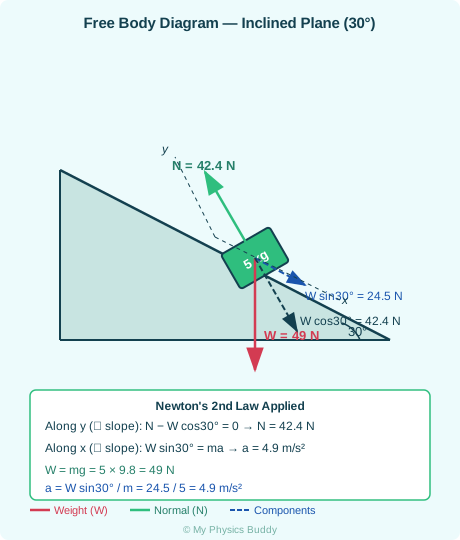
This is exactly the scenario illustrated in the diagram above — note how the weight vector is resolved into two clean components aligned with the tilted axes, making the algebra immediate. You can explore more problems like this with a dedicated AP Physics 1 tutor. For a deeper treatment of force resolution and vector methods, the Khan Academy guide on normal forces and inclined planes is an excellent reference.
Common Mistakes Students Make with Free Body Diagrams
✗ Mistake: Drawing the reaction force that the object exerts on another surface as part of the FBD.
✓ Fix: Include only forces acting on the chosen object. Newton’s third law pairs belong on a separate FBD for the other object.✗ Mistake: Forgetting to include weight when the object is on a surface, assuming forces “cancel out automatically.”
✓ Fix: Always draw weight first — it acts on every object with mass regardless of what surface supports it.✗ Mistake: Drawing the normal force vertically upward even on an inclined plane.
✓ Fix: The normal force is always perpendicular to the contact surface, not to the ground — tilt it correctly when the surface is angled.
Exam Relevance: Free body diagram questions appear in IGCSE Physics (0625), A/AS Level Physics (9702), AP Physics 1, and IB Physics HL/SL, often as mandatory diagram-drawing tasks worth dedicated marks.
Pro Tip from Ali W: Always redraw your FBD after choosing your axes — arrows that looked diagonal often align perfectly once you tilt the coordinate system to match the surface.
Related Questions
How to analyze motion graphs for AP Physics?
What is the difference between static and kinetic friction in AP Physics?
How to handle unit conversions in AP Physics problems?
What are the FRQ scoring guidelines for AP Physics?
How to solve impulse and momentum problems on the AP exam?
What is the best AP Physics prep book for self-study?
How to approach experimental design questions on AP Physics?
How do you calculate the moment of inertia for different shapes?