J Rogers
asked on September 5, 2025
AP Physics 1 lab question full credit
How to earn full credit on AP Physics 1 lab-based questions?
Need Help?
Hire one of our expert Physics tutor online. 24/7 Service. Available now.
Expert Answer
Answered on October 5, 2025 by EXPERT TUTOR
Nothing Found
Dear J Rogers,
To earn full credit on AP Physics 1 lab-based questions, you must clearly describe experimental design, identify variables, justify your procedure, and connect your results to the underlying physics principle. According to expert tutors at My Physics Buddy, students who lose points almost always skip the “why” behind their method rather than the method itself.
How to Earn Full Credit on AP Physics 1 Lab-Based Questions
Lab-based questions — often called experimental design questions or data analysis questions — are among the most predictable high-value tasks on the AP Physics 1 exam. They reward students who think like scientists, not just calculators. The good news is that once you understand exactly what the College Board expects, these questions become very manageable.
The Four Pillars of a Full-Credit Lab Response
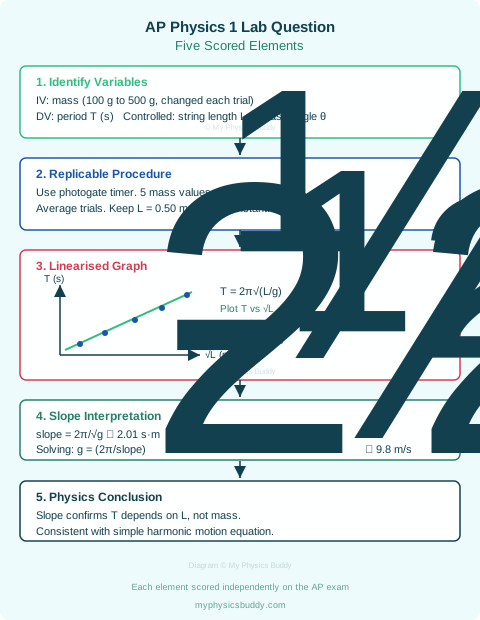
1. Identify and control variables. Every experimental design response must clearly state the independent variable (what you deliberately change), the dependent variable (what you measure), and the controlled variables (everything you hold constant). Think of it like baking a recipe: if you want to know whether oven temperature affects rise time, you must keep the ingredients, pan size, and humidity constant. In physics, if you are testing how mass affects the period of a pendulum, you must keep the string length and release angle fixed. If you skip naming controlled variables, you will lose points even with a perfect procedure.
2. Describe a clear, repeatable procedure. Your procedure must be specific enough that another student could replicate your experiment. Mention the equipment, how you will measure quantities (e.g. “use a photogate timer to measure the period”), how many trials you will run, and what range of values you will test. A common student struggle I see in my tutoring is writing something like “change the mass and measure the period” — that is far too vague. Instead, write: “Use five different hanging masses from 100 g to 500 g in 100 g increments. Record three trials per mass and average the results to reduce random error.”
3. Specify how you will analyse the data — and what graph to draw. This is where many students drop points unnecessarily. The College Board consistently awards a mark for correctly identifying the graph that will yield a straight line and explaining why. If you expect a relationship like:
T = 2π √(L/g)
where T is the period (s), L is the string length (m), and g is gravitational acceleration (9.8 m/s²), then plotting T versus √L will give a straight line with slope 2π/√g. State this explicitly. A straight-line graph is your best friend in AP Physics 1 analysis — it makes the relationship clear and lets you extract a physical constant from the slope.
4. Connect your results to the physics principle. After your analysis, write a brief statement explaining what a successful result would look like and what it confirms about the physics. For example: “If the slope of the T vs. √L graph equals 2π/√g ≅ 2.0 s/m½, this confirms the period depends on string length and is independent of mass, consistent with simple harmonic motion.” This closing connection is what separates a 4-point response from a 3-point one.
Data Analysis Questions: Reading Graphs Carefully
When a lab question gives you a graph and asks you to interpret it, always: (1) identify the slope and what physical quantity it represents, (2) check units carefully by dividing the y-axis unit by the x-axis unit, and (3) use the best-fit line, not just two convenient data points that happen to be close together.
As a 20-year math and physics teacher, I can tell you that unit analysis on graph slopes is the single fastest way to earn a point that most students leave behind. If a velocity–time graph has a slope with units m/s per second = m/s², the slope is acceleration. Always write that out explicitly in your answer.
For deeper guidance on how experimental reasoning is assessed across science exams, the College Board AP Physics 1 Assessment page outlines the science practices and scoring criteria directly.
You may also find it useful to explore Experimental Physics & Lab Skills tutoring to build strong lab reasoning habits that transfer across exams.
Scoring Rubric Awareness
AP Physics 1 lab questions are typically worth 7–12 points within the free-response section. The scoring rubric awards separate points for: naming variables, describing a valid procedure, specifying an appropriate graph, correctly interpreting the slope, and making a physics-based conclusion. Because each element is scored independently, you can still earn 4 out of 5 points even if your procedure is slightly flawed — as long as your graph reasoning and conclusion are solid. Always answer every sub-part, even if you are unsure.
| Scoring Element | What Earns the Point |
|---|---|
| Variable identification | Name IV, DV, and at least two controlled variables |
| Procedure | Equipment named, steps replicable, range of values specified |
| Graph choice | Correct linearised graph stated with axes labelled |
| Slope interpretation | Slope related to a physical quantity with correct units |
| Physics conclusion | Result connected explicitly to the underlying physics law |
Common Mistakes on AP Physics 1 Lab Questions
✗ Mistake: Writing “keep everything else constant” without naming specific controlled variables.
✓ Fix: Name at least two specific controlled variables relevant to your experiment (e.g. “keep string length and release angle constant”).✗ Mistake: Drawing a curve through data points and stopping there, without explaining the graph choice or interpreting the slope.
✓ Fix: Always state what you are plotting on each axis, why that choice linearises the relationship, and what physical quantity the slope represents with its units.✗ Mistake: Describing a qualitative conclusion such as “period increases with length” without linking it back to the equation or physics principle.
✓ Fix: Cite the relevant equation or law and explain how your data result confirms or is consistent with it numerically or conceptually.
Exam Relevance: Lab-based questions appear prominently in AP Physics 1 free-response sections and are aligned with College Board Science Practice standards. Similar experimental design tasks appear in IB Physics HL/SL internal assessments and AP Physics 2.
💡 Pro Tip from Katherine H: Always write your graph choice before your conclusion — examiners award that point independently, and it takes only one sentence to secure it.
Related Questions
How to interpret and draw electric field line diagrams?
What is the best revision strategy for CIE A Level Physics?
What is the difference between transverse and longitudinal waves?
What is the difference between series and parallel circuits?
How does Bernoulli’s principle explain airplane lift?
What is the relationship between frequency wavelength and speed of a wave?
How to calculate net force when multiple forces act on an object?
What is the work-energy theorem and how do you apply it?