Fahid A
asked on February 8, 2026
Qualitative explanations AP Physics 1 FRQs
How to explain physics concepts qualitatively for AP Physics 1 FRQs?
Need Help?
Hire one of our expert Physics tutor online. 24/7 Service. Available now.
Expert Answer
Answered on February 22, 2026 by EXPERT TUTOR
Nothing Found
Dear Fahid A,
Explaining physics concepts qualitatively for AP Physics 1 FRQs means translating equations into cause-and-effect reasoning using plain language. According to expert tutors at My Physics Buddy, graders reward clear logical chains — not just correct formulas. State what changes, why it changes, and what the physical consequence is.
How to Explain Physics Concepts Qualitatively for AP Physics 1 FRQs
The single biggest struggle I see from students preparing for AP Physics 1 FRQs is this: they write down an equation and assume the grader will figure out the reasoning. They won’t — and the scoring rubric won’t give credit for it either. The College Board explicitly rewards verbal, causal reasoning, and that means you need to build a habit of speaking physics out loud, in sentences.
What “Qualitative” Really Means on the Exam
A qualitative explanation is one that describes why a physical outcome happens, not just what equation governs it. Think of it like the difference between a mechanic saying “your brake pads are 3 mm thick” versus “your brake pads are too thin, so friction drops, stopping distance increases, and you crash.” The second version tells a story with a causal chain. That is exactly the level of reasoning AP Physics 1 FRQs demand.
The formula you need to anchor your reasoning is still important — but only as a starting point. For example, Newton’s second law:
Fnet = ma
Where Fnet is the net force on the object (in Newtons), m is mass (in kg), and a is acceleration (in m/s²). A qualitative answer does not just cite this equation. It says: “Because the net force acting on the cart increases while the mass stays constant, the acceleration must increase proportionally. The cart therefore reaches a higher speed in the same time interval.”
The Three-Part Qualitative Answer Structure
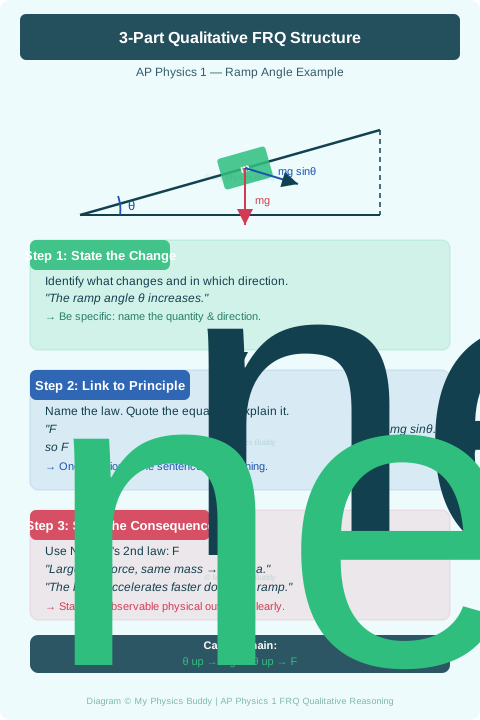
As an MSc physicist who has reviewed hundreds of student FRQ responses, I recommend a simple three-part structure for every qualitative explanation:
- State the change: Identify what physical quantity is changing and in which direction (increases, decreases, remains constant).
- Link to the principle: Name the law or relationship that connects the cause to the effect. Quote the relevant equation if it helps, but follow it immediately with a sentence.
- State the consequence: Describe the physical outcome — what happens to the observable quantity as a result.
Here is a worked example using this structure. Suppose the FRQ asks: “A block slides down a frictionless ramp. If the angle of the ramp is increased, what happens to the block’s acceleration? Justify your answer.”
Step 1 — State the change: The angle θ of the ramp increases.
Step 2 — Link to the principle: The component of gravitational force acting along the ramp is F∥ = mg sin θ, where m is the block’s mass, g is gravitational field strength (9.8 m/s²), and θ is the ramp angle. As θ increases, sin θ increases, so F∥ increases.
Step 3 — State the consequence: By Newton’s second law, a larger net force on the same mass produces a larger acceleration. The block accelerates more quickly down the ramp.
Notice that the answer flows as a logical chain: angle up → force component up → acceleration up. That causal chain is what earns full marks.
Using Everyday Analogies to Build Intuition
A powerful technique — one I use constantly in tutoring — is to anchor abstract physics in a familiar everyday scenario before writing any formal answer. Think of a bicycle: when you pedal harder (more force) on a lighter bike (less mass), you accelerate faster. That is Newton’s second law in a form you already feel intuitively. Once that analogy is live in your mind, the qualitative reasoning writes itself.
For energy concepts, think of a stretched rubber band. The more you stretch it (greater displacement from equilibrium), the more elastic potential energy it stores. When released, that stored energy converts to kinetic energy — the ball flies faster. This intuition directly supports qualitative explanations about energy conservation and the relationship between potential and kinetic energy.
Connecting Qualitative Reasoning to the Scoring Rubric
The College Board AP Physics 1 FRQ scoring guidelines consistently award separate points for: (1) identifying the correct physical principle, (2) applying it correctly to the specific scenario, and (3) reaching the correct conclusion. Your three-part structure maps directly onto these three scoring targets. Skipping even one part — for example, stating the conclusion without naming the principle — costs you a point.
For deeper practice on building these reasoning skills within AP Physics, it helps to drill past FRQs by writing out your causal chain explicitly before checking the mark scheme. This trains you to notice when your reasoning has a gap.
One last method worth knowing: proportional reasoning. Many AP Physics 1 qualitative questions ask what happens when one variable doubles, halves, or triples. Write the equation, identify which variable changes, and determine how the target quantity scales. For example, if kinetic energy KE = ½mv² and speed doubles, then KE increases by a factor of four — because KE scales with v². State that scaling relationship explicitly in your answer and you will almost always earn full marks.
Common Mistakes in AP Physics 1 Qualitative FRQs
✗ Mistake: Writing only the equation (e.g. “F = ma”) with no verbal explanation of what changes and why.
✓ Fix: Always follow every equation with at least one sentence that explains what each relevant variable is doing in this specific situation and what the consequence is.✗ Mistake: Using vague directional language like “it goes up” or “it gets bigger” without naming the specific physical quantity.
✓ Fix: Name the quantity explicitly — “the acceleration increases” or “the kinetic energy decreases” — so the grader can award the point without interpretation.✗ Mistake: Stating the correct final answer but skipping the causal link — for example, “the block moves faster because the angle is bigger.”
✓ Fix: Always include the connecting principle: “the gravitational force component along the ramp, mg sin θ, increases with θ, so by Newton’s second law the acceleration — and therefore the speed gained — is greater.”
Exam Relevance: Qualitative reasoning is tested heavily on the AP Physics 1 exam, particularly in the Paragraph Argument Short Answer (PASA) and multi-part FRQ sections. It also appears in the AP Physics 2 and IB Physics HL/SL extended response questions.
💡 Pro Tip from Christi J: Before writing your FRQ answer, say the causal chain aloud in one breath — if you stumble, your reasoning has a gap. Fix the spoken version first, then write it down.
Related Questions
How to calculate Young modulus from a stress-strain graph?
What is the difference between progressive and stationary waves 9702?
How does a potential divider circuit work in CIE physics?
How to determine internal resistance of a cell using a graph?
What is the photoelectric effect and how to solve threshold frequency problems?
How to calculate gravitational field strength at a distance from a planet?
What are the key differences between gravitational and electric fields 9702?
How to use the decay equation for radioactive decay problems?