M Hawkins
asked on February 9, 2026
How to score 5 on AP Physics
How to get a 5 on the AP Physics exam?
Need Help?
Hire one of our expert Physics tutor online. 24/7 Service. Available now.
Expert Answer
Answered on March 4, 2026 by EXPERT TUTOR
Nothing Found
Dear M Hawkins,
Getting a 5 on the AP Physics exam is absolutely achievable with the right strategy. According to expert tutors at My Physics Buddy, consistent conceptual understanding combined with deliberate free-response practice separates 5-scorers from the rest. It is less about memorizing formulas and more about reasoning through physics.
How to Score a 5 on the AP Physics Exam: A Complete Strategy Guide
Think of the AP Physics exam like a driving test. You can memorize every rule in the handbook, but if you have never actually driven in tricky conditions, you will freeze when something unexpected happens. The exam is designed to test whether you can apply physical reasoning, not just recall equations. That shift in mindset is the single most important thing you can internalize before exam day.
Whether you are sitting AP Physics 1, AP Physics C: Mechanics, or any other variant, the scoring breakdown is similar: roughly 50% multiple choice and 50% free response. Each section demands a different skill set, and you need to train for both explicitly.
Step 1 — Build a Conceptual Foundation First
The most common struggle I see among students, even hardworking ones, is that they jump straight into problem-solving without genuinely understanding the underlying concept. Before you solve a single kinematics problem, you should be able to explain in plain English what acceleration means and why velocity changes. That depth of understanding is what allows you to handle novel scenarios on the exam.
For each major topic — mechanics, energy, waves, electricity, magnetism — ask yourself three questions:
- What does this concept physically represent?
- Under what conditions does it apply?
- How does it connect to the concepts I already know?
Step 2 — Master the Core Equations and Know What They Mean
The AP Physics exam provides a formula sheet, but knowing when and why to use each equation is the real skill. Here are a few foundational relationships you must own completely:
- Newton’s Second Law: Fnet = ma — The net force (in Newtons) on an object equals its mass (kg) times its acceleration (m/s²). The key word is net: always draw a free-body diagram first.
- Work-Energy Theorem: Wnet = ΔKE = ½mv² − ½mv₀² — Net work done on an object equals its change in kinetic energy. This bypasses forces entirely when you only care about energy states.
- Impulse-Momentum: J = FΔt = Δp = mΔv — Impulse (N·s) equals change in momentum (kg·m/s). Useful whenever a collision or time-varying force is involved.
- Gauss’s Law (AP Physics C: E&M): ΦE = Qenc/ε0 — The total electric flux through a closed surface equals the enclosed charge divided by the permittivity of free space.
As a BSc Physical Science student and IIT-JAM Physics aspirant, I can tell you that the students who score highest are not those who know the most formulas — they are the ones who can derive relationships on the fly because their conceptual foundation is solid.
Step 3 — Free Response Is Where the 5 Is Won or Lost
The free-response section (FRQ) is where score differentiation happens most sharply. Here is a structured approach for every FRQ:
- Read the entire question before writing anything. Identify what physical principle is being tested.
- Draw a diagram. Free-body diagrams, circuit diagrams, or ray diagrams earn setup points and keep your reasoning clear.
- State your starting equation explicitly. Graders award points for showing correct physics reasoning, not just a final number.
- Show all algebraic steps. A correct method with an arithmetic error can still earn most of the points. A correct answer with no work earns nothing.
- Include units at every step and circle or box your final answer.
For a quick worked example: suppose you are asked to find the speed of a 2 kg block after sliding 5 m down a frictionless ramp inclined at 30°.
Using energy conservation:
mgh = ½mv²
Height: h = 5 × sin(30°) = 2.5 m
v = √(2gh) = √(2 × 9.8 × 2.5) = √49 = 7.0 m/s
Notice that mass cancelled — that is a conceptual insight the exam rewards. Always look for what simplifies.
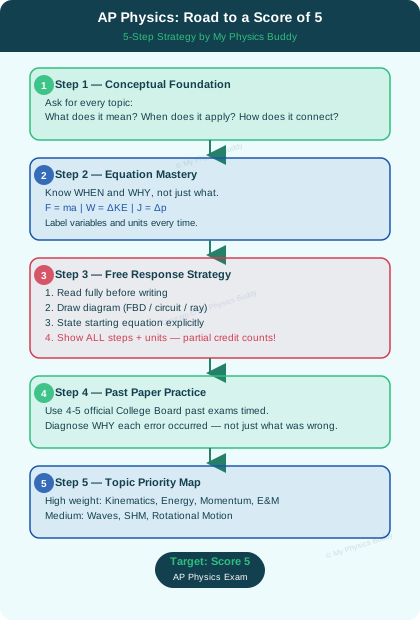
Step 4 — Use Past Papers Strategically
The College Board’s official AP Physics released exams are your single best resource. Work through at least 4–5 full past papers under timed conditions. After each one, do not just check your answers — analyse why you got something wrong. Was it a conceptual gap? A diagram you skipped? A unit error? That diagnosis is more valuable than the practice itself.
Step 5 — Build a Topic Priority Map
| Topic Area | Typical Exam Weight | Key Strategy |
|---|---|---|
| Kinematics & Dynamics | High | Always draw FBD first |
| Energy & Momentum | High | Choose conservation law wisely |
| Waves & Simple Harmonic Motion | Medium | Link period to physical setup |
| Electricity & Magnetism | High (AP Physics 2 / C) | Master field direction rules |
| Rotational Motion | Medium–High | Parallel the linear equations |
You can also explore our dedicated AP Physics resources for topic-by-topic breakdowns and worked examples tailored exactly to exam style.
Common Mistakes Students Make
✗ Mistake: Skipping the free-body diagram to save time and jumping straight to equations.
✓ Fix: Always draw the FBD first — it takes 30 seconds and prevents sign errors that cost 3–4 points per question.✗ Mistake: Memorizing formulas without understanding the conditions under which they apply, then using them in the wrong context.
✓ Fix: For every equation, write one sentence describing its physical meaning and one condition that must be true for it to be valid.✗ Mistake: Leaving free-response parts blank when stuck, believing no partial credit is available.
✓ Fix: Write the relevant principle, state the equation, and set up the problem even if you cannot finish — partial credit is awarded generously on AP FRQs.
Exam Relevance: This strategy applies directly to AP Physics 1, AP Physics 2, AP Physics C: Mechanics, and AP Physics C: Electricity and Magnetism, all administered by the College Board and widely accepted for university credit.
💡 Pro Tip from Mohit H: On exam day, tackle the FRQ part you are most confident about first — momentum builds, and confident reasoning early keeps your mind sharp for harder parts.
Related Questions
How to analyze motion graphs for AP Physics?
What is the difference between static and kinetic friction in AP Physics?
How to handle unit conversions in AP Physics problems?
What are the FRQ scoring guidelines for AP Physics?
How to solve impulse and momentum problems on the AP exam?
What is the best AP Physics prep book for self-study?
How to approach experimental design questions on AP Physics?
How do you calculate the moment of inertia for different shapes?