A Torres
asked on May 2, 2025
Unit conversions in AP Physics
How to handle unit conversions in AP Physics problems?
Need Help?
Hire one of our expert Physics tutor online. 24/7 Service. Available now.
Expert Answer
Answered on May 25, 2025 by EXPERT TUTOR
Nothing Found
Dear A Torres,
Unit conversions in AP Physics problems are handled most reliably using the factor-label method, also called dimensional analysis, where you multiply by fractions equal to 1 until unwanted units cancel. According to expert tutors at My Physics Buddy, keeping units visible throughout every calculation step prevents the majority of conversion errors students make under exam pressure.
Mastering Unit Conversions in AP Physics: The Complete Method
Unit conversion is one of those skills that looks trivial on the surface but quietly costs students marks on every major physics exam. In my eight years teaching AP Physics, I have watched talented students set up perfect equations only to arrive at a wrong numerical answer because they forgot to convert kilometres to metres or minutes to seconds. The good news: once you internalise one systematic method, the errors essentially disappear.
The Factor-Label Method: How It Works
The core idea is to treat units exactly like algebraic variables. You multiply your quantity by a conversion factor — a fraction whose numerator and denominator represent the same physical quantity in different units, making the fraction equal to exactly 1. Because multiplying by 1 never changes a value, your answer remains correct while the units transform.
The general form looks like this:
Quantity × (New unit / Old unit) = Result in new unit
Or written more concisely:
x [unit A] × (conversion factor [unit B / unit A]) = x’ [unit B]
The unit A appears in the denominator of the conversion factor so it cancels with the unit A of the original quantity, leaving only unit B.
Everyday Analogy
Think of currency exchange. If you have 50 US dollars and the rate is 1 USD = 0.92 EUR, you multiply: 50 USD × (0.92 EUR / 1 USD) = 46 EUR. The USD labels cancel top and bottom, just like physical units do. You would never add dollars and euros without converting first — and the same logic applies to metres and centimetres in a physics equation.
Essential SI Prefixes You Must Know for AP Physics
| Prefix | Symbol | Multiplier | Example |
|---|---|---|---|
| nano (n) | n | 10−9 | 650 nm = 650 × 10−9 m |
| micro (μ) | μ | 10−6 | 200 μs = 200 × 10−6 s |
| milli (m) | m | 10−3 | 35 mm = 0.035 m |
| centi (c) | c | 10−2 | 45 cm = 0.45 m |
| kilo (k) | k | 103 | 2.5 km = 2500 m |
Fully Worked Example: Speed Conversion with Kinematic Equation
A car accelerates from rest to 72 km/h in 8.0 s. Find the acceleration in m/s2.
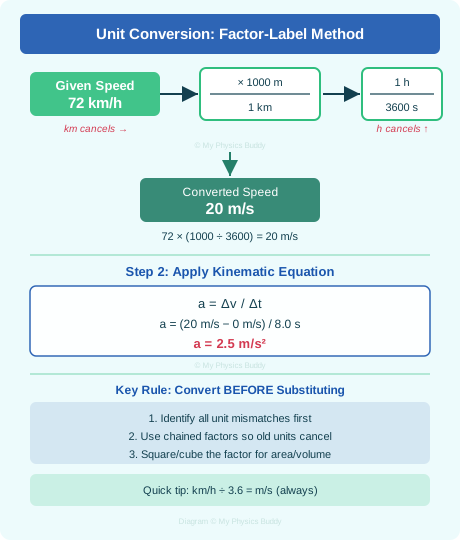
Step 1 — Identify the unit mismatch. The velocity is in km/h but the time is in seconds. The SI unit for acceleration is m/s2, so you need velocity in m/s.
Step 2 — Convert km/h to m/s using chained conversion factors.
72 km/h × (1000 m / 1 km) × (1 h / 3600 s)
= 72 × (1000 / 3600) m/s = 72 × 0.2778 m/s = 20 m/s
Notice how km cancelled with km, and h cancelled with h, leaving only m/s. This is the power of keeping units explicit.
Step 3 — Apply the kinematic equation.
a = Δv / Δt = (20 m/s − 0 m/s) / 8.0 s = 2.5 m/s2
Where a is acceleration, Δv is change in velocity, and Δt is time interval.
For problems involving area or volume, remember to apply the conversion factor raised to the correct power. For example, converting cm2 to m2: since 1 m = 100 cm, then 1 m2 = (100)2 cm2 = 10,000 cm2. A common trap in kinematics and pressure problems is forgetting to square or cube the linear conversion factor. As someone who holds CSIR NET Rank 71 (All India), I can tell you that dimensional analysis with powered units trips up even advanced students until they make it a deliberate habit.
For further reference on SI units and their relationships, the NIST SI Units reference is the definitive authoritative source for all standard unit definitions used in AP Physics.
Common Mistakes in Unit Conversions
✗ Mistake: Converting km/h to m/s by dividing by 100 instead of 3.6.
✓ Fix: Always use chained factor-label steps: multiply by (1000 m/1 km) and (1 h/3600 s) separately so nothing is guessed.✗ Mistake: Forgetting to square the linear conversion factor when converting units of area, such as using ×100 instead of ×10,000 when going from m2 to cm2.
✓ Fix: Write the conversion factor in parentheses and apply the exponent explicitly: (1 m / 100 cm)2 = 1 m2 / 10,000 cm2.✗ Mistake: Converting at the very end of a multi-step problem after plugging in mixed units, which produces a dimensionally inconsistent intermediate result.
✓ Fix: Convert all given quantities to SI units at the very start, before writing any physics equation, so every substitution is already in consistent units.
Exam Relevance: Unit conversions appear in AP Physics 1, AP Physics 2, and AP Physics C: Mechanics across both the multiple-choice and free-response sections. The College Board expects answers in SI units and may award method marks even when the final value is wrong due to a unit slip.
💡 Pro Tip from Neha A: Memorise that dividing km/h by 3.6 always gives m/s — it is the single most tested speed conversion on AP Physics free-response papers.
Related Questions
How to calculate the speed of a wave on a string?
What are standing waves and how do harmonics work?
How to explain physics concepts qualitatively for AP Physics 1 FRQs?
What is the best way to review for AP Physics 1 in two weeks?
How to apply Newton’s second law in rotational form?
How does energy transfer work in simple harmonic motion?
How to solve problems with pulleys and tension in AP Physics 1?
What is mechanical energy and when is it conserved?