Gia Santos
asked on August 8, 2025
Electric field line diagram interpretation
How to interpret and draw electric field line diagrams?
Need Help?
Hire one of our expert Physics tutor online. 24/7 Service. Available now.
Expert Answer
Answered on November 10, 2025 by EXPERT TUTOR
Nothing Found
Dear Gia Santos,
Electric field line diagrams are a visual tool that show the direction and relative strength of an electric field at any point in space. The lines run from positive to negative charges, and their spacing tells you how strong the field is — closer lines mean a stronger field. According to expert tutors at My Physics Buddy, mastering these diagrams is one of the most reliable ways to score highly on electrostatics questions.
Understanding and Drawing Electric Field Line Diagrams
Think of electric field lines like the flow of water downhill — water always flows in the direction a ball would roll if placed on the slope, and it flows fastest where the slope is steepest. Electric field lines work the same way: they show the direction a small positive test charge would move if placed at that point, and they are densest where the field is strongest.
As a PhD physicist who has tutored A/AS Level Physics (9702) students for several years, I can tell you that the single biggest conceptual leap students need to make is understanding that field lines are not paths of real particles — they are a map of force direction at every point in the field.
The Key Rules for Interpreting Electric Field Lines
- Direction: Lines always point from positive (+) to negative (−) charges. The arrowhead on each line tells you the direction of the force on a positive test charge placed at that point.
- Density equals strength: Where lines are packed closely together, the electric field is strong. Where they are spread apart, the field is weak.
- Lines never cross: At any single point in space, the field can only point in one direction. If two lines crossed, the field would have two directions at that point — which is physically impossible.
- Perpendicularity to surfaces: Field lines always meet a conducting surface at exactly 90°. If they did not, there would be a component of force along the surface, which would move charges until they rearranged — so in electrostatic equilibrium, the angle must be 90°.
- Lines start and end on charges: They begin on positive charges and terminate on negative charges, or they extend to infinity if the charge is isolated.
The Underlying Physics: Coulomb’s Law and Field Strength
The electric field strength E at a distance r from a point charge Q is given by:
E = kQ / r²
where k = 8.99 × 10⁹ N m² C⁻² (Coulomb’s constant), Q is the source charge in coulombs, and r is the distance from the charge in metres. The field strength E is in N C⁻¹ (or equivalently V m⁻¹).
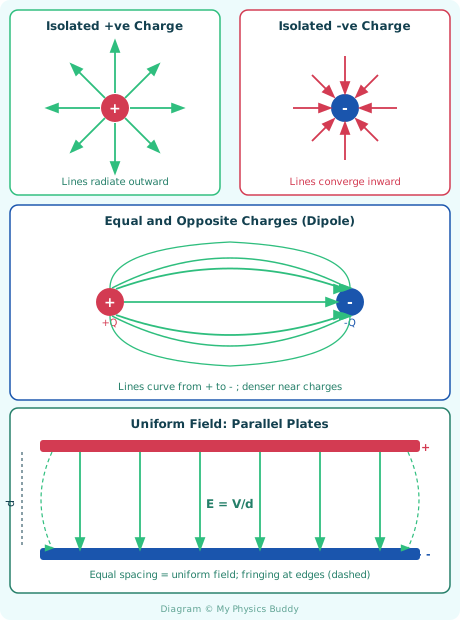
Notice the inverse-square relationship: double the distance, and the field drops to one quarter. This is directly represented in the diagram — as you move away from a point charge, the field lines spread out and the density (lines per unit area) falls off with the square of the distance. The diagram is not just decorative; it is a geometric encoding of this inverse-square law.
The force on a test charge q placed in the field is simply:
F = qE
where F is in newtons, q is in coulombs, and E is in N C⁻¹. A positive q feels a force in the direction of the field line arrow; a negative q feels a force opposite to the arrow.
Drawing Electric Field Lines: Step-by-Step Method
When drawing field line diagrams in your Electrostatics exam questions, follow this sequence:
- Identify all charges and their signs. Mark + and − clearly.
- Draw lines radiating outward from each positive charge and inward toward each negative charge. Use symmetric spacing — if you draw 8 lines on one side of a charge, draw 8 on the other side too.
- Match the number of lines to charge magnitude. If one charge is twice as large, draw twice as many lines from it. For example, a +2Q charge should have twice as many lines as a +Q charge.
- Curve the lines smoothly between opposite charges so that each line terminates on a negative charge where possible.
- Add arrowheads pointing away from positive charges and toward negative charges.
- Check spacing: Lines must be closer together near the charges (strong field region) and spread apart further away (weak field region).
Common Configurations You Must Know
| Configuration | Field Line Pattern | Field Uniformity |
|---|---|---|
| Isolated positive point charge | Radiate outward symmetrically | Non-uniform (weaker further away) |
| Isolated negative point charge | Converge inward symmetrically | Non-uniform (weaker further away) |
| Equal and opposite charges (+Q and −Q) | Curve from + to −, dipole pattern | Non-uniform |
| Two parallel oppositely charged plates | Straight, parallel, equally spaced (with fringing at edges) | Uniform between plates |
| Two like charges (+Q and +Q) | Lines repel each other, neutral point between | Zero field at neutral point |
The parallel plate configuration is especially important for the 9702 syllabus because it links directly to capacitor theory and the uniform field equation E = V/d, where V is the potential difference between the plates in volts and d is the plate separation in metres. You can read more about electric field theory from the Physics Classroom’s guide on electric field lines.
Worked Example: Locating the Neutral Point Between Two Like Charges
Suppose you have two positive charges, +4 μC at point A and +1 μC at point B, separated by 30 cm. Where is the neutral point (where E = 0)?
Let the neutral point be at distance x from the +4 μC charge, so it is (0.30 − x) from the +1 μC charge.
Setting the magnitudes equal:
kQ₁/x² = kQ₂/(0.30 − x)²
4/(x²) = 1/(0.30 − x)²
Taking square roots: 2/x = 1/(0.30 − x)
Solving: 2(0.30 − x) = x → 0.60 − 2x = x → x = 0.20 m
The neutral point is 20 cm from the +4 μC charge (and 10 cm from the +1 μC charge). In the field line diagram, this is the point where no lines pass through — it is the calm eye between two repelling storms. For further reading on Cambridge assessment expectations, see the Cambridge International AS and A Level Physics 9702 syllabus page.
Common Mistakes Students Make with Electric Field Line Diagrams
✗ Mistake: Drawing field lines that cross each other, especially near the midpoint between two charges.
✓ Fix: Remember that field lines can never cross — at the neutral point between two like charges, the lines simply end or avoid the region entirely, they do not intersect.✗ Mistake: Drawing the same number of lines from charges of different magnitudes (e.g., +Q and +2Q both get 6 lines).
✓ Fix: Scale the number of lines to the charge size — if +Q gets 4 lines, +2Q must get 8 lines. This is how the diagram visually encodes field strength.✗ Mistake: Drawing field lines that meet a conducting surface at an oblique angle rather than perpendicularly.
✓ Fix: Field lines must always be perpendicular (90°) to any conductor surface. Sketch a small right-angle marker at the surface to show this explicitly in exams.
Exam Relevance: Electric field line diagrams are assessed in Cambridge A/AS Level Physics (9702), Edexcel A Level Physics, and IB Physics HL/SL. Questions typically ask students to sketch patterns, identify neutral points, or compare field strengths from diagram spacing.
Pro Tip from Dr Shivani G: Always draw field lines in odd numbers per charge — it forces symmetry and instantly reveals whether your diagram is balanced and physically correct.
Related Questions
How to answer 9702 Paper 5 planning questions effectively?
How does electromagnetic induction work and what is Faraday’s law?
What is the difference between nuclear fission and fusion in A Level?
How to calculate specific heat capacity from experimental data?
What is simple harmonic motion and how to derive its equations?
How to solve problems involving circular motion and centripetal force?
What are the common mistakes in 9702 Paper 2 structured questions?
How to interpret and draw electric field line diagrams?