A Erickson
asked on November 20, 2025
MCAT physics section preparation tips
How to prepare for the physics section of the MCAT exam?
Need Help?
Hire one of our expert Physics tutor online. 24/7 Service. Available now.
Expert Answer
Answered on November 29, 2025 by EXPERT TUTOR
Nothing Found
Dear A Erickson,
To prepare for the physics section of the MCAT exam, you need to master a focused set of classical physics topics — mechanics, fluids, waves, optics, electricity, and basic thermodynamics — without getting lost in advanced derivations. According to expert tutors at My Physics Buddy, the MCAT tests conceptual reasoning and proportional thinking far more than raw calculation. Building strong physical intuition is your biggest competitive advantage.
What the MCAT Physics Section Actually Tests — And How to Prepare Strategically
The MCAT physics content falls under the Chemical and Physical Foundations of Biological Systems section. Physics accounts for roughly 25% of that section, meaning around 12–15 questions out of 59. The topics are drawn from introductory college physics, but the questions are passage-based and require you to apply principles to biological and medical scenarios — not just plug numbers into formulas.
Think of it like learning to drive versus memorising the highway code. You can recite every rule, but the exam puts you in traffic and asks you to react. Your preparation must build genuine understanding, not just formula recall.
Core Topic Areas You Must Cover
Below is a breakdown of the high-yield physics topics the MCAT tests, along with the key formulas you need to understand deeply — not just memorise.
| Topic Area | Key Concepts | Core Formula |
|---|---|---|
| Mechanics | Newton’s laws, work-energy, momentum | F = ma, KE = ½mv² |
| Fluids | Pressure, buoyancy, flow rate, viscosity | P = ρgh, A₁v₁ = A₂v₂ |
| Waves & Sound | Frequency, wavelength, Doppler effect | v = fλ |
| Optics & Light | Reflection, refraction, lenses, mirrors | 1/f = 1/d₀ + 1/dᵢ |
| Electricity | Circuits, Ohm’s law, capacitance | V = IR, P = IV |
| Thermodynamics | Heat transfer, gas laws, entropy | PV = nRT, Q = mcΔT |
A Worked Example: Fluid Pressure in a Blood Vessel
Fluid mechanics is among the highest-yield topics on the MCAT because of its direct link to cardiovascular physiology. Here is a typical style of reasoning the exam demands.
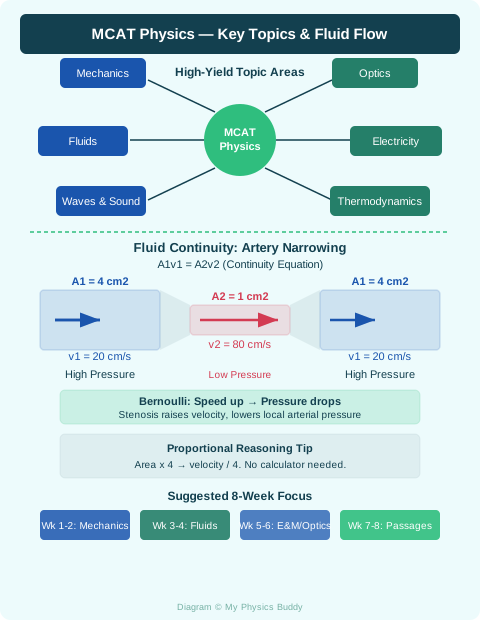
Scenario: Blood flows through an artery of cross-sectional area A₁ = 4 cm² at velocity v₁ = 20 cm/s. It enters a narrowed section where A₂ = 1 cm². What is the velocity v₂ in the narrowed section?
Step 1 — Apply the continuity equation (conservation of mass for incompressible flow):
A₁v₁ = A₂v₂
where A₁ and A₂ are cross-sectional areas (cm²), and v₁ and v₂ are flow velocities (cm/s).
Step 2 — Solve for v₂:
v₂ = (A₁ × v₁) / A₂ = (4 × 20) / 1 = 80 cm/s
Step 3 — Apply Bernoulli’s principle: When velocity increases, pressure decreases. This is exactly the mechanism behind arterial stenosis — the narrowing raises flow speed and drops local pressure, which can be clinically dangerous. The MCAT loves asking you to reason about this direction of change without heavy calculation.
As a PhD in Theoretical Nuclear Physics and a tutor with experience in MCAT Physics, I can tell you that one of the most consistent student struggles I observe is treating MCAT physics like an engineering exam — setting up long equations — when the actual skill being tested is proportional reasoning. If the area halves, the velocity doubles. Train your brain to see ratios first.
How to Structure Your Study Plan
- Weeks 1–2: Build your conceptual foundation in mechanics, kinematics, and Newton’s laws. Use diagrams and free-body analysis for every problem.
- Weeks 3–4: Move into fluids, waves, and sound. Connect every concept to a physiological example — blood flow, the ear, ultrasound.
- Weeks 5–6: Cover electricity, optics, and thermodynamics. Understand circuits qualitatively and master the thin-lens equation with sign conventions.
- Weeks 7–8: Do full passage-based practice exclusively. Review official AAMC material and identify your weakest concept clusters by topic, not just by score.
For a broader foundation in the underlying physics, working through structured Physics resources will help you build the intuition the MCAT passages demand.
The AAMC content outline is the single most authoritative guide to what is and is not tested. You can find the official physics and chemistry content categories directly at the AAMC MCAT Content page. Cross-reference your study notes against that list once per week to avoid over-preparing in low-yield areas.
Proportional Reasoning: Your Most Powerful MCAT Tool
Many MCAT physics questions never give you real numbers. They ask: “If the radius of a pipe doubles, how does the flow resistance change?” The answer requires knowing Poiseuille’s Law: R ∝ L/(r⁴), where R is resistance, L is vessel length, and r is radius. If radius doubles, resistance drops by a factor of 2⁴ = 16. No calculator needed — just ratio thinking. Drill this skill deliberately across every topic area.
Common Mistakes Students Make When Preparing for MCAT Physics
✗ Mistake: Memorising every formula without understanding what the variables represent physically.
✓ Fix: For each formula, draw a diagram, write a one-sentence plain-English meaning, and identify which variable doubles or halves when another changes.✗ Mistake: Skipping fluids and waves because they feel unfamiliar, and over-investing in mechanics.
✓ Fix: Fluids and sound are directly tied to biological systems — the heart, lungs, and ear — making them among the most passage-relevant topics on the exam. Allocate equal study time across all topic clusters.✗ Mistake: Practising only isolated single-question drills rather than full passage-based sets under timed conditions.
✓ Fix: Simulate real exam conditions from week 7 onward using official AAMC passages, and review each wrong answer by tracing the conceptual reasoning error, not just the arithmetic.
Exam Relevance: The physics content described here is directly tested in the MCAT Chemical and Physical Foundations section. Related physics reasoning skills also appear in the OAT Physics exam and undergraduate pre-medical physics courses across North American universities.
Pro Tip from Ashutosh S: Master proportional reasoning over formula memorisation — on the MCAT, knowing which direction a quantity changes and by what factor wins more marks than arithmetic speed.
Related Questions
How to calculate Young modulus from a stress-strain graph?
What is the difference between progressive and stationary waves 9702?
How does a potential divider circuit work in CIE physics?
How to determine internal resistance of a cell using a graph?
What is the photoelectric effect and how to solve threshold frequency problems?
How to calculate gravitational field strength at a distance from a planet?
What are the key differences between gravitational and electric fields 9702?
How to use the decay equation for radioactive decay problems?