M Maynard
asked on January 19, 2025
Atwood machine problem setup
How to set up and solve Atwood machine problems?
Need Help?
Hire one of our expert Physics tutor online. 24/7 Service. Available now.
Expert Answer
Answered on April 22, 2025 by EXPERT TUTOR
Nothing Found
Dear M Maynard,
To set up and solve Atwood machine problems, you treat the two hanging masses as a single system connected by an inextensible string over a massless pulley, then apply Newton’s second law to each mass separately. According to expert tutors at My Physics Buddy, the key is choosing a consistent positive direction before writing your equations.
Understanding and Solving Atwood Machine Problems in AP Physics
An Atwood machine is one of those beautifully simple setups that teaches deep ideas about Newton’s laws, tension, and connected systems. It consists of two masses, m1 and m2, hanging on either side of a pulley via a light, inextensible string. The pulley is assumed massless and frictionless in most AP Physics problems. Think of it like a tug-of-war where both teams are pulling on the same rope — the heavier side wins, but the rope constrains both teams to move together.
Step 1 — Identify the System and Choose a Positive Direction
This is where most students go wrong. Before writing a single equation, decide which direction you call positive. The most intuitive choice: define positive as the direction of expected motion. If m2 is heavier, it will accelerate downward, so call downward on the m2 side positive, and upward on the m1 side positive. This means both masses share the same magnitude of acceleration a, since the string length is constant — a constraint called the kinematic constraint.
Step 2 — Draw Free Body Diagrams for Each Mass
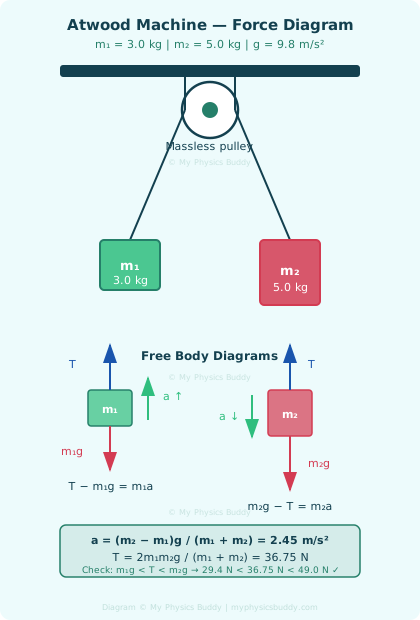
For each mass, two forces act: gravity (weight = mg, downward) and string tension T (upward). The tension is the same throughout the string for a massless, frictionless pulley.
For m1 (lighter, accelerating upward — positive direction is upward for this mass):
T − m1g = m1a
For m2 (heavier, accelerating downward — positive direction is downward for this mass):
m2g − T = m2a
Here, T is the string tension in Newtons, g is gravitational acceleration (9.8 m/s²), and a is the magnitude of acceleration (m/s²). Both equations use Newton’s second law: net force = mass × acceleration.
Step 3 — Solve the System of Equations
Add the two equations to eliminate T:
m2g − m1g = (m1 + m2)a
Solving for acceleration:
a = (m2 − m1)g / (m1 + m2)
Substitute back to find tension:
T = m1(g + a) = 2m1m2g / (m1 + m2)
Notice: if m1 = m2, then a = 0 and T = m1g. The system stays in equilibrium — which makes perfect physical sense.
Worked Example
Let m1 = 3.0 kg and m2 = 5.0 kg.
| Quantity | Calculation | Result |
|---|---|---|
| Acceleration a | (5.0 − 3.0) × 9.8 / (3.0 + 5.0) | 2.45 m/s² |
| Tension T | 2 × 3.0 × 5.0 × 9.8 / (3.0 + 5.0) | 36.75 N |
As a PhD in Physics, I can tell you that the most powerful check here is units: (kg·m/s²) = N throughout. Also verify that T lies between m1g (29.4 N) and m2g (49.0 N) — it always should, since the tension must partially support each mass while still allowing acceleration. This cross-check alone catches most arithmetic errors. For deeper practice with connected-system problems, the Classical (Newtonian) Mechanics resource at My Physics Buddy is excellent. You can also review Newton’s laws at the foundational level via Khan Academy’s AP Physics Atwood machine guide.
Common Mistakes with Atwood Machine Problems
✗ Mistake: Assigning opposite tension values to the two masses, writing T1 for m1 and T2 for m2.
✓ Fix: For a massless, frictionless pulley with an inextensible string, there is only one tension T throughout the entire string. Use the same symbol T in both equations.✗ Mistake: Using the same sign for both masses without setting a consistent positive direction, leading to a = 0 or a negative nonsensical result.
✓ Fix: Explicitly state your sign convention before writing equations. Positive for m1 is upward; positive for m2 is downward. This makes acceleration appear positive in both equations.✗ Mistake: Forgetting to verify the tension answer is physically reasonable — e.g., accepting T greater than m2g.
✓ Fix: Always check that m1g < T < m2g. If this inequality fails, an algebraic or sign error exists somewhere in your solution.
Exam Relevance: Atwood machine problems appear in AP Physics 1, AP Physics C: Mechanics, IB Physics HL/SL, and A/AS Level Physics (9702). They test Newton’s second law, tension in connected systems, and kinematic constraint reasoning.
💡 Pro Tip from Dr Shivani G: Treat the whole Atwood system as one object of mass (m1 + m2) driven by net force (m2 − m1)g to find acceleration instantly, then use one individual equation just for tension.
Related Questions
What is the best way to review for AP Physics 1 in two weeks?
How to apply Newton’s second law in rotational form?
How does energy transfer work in simple harmonic motion?
How to solve problems with pulleys and tension in AP Physics 1?
What is mechanical energy and when is it conserved?
How to interpret position vs time and velocity vs time graphs?
How do open and closed pipe resonance problems work?
What are the most difficult topics on AP Physics 1?