Valeria Fernández
asked on February 12, 2025
SUVAT equations for 9702 kinematics
How to solve 9702 kinematics problems using SUVAT equations?
Need Help?
Hire one of our expert Physics tutor online. 24/7 Service. Available now.
Expert Answer
Answered on April 7, 2025 by EXPERT TUTOR
Nothing Found
Dear Valeria Fernández,
Solving 9702 kinematics problems using SUVAT equations becomes straightforward once you learn to identify your five variables — s, u, v, a, and t — from the question and select the one equation that connects exactly the variables you know and need. According to expert tutors at My Physics Buddy, this systematic approach eliminates guesswork and works reliably under exam conditions.
Understanding and Applying SUVAT Equations in A/AS Level Physics (9702)
The SUVAT equations describe motion under constant (uniform) acceleration in a straight line. Every variable has a precise meaning:
- s — displacement (metres, m) — the vector distance from start to finish
- u — initial velocity (m s−1) — speed and direction at the start
- v — final velocity (m s−1) — speed and direction at the end
- a — acceleration (m s−2) — must be constant throughout
- t — time (s) — duration of the motion
Think of driving on a motorway with cruise control that gradually increases your speed at a fixed rate. Your car’s speedometer reading at any moment, the distance covered, and the time elapsed are all linked by exactly this kind of relationship. SUVAT is simply that link expressed mathematically.
The Five SUVAT Equations
| Equation | Variables Used | Variable Missing |
|---|---|---|
| v = u + at | v, u, a, t | s |
| s = ut + ½at² | s, u, a, t | v |
| s = vt − ½at² | s, v, a, t | u |
| v² = u² + 2as | v, u, a, s | t |
| s = ½(u + v)t | s, u, v, t | a |
The strategy is always the same: identify which three variables are given, spot the one you want, and use the equation where those four appear together. The fifth variable — the one not mentioned — tells you exactly which equation to pick.
Sign Convention — the Step Most Students Overlook
Because displacement, velocity, and acceleration are all vectors, you must choose a positive direction before writing any values. In A/AS Level Physics (9702), the standard convention is to take upward or forward as positive. If a ball is thrown upward, its initial velocity is positive but gravitational acceleration is −9.81 m s−2. Getting this wrong is the single most common source of errors I see in student scripts. As an IBDP and A-Level Physics Specialist, I can tell you that sign errors account for a disproportionate share of lost marks in kinematics questions.
A Full Worked Example
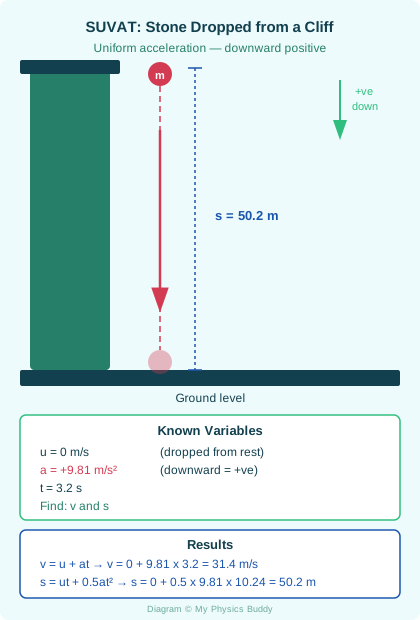
Problem: A stone is dropped from rest from a cliff. It hits the ground 3.2 s later. Calculate (a) its final velocity just before impact and (b) the height of the cliff. Take g = 9.81 m s−2 downward.
Step 1 — Define positive direction. Take downward as positive.
Step 2 — List known variables.
- u = 0 m s−1 (dropped from rest)
- a = +9.81 m s−2 (downward = positive)
- t = 3.2 s
- v = ? and s = ?
Part (a) — Find v. The missing variable is s, so use v = u + at:
v = 0 + (9.81)(3.2) = 31.4 m s−1 downward
Part (b) — Find s. Now t is known, so use s = ut + ½at²:
s = (0)(3.2) + ½(9.81)(3.2)² = 0 + ½ × 9.81 × 10.24 = 50.2 m
You could verify part (b) using v² = u² + 2as: (31.4)² = 0 + 2(9.81)(s), giving s = 986/19.62 = 50.3 m ✓ (small rounding difference only).
For a deeper look at how Kinematics connects to graphs of motion, displacement–time and velocity–time graphs are equally important to master alongside the SUVAT equations. The gradient of a v–t graph gives acceleration; the area under it gives displacement — both of which the Cambridge 9702 paper tests regularly. You can also cross-check your SUVAT answers against the Cambridge International AS and A Level Physics syllabus to confirm which equations are provided in your data booklet.
Common Mistakes When Using SUVAT Equations
✗ Mistake: Treating displacement s as the same as total distance when the object changes direction (for example, a ball thrown upward then falling back down).
✓ Fix: Split the motion into separate stages at the turning point where v = 0, and apply SUVAT independently to each stage.✗ Mistake: Forgetting to assign a sign to acceleration, especially with free-fall problems, leading to incorrect cancellation or addition of terms.
✓ Fix: Write your positive direction explicitly at the top of every kinematics solution before substituting any values.✗ Mistake: Selecting an equation that contains the unknown on both sides (such as using s = vt − ½at² when both s and v are unknown) and then being unable to solve it.
✓ Fix: Always verify that you have exactly three known values and one unknown before choosing your equation; if two variables are unknown, you need two equations and a two-stage solution.
Exam Relevance: SUVAT kinematics appears in Cambridge A/AS Level Physics (9702) Paper 2 and Paper 4, Edexcel A Level Physics Unit 1, and also features prominently in AP Physics mechanics free-response questions.
Pro Tip from Mamatha M: Always write your SUVAT variable list — s, u, v, a, t — for every problem and tick off known values before touching any equation. This habit alone saves minutes and marks.
Related Questions
How to solve center of mass problems in AP Physics 1?
How to earn full credit on AP Physics 1 lab-based questions?
How does the AP Physics exam curve work?
What calculator is allowed on the AP Physics exam?
How to solve conservation of energy problems on AP Physics?
What formulas are given on the AP Physics equation sheet?
How to set up and solve Atwood machine problems?
How to analyze motion graphs for AP Physics?