Thani E
asked on September 20, 2025
AP Physics rotational dynamics problems
How to solve AP Physics problems involving rotational dynamics?
Need Help?
Hire one of our expert Physics tutor online. 24/7 Service. Available now.
Expert Answer
Answered on October 7, 2025 by EXPERT TUTOR
Nothing Found
Dear Thani E,
Solving AP Physics problems involving rotational dynamics becomes straightforward once you map every linear concept to its rotational counterpart. According to expert tutors at My Physics Buddy, the key is applying Newton’s second law for rotation — τ = Iα — systematically, just as you would use F = ma for linear motion.
Rotational Dynamics in AP Physics: A Complete Problem-Solving Guide
Rotational dynamics is the study of what causes objects to rotate and how they respond to twisting forces. As a BSc Physical Science graduate from Hansraj College, University of Delhi, and having worked through 900+ physics problems, I can tell you that most students already understand linear dynamics well — and rotational dynamics is genuinely just the same physics written in a rotating language.
Think of it this way: pushing a heavy door straight at its hinge does almost nothing. Pushing at the far edge swings it open easily. That everyday experience captures the entire concept of torque — the rotational equivalent of force.
The Core Quantities and Their Linear Analogues
Every quantity in linear dynamics has a rotational twin. Building this mental map first saves you enormous confusion later:
| Linear Quantity | Symbol | Rotational Analogue | Symbol |
|---|---|---|---|
| Mass | m | Moment of Inertia | I |
| Force | F | Torque | τ |
| Acceleration | a | Angular Acceleration | α |
| Linear Momentum | p | Angular Momentum | L |
The Three Laws You Need
1. Newton’s Second Law for Rotation: Just as F = ma governs linear motion, rotation obeys:
τnet = I × α
Here, τnet is the net torque in N·m, I is the moment of inertia in kg·m², and α is the angular acceleration in rad/s².
2. Torque Definition:
τ = r × F × sin(θ)
where r is the distance from the pivot (lever arm in metres), F is the applied force in N, and θ is the angle between the force vector and the lever arm. Always use the perpendicular component of force — this is where most students lose marks.
3. Conservation of Angular Momentum: When no net external torque acts on a system, angular momentum is conserved:
I1ω1 = I2ω2
A spinning figure skater pulling in their arms is the classic demonstration — smaller I, larger ω.
Common Moment of Inertia Formulas
- Solid disk or cylinder: I = ½MR²
- Thin ring (hoop): I = MR²
- Solid sphere: I = ⅔MR²
- Rod about centre: I = ⅓⁄¹₂ ML² — actually I = (1/12)ML²
- Rod about end: I = (1/3)ML²
For problems involving AP Physics 1 and AP Physics C: Mechanics, knowing these by heart is non-negotiable. The AP C exam in particular uses the parallel axis theorem — I = Icm + Md² — so always check whether the axis passes through the centre of mass or is offset.
Step-by-Step Worked Example
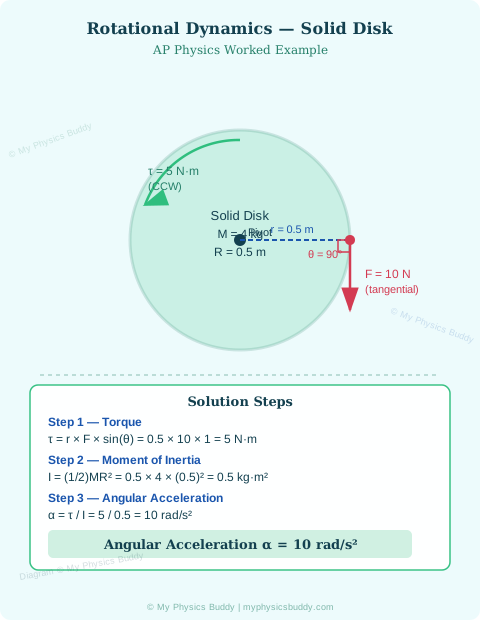
Problem: A uniform disk of mass M = 4 kg and radius R = 0.5 m is free to rotate about its central axis. A constant tangential force F = 10 N is applied at the rim. Find the angular acceleration.
Step 1 — Find the torque.
The force is tangential (θ = 90°), so sin(90°) = 1.
τ = r × F = 0.5 m × 10 N = 5 N·m
Step 2 — Find the moment of inertia.
For a solid disk: I = ½MR² = ½ × 4 × (0.5)² = ½ × 4 × 0.25 = 0.5 kg·m²
Step 3 — Apply Newton’s second law for rotation.
α = τ / I = 5 N·m ÷ 0.5 kg·m² = 10 rad/s²
The disk accelerates rotationally at 10 rad/s². Clean, direct, and identical in structure to a linear F = ma problem. That parallel structure is exactly what makes rotational dynamics manageable once it clicks.
You can read more about how torque and rotation connect to broader mechanics frameworks in the Khan Academy AP Physics 1 torque and angular momentum unit, which reinforces these same steps with additional practice sets. For official College Board guidance on what rotational dynamics skills are assessed, the AP Physics 1 Course and Exam Description from College Board is the authoritative source.
Common Mistakes in Rotational Dynamics Problems
✗ Mistake: Using the full force magnitude in the torque formula without accounting for the angle, writing τ = rF instead of τ = rF sin(θ).
✓ Fix: Always identify the angle between the force vector and the lever arm. If the force is not perpendicular to the radius, multiply by sin(θ) to get only the effective perpendicular component.✗ Mistake: Using the wrong moment of inertia formula — for example, treating a solid disk as a hoop (I = MR²) or forgetting to apply the parallel axis theorem when the rotation axis is not through the centre of mass.
✓ Fix: Write down the object type and axis location before choosing any formula. If the axis is offset from the centre of mass by distance d, always add Md² to Icm.✗ Mistake: Mixing units — computing torque in N·cm instead of N·m, then plugging directly into τ = Iα without converting.
✓ Fix: Convert all distances to metres before computing torque or moment of inertia. Track units explicitly at every step to catch errors before the final answer.
Exam Relevance: Rotational dynamics appears in AP Physics 1 (Unit 5: Torque and Rotational Motion), AP Physics C: Mechanics (Unit 4), and IB Physics HL. It is a consistently high-yield topic across all three curricula.
💡 Pro Tip from Mohit H: Always redraw your problem with a clearly labelled pivot point and all torque directions marked as clockwise or counterclockwise before writing any equation.
Related Questions
How to analyze motion graphs for AP Physics?
What is the difference between static and kinetic friction in AP Physics?
How to handle unit conversions in AP Physics problems?
What are the FRQ scoring guidelines for AP Physics?
How to solve impulse and momentum problems on the AP exam?
What is the best AP Physics prep book for self-study?
How to approach experimental design questions on AP Physics?
How do you calculate the moment of inertia for different shapes?