Ghulam A
asked on November 22, 2025
Springs and Hooke's law AP Physics
How to solve AP Physics problems with springs and Hooke’s law?
Need Help?
Hire one of our expert Physics tutor online. 24/7 Service. Available now.
Expert Answer
Answered on December 2, 2025 by EXPERT TUTOR
Nothing Found
Dear Ghulam A,
Solving AP Physics problems with springs and Hooke’s law becomes straightforward once you master the core equation and sign convention. According to expert tutors at My Physics Buddy, the key is identifying displacement direction, applying F = −kx, and connecting spring potential energy to conservation of energy.
Springs and Hooke’s Law: Complete AP Physics Guide
Hooke’s Law states that the restoring force exerted by a spring is directly proportional to its displacement from the natural (equilibrium) length, and always points back toward equilibrium. The equation is:
F = −kx
- F = spring force (N) — the restoring force, always opposing displacement
- k = spring constant (N/m) — a measure of stiffness; larger k means stiffer spring
- x = displacement from equilibrium (m) — positive for stretch, negative for compression (or your chosen sign convention)
Think of it like pressing your palm into a firm foam cushion. The harder you push (more displacement), the harder it pushes back. That “pushes back” quality is the restoring force. The foam’s stiffness is its spring constant.
Understanding the Negative Sign
The negative sign is one of the most misunderstood parts of Hooke’s law in AP Physics. It simply tells you the direction of the force relative to displacement. If you stretch the spring to the right (+x), the spring pulls left (−F). If you compress it to the left (−x), it pushes right (+F). When solving for the magnitude of force, you can write |F| = kx, but always keep the negative sign in free-body diagrams and equations of motion.
Spring Potential Energy
Every stretched or compressed spring stores elastic potential energy:
Us = ½kx²
- Us = spring potential energy (J)
- k = spring constant (N/m)
- x = displacement from equilibrium (m)
Notice Us is always positive regardless of whether the spring is stretched or compressed, because x is squared. This energy converts to kinetic energy as the spring returns to equilibrium — that’s the foundation of simple harmonic motion problems.
Step-by-Step Problem-Solving Method
As a PhD physicist, I find that the students who struggle most are those who skip the free-body diagram step and jump straight to equations. Always follow this sequence:
- Identify equilibrium. Define x = 0 at the spring’s natural length or, for a hanging mass, at the new static equilibrium position.
- Draw a free-body diagram. Label all forces: spring force, gravity, normal force, applied force if any.
- Apply Newton’s second law or energy conservation depending on what the question asks.
- Track units at every step. Spring constant k must be in N/m; displacement x in metres.
Fully Worked Example
Problem: A spring with k = 200 N/m is compressed by 0.15 m and then releases a 0.50 kg block from rest on a frictionless surface. Find the block’s speed when the spring returns to its natural length.
Step 1 — Identify the energy conversion. All spring potential energy converts to kinetic energy (frictionless, horizontal surface, no height change).
Step 2 — Write the energy conservation equation:
½kx² = ½mv²
Step 3 — Substitute values:
½ × 200 N/m × (0.15 m)² = ½ × 0.50 kg × v²
½ × 200 × 0.0225 = ½ × 0.50 × v²
2.25 J = 0.25 kg × v²
Step 4 — Solve for v:
v² = 2.25 / 0.25 = 9.0 m²/s²
v = 3.0 m/s
Units check: J = kg·m²/s², so v² = (kg·m²/s²)/kg = m²/s² ✓
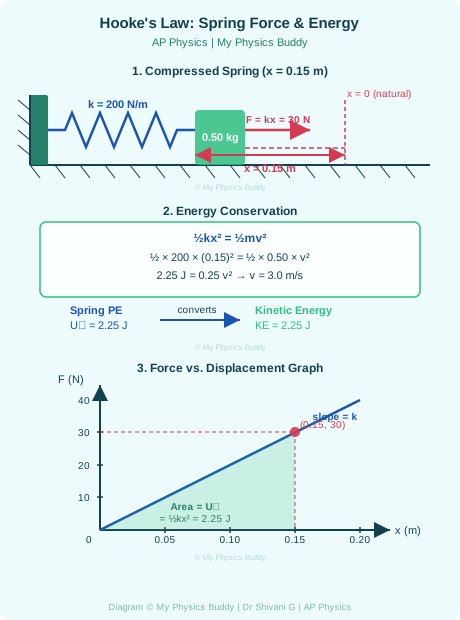
This type of problem appears frequently in AP Physics 1 and requires confident use of both Hooke’s law and conservation of mechanical energy. For a deeper review of how springs connect to oscillatory systems, the College Board AP Physics 1 course page outlines the exact learning objectives tested. You can also explore the derivation of simple harmonic motion at NIST’s physics reference resources.
Springs in Series and Parallel
AP Physics problems sometimes involve combined springs. Know these rules:
| Configuration | Effective Spring Constant | Intuition |
|---|---|---|
| Parallel | keff = k1 + k2 | Two springs share the load — stiffer overall |
| Series | 1/keff = 1/k1 + 1/k2 | Springs stretch independently — softer overall |
Common Mistakes with Hooke’s Law Problems
✗ Mistake: Forgetting to square the displacement when calculating spring potential energy, writing Us = ½kx instead of ½kx².
✓ Fix: Always write the full formula Us = ½kx² and substitute x² explicitly to avoid this slip under exam pressure.✗ Mistake: Using displacement in centimetres instead of metres when k is given in N/m, producing answers off by a factor of 100 or 10,000.
✓ Fix: Convert all displacements to metres immediately upon reading the problem, before touching any equation.✗ Mistake: Setting x equal to the total length of the spring rather than the displacement from the natural (equilibrium) length.
✓ Fix: Explicitly calculate x = (stretched or compressed length) − (natural length), then use that value in F = −kx.
Exam Relevance: Springs and Hooke’s law are core topics in AP Physics 1 (Unit 4: Energy), AP Physics C: Mechanics, IB Physics HL/SL, and A/AS Level Physics (9702). Expect both calculation questions and conceptual free-response items.
💡 Pro Tip from Dr Shivani G: Always set up energy conservation before Newton’s second law — if the question asks for speed or distance, energy is almost always faster and cleaner.
Related Questions
How to solve center of mass problems in AP Physics 1?
How to earn full credit on AP Physics 1 lab-based questions?
How does the AP Physics exam curve work?
What calculator is allowed on the AP Physics exam?
How to solve conservation of energy problems on AP Physics?
What formulas are given on the AP Physics equation sheet?
How to set up and solve Atwood machine problems?
How to analyze motion graphs for AP Physics?