Adam M
asked on January 11, 2026
Center of mass AP Physics 1 problems
How to solve center of mass problems in AP Physics 1?
Need Help?
Hire one of our expert Physics tutor online. 24/7 Service. Available now.
Expert Answer
Answered on February 16, 2026 by EXPERT TUTOR
Nothing Found
Dear Adam M,
To solve center of mass problems in AP Physics 1, you calculate the mass-weighted average position of all objects in a system. According to expert tutors at My Physics Buddy, the key is treating each mass as a point and applying the formula consistently. With practice, this becomes one of the most reliable question types on the exam.
Understanding and Solving Center of Mass Problems in AP Physics 1
The center of mass (CoM) is the single point where the entire mass of a system can be considered to act for the purposes of describing its translational motion. Think of it like this: if you had a see-saw with different weights placed at different positions, the center of mass is the exact balance point. Shift a heavier weight further out, and that balance point shifts toward it. That everyday intuition is the physics.
The Core Formula
For a system of point masses along one dimension (the x-axis), the center of mass position is:
xcm = (m1x1 + m2x2 + m3x3 + …) / (m1 + m2 + m3 + …)
- xcm — the position of the center of mass along the x-axis (in metres)
- m1, m2, m3 — the individual masses (in kg)
- x1, x2, x3 — the positions of each mass along the x-axis (in metres, measured from a chosen origin)
For two-dimensional problems, you apply the same formula separately for both x and y coordinates to find (xcm, ycm).
Step-by-Step Method
- Set up a coordinate system. Pick a convenient origin — often the leftmost or bottommost object, or the position of the heaviest mass. Your answer will be a position relative to this origin.
- List each mass and its position from the origin. Be consistent with direction — positive to the right, negative to the left.
- Multiply each mass by its position to get the moment (m × x) for each object.
- Sum all moments and divide by the total mass of the system.
- Check your answer makes physical sense. The center of mass must always lie between the outermost objects in the system, and it should be closer to the heavier mass.
Fully Worked Example
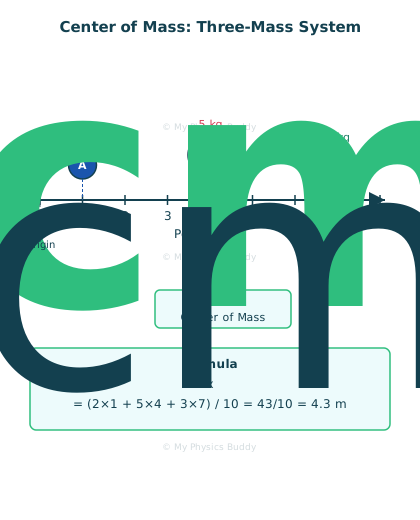
Three masses are placed along the x-axis:
| Object | Mass (kg) | Position (m) |
|---|---|---|
| A | 2 kg | 1 m |
| B | 5 kg | 4 m |
| C | 3 kg | 7 m |
Step 1: Origin is at x = 0 m (already set).
Step 2: Calculate each moment (m × x):
- Object A: 2 kg × 1 m = 2 kg·m
- Object B: 5 kg × 4 m = 20 kg·m
- Object C: 3 kg × 7 m = 21 kg·m
Step 3: Total mass = 2 + 5 + 3 = 10 kg
Step 4: Sum of moments = 2 + 20 + 21 = 43 kg·m
Step 5: xcm = 43 kg·m ÷ 10 kg = 4.3 m
Notice the center of mass sits closest to Object B (at 4 m), the heaviest mass. That’s exactly what you’d expect physically.
Velocity and Momentum of the Center of Mass
In AP Physics 1, center of mass questions also extend to motion. The velocity of the center of mass is:
vcm = (m1v1 + m2v2 + …) / Mtotal
This is directly connected to the total momentum of the system: ptotal = Mtotal × vcm. When no external net force acts on a system, the center of mass moves at constant velocity — this is the heart of momentum conservation. You can read more about the underlying Classical (Newtonian) Mechanics principles that support this idea. As a 20-year math and physics teacher, I can tell you that students who understand CoM velocity nail explosion and collision problems much more reliably than those who treat each object in isolation.
The College Board’s official AP Physics 1 curriculum framework covers this clearly — you can review it directly on the College Board AP Physics 1 page to see exactly how it is assessed.
Common Mistakes in Center of Mass Problems
✗ Mistake: Choosing an origin but then measuring some positions from a different reference point mid-calculation.
✓ Fix: Decide your origin at the start and measure every single position consistently from that same point throughout.✗ Mistake: Forgetting that the center of mass must lie between the outermost masses, not outside the system.
✓ Fix: After calculating xcm, verify it falls within the range of positions in your system. If it doesn’t, recheck your arithmetic or sign conventions immediately.✗ Mistake: Using just the number of objects instead of the total mass in the denominator — effectively treating all masses as equal.
✓ Fix: Always sum the actual mass values for the denominator. The whole point of the formula is that heavier objects pull the CoM toward them proportionally.
Exam Relevance: Center of mass is a core topic in AP Physics 1, IB Physics HL/SL, and A/AS Level Physics. It appears in both multiple-choice and free-response sections, often combined with momentum and collision scenarios.
💡 Pro Tip from Katherine H: Always sanity-check your center of mass answer by confirming it sits closer to the heaviest mass. If it doesn’t, you’ve made an error somewhere before any algebra.
Related Questions
How to interpret and draw electric field line diagrams?
What is the best revision strategy for CIE A Level Physics?
What is the difference between transverse and longitudinal waves?
What is the difference between series and parallel circuits?
How does Bernoulli’s principle explain airplane lift?
What is the relationship between frequency wavelength and speed of a wave?
How to calculate net force when multiple forces act on an object?
What is the work-energy theorem and how do you apply it?