I Jackson
asked on July 1, 2025
Conservation of energy AP Physics
How to solve conservation of energy problems on AP Physics?
Need Help?
Hire one of our expert Physics tutor online. 24/7 Service. Available now.
Expert Answer
Answered on July 4, 2025 by EXPERT TUTOR
Nothing Found
Dear I Jackson,
To solve conservation of energy problems in AP Physics, identify every form of energy at two key moments and set their totals equal. According to expert tutors at My Physics Buddy, the method is systematic: list initial energy, list final energy, account for any work done by non-conservative forces, then solve.
How Conservation of Energy Problems Work in AP Physics
The Law of Conservation of Energy states that energy cannot be created or destroyed — it only transforms from one form to another. In mechanics problems, the two forms you will almost always deal with are gravitational potential energy (PE) and kinetic energy (KE). When only conservative forces like gravity act on an object, the total mechanical energy stays constant throughout the motion.
Think of it like a bank account. The total amount of money never changes — you just move funds between savings (potential energy) and checking (kinetic energy). When you withdraw from savings, your checking balance rises by exactly the same amount. That is exactly what happens when a ball rolls down a hill: it loses height (potential energy decreases) and gains speed (kinetic energy increases).
The Core Equation
The fundamental relationship you will write for every conservation of energy problem is:
KE₁ + PE₁ + Wnc = KE₂ + PE₂
Expanding each term:
- KE = ½mv² — kinetic energy, where m is mass in kg and v is speed in m/s
- PEgrav = mgh — gravitational potential energy, where g = 9.8 m/s² and h is height in metres above your chosen reference level
- PEspring = ½kx² — elastic potential energy, where k is spring constant in N/m and x is compression or extension in metres
- Wnc — work done by non-conservative forces such as friction or an applied engine force (negative if friction removes energy)
When no friction or other non-conservative forces act, Wnc = 0 and the equation simplifies to:
KE₁ + PE₁ = KE₂ + PE₂
Step-by-Step Method
- Choose two moments: an initial state (subscript 1) and a final state (subscript 2). Pick them so that at least one unknown appears between them.
- Set your reference height: Choose a convenient zero for gravitational PE, usually the lowest point in the problem. Height is measured upward from this level.
- List all energies at state 1: Write out KE₁, PE₁(grav), PE₁(spring) with known values plugged in.
- List all energies at state 2: Repeat for KE₂, PE₂(grav), PE₂(spring).
- Include Wnc if needed: If friction acts, Wfriction = −μkmgcosθ × d, where d is the distance travelled along the surface.
- Solve for the unknown: Algebra from here is usually straightforward — one equation, one unknown.
Worked Example
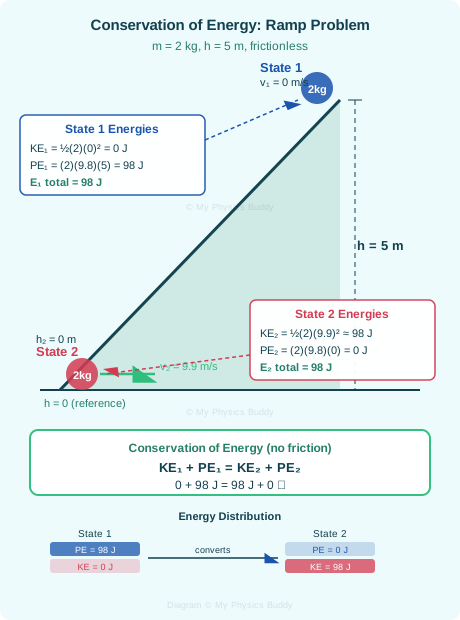
A 2 kg ball is released from rest at the top of a frictionless ramp that is 5 m high. What is its speed at the bottom?
Given: m = 2 kg, h₁ = 5 m, v₁ = 0 m/s, h₂ = 0 m (bottom = reference level), g = 9.8 m/s²
Step 1 — Write the energy equation (no friction, so Wnc = 0):
KE₁ + PE₁ = KE₂ + PE₂
Step 2 — Substitute known values:
½(2)(0)² + (2)(9.8)(5) = ½(2)v₂² + (2)(9.8)(0)
0 + 98 J = v₂² + 0
Step 3 — Solve for v₂:
v₂² = 98
v₂ = √98 ≈ 9.9 m/s
Notice that mass cancelled out entirely — the speed at the bottom is independent of the mass of the object. As someone studying Classical (Newtonian) Mechanics, you will see this cancellation appear repeatedly and it is a great self-check when your answer does not contain m.
As a BSc Physical Science graduate from Hansraj College, University of Delhi, I can tell you that the single most valuable habit you can build is drawing a clear before-and-after diagram and labelling every energy term before touching the algebra. Students who skip the diagram almost always miss a term.
For problems involving friction, the setup is nearly identical. Suppose the same ramp has a coefficient of kinetic friction μk = 0.2 and the ramp length along the surface is 6 m. Then Wnc = −μkmgcosθ × d. You subtract this from the left side, and the final speed will be lower — exactly as physical intuition demands. You can explore more on this approach through the PhET Energy Skate Park simulation, which lets you toggle friction on and off and watch energy bars shift in real time — it is one of the best visual tools available for this topic.
Quick Reference Table
| Energy Type | Formula | Unit | When to include |
|---|---|---|---|
| Kinetic Energy | ½mv² | J | Object is moving |
| Gravitational PE | mgh | J | Object has height above reference |
| Elastic (Spring) PE | ½kx² | J | Spring is compressed or stretched |
| Work by Friction | −μkmgcosθ × d | J | Surface has friction |
Common Mistakes to Avoid
✗ Mistake: Choosing an inconsistent reference height — setting h = 0 at the top for one term and at the bottom for another in the same problem.
✓ Fix: Declare your reference level once at the start (usually the lowest point) and measure every height from that same level throughout the entire problem.✗ Mistake: Forgetting to include elastic potential energy when a spring is involved, only writing KE and gravitational PE.
✓ Fix: Before writing your energy equation, list every energy storage mechanism present — gravitational, kinetic, and spring — then write a term for each one on both sides.✗ Mistake: Applying the simple KE₁ + PE₁ = KE₂ + PE₂ equation to a problem where friction is clearly mentioned, giving an answer that is too large.
✓ Fix: Any time friction, air resistance, or an applied motor force appears, include Wnc explicitly. Energy is still conserved — it just flows into thermal energy rather than staying mechanical.
Exam Relevance: Conservation of energy problems appear heavily on the AP Physics 1 and AP Physics C: Mechanics exams, as well as IB Physics HL/SL and the SAT Physics Subject Test. The College Board consistently tests both frictionless and friction-included scenarios. See the official AP Physics 1 course page for the full energy unit scope.
💡 Pro Tip from Mohit H: Always write the full energy equation first, then cross out zero terms. This prevents accidentally dropping a term that is actually non-zero.
Related Questions
How to solve impulse and momentum problems on the AP exam?
What is the best AP Physics prep book for self-study?
How to approach experimental design questions on AP Physics?
How do you calculate the moment of inertia for different shapes?
What are common AP Physics mistakes students make on the exam?
What is the difference between AP Physics 1, 2, and C?
How to calculate gravitational field strength at a distance from a planet?
What are the key differences between gravitational and electric fields 9702?