S Harrington
asked on February 9, 2026
Gauss's law problems AP Physics 2
How to solve Gauss’s law problems in AP Physics 2?
Need Help?
Hire one of our expert Physics tutor online. 24/7 Service. Available now.
Expert Answer
Answered on February 28, 2026 by EXPERT TUTOR
Nothing Found
Dear S Harrington,
To solve Gauss’s law problems in AP Physics 2, you choose a symmetric Gaussian surface, evaluate the electric flux through it, and set that equal to the enclosed charge divided by ε₀. According to expert tutors at My Physics Buddy, mastering symmetry recognition is the single most important skill for these problems.
How to Solve Gauss’s Law Problems in AP Physics 2: A Complete Strategy
Gauss’s law is one of the most elegant tools in AP Physics 2 electrostatics. At its core, it tells you something powerful: the total electric flux through any closed surface depends only on the net charge enclosed inside that surface — nothing outside matters at all. Think of it like a security checkpoint counting how many people leave a building. It doesn’t matter where inside the building they’re standing; all that matters is how many walk out through the doors.
The mathematical statement of Gauss’s law is:
ΦE = Qenc / ε₀
Where ΦE is the total electric flux (in N·m²/C), Qenc is the total charge enclosed by your chosen surface (in coulombs), and ε₀ = 8.85 × 10⁻¹² C²/(N·m²) is the permittivity of free space.
Electric flux itself is defined as:
ΦE = E · A · cos(θ)
Where E is the magnitude of the electric field, A is the area of the surface, and θ is the angle between the electric field vector and the outward normal to the surface. When the field is perpendicular to the surface (θ = 0°), flux is simply E·A — this is the ideal case you’ll engineer by choosing the right Gaussian surface.
The Four-Step Strategy
Every Gauss’s law problem in AP Physics follows the same four-step framework. Internalize this and you’ll handle any geometry the exam throws at you.
Step 1 — Identify the symmetry. Look at the charge distribution. Is it a point charge or a uniformly charged sphere? That’s spherical symmetry. A long straight wire or cylindrical shell? That’s cylindrical symmetry. An infinite flat plane or slab? That’s planar symmetry. The symmetry tells you what shape of Gaussian surface to draw.
Step 2 — Draw the Gaussian surface. Choose a surface that matches the symmetry so that E is constant in magnitude and either perfectly perpendicular or perfectly parallel to every part of that surface. For spherical symmetry, draw a sphere of radius r centered on the charge. For cylindrical symmetry, draw a coaxial cylinder of radius r and length L. For planar symmetry, draw a pill-box (flat cylinder) straddling the plane.
Step 3 — Evaluate the flux. Because you’ve engineered the surface so E is uniform and perpendicular, the integral simplifies beautifully: ΦE = E × Atotal. For a sphere: A = 4πr². For a cylinder: A = 2πrL (the two flat end caps contribute zero flux for cylindrical symmetry). For a planar pill-box: A = 2Aface.
Step 4 — Find Qenc and solve for E. Calculate how much charge sits inside your Gaussian surface, set E·A = Qenc/ε₀, and isolate E.
Worked Example: Uniformly Charged Solid Sphere
A solid non-conducting sphere of radius R = 0.10 m carries a total charge Q = +4.0 × 10⁻⁶ C distributed uniformly throughout its volume. Find the electric field at r = 0.15 m (outside the sphere) and at r = 0.06 m (inside the sphere).
Outside the sphere (r = 0.15 m):
Draw a spherical Gaussian surface of radius r = 0.15 m. All the charge Q is enclosed.
E × 4πr² = Q/ε₀
E = Q / (4πε₀r²) = (4.0 × 10⁻⁶) / (4π × 8.85 × 10⁻¹² × (0.15)²)
E = (4.0 × 10⁻⁶) / (2.51 × 10⁻¹²) ≈ 1.6 × 10⁶ N/C, directed radially outward
Notice: outside a uniformly charged sphere, Gauss’s law gives you exactly the same field as a point charge at the centre. That’s a deep and beautiful result.
Inside the sphere (r = 0.06 m):
Now only the charge within radius r = 0.06 m is enclosed. Since charge is uniform, Qenc = Q × (r³/R³).
Qenc = 4.0 × 10⁻⁶ × (0.06)³/(0.10)³ = 4.0 × 10⁻⁶ × 0.216 = 8.64 × 10⁻⁷ C
E × 4πr² = Qenc/ε₀
E = Qenc / (4πε₀r²) = (8.64 × 10⁻⁷) / (4π × 8.85 × 10⁻¹² × (0.06)²)
E ≈ 2.16 × 10⁶ N/C, directed radially outward
As a physics educator with a dual MS in Physics and Astronomy, I can tell you that students who sketch the Gaussian surface first — before writing any equations — consistently solve these problems faster and with fewer errors. The diagram is not optional; it’s the engine of the method.
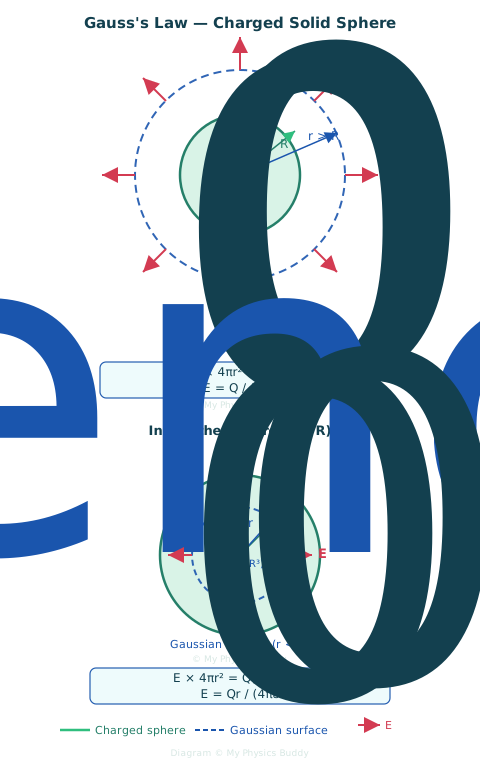
For deeper reading on the formal derivation and applications of Gauss’s law, the OpenStax University Physics II — Gauss’s Law chapter is an excellent free resource that aligns well with AP Physics 2 content.
Symmetry Types at a Glance
| Charge Distribution | Gaussian Surface | Flux Area Used |
|---|---|---|
| Point charge / charged sphere | Concentric sphere (radius r) | 4πr² |
| Long charged wire / cylindrical shell | Coaxial cylinder (radius r, length L) | 2πrL |
| Infinite charged plane | Pill-box (two faces, area A each) | 2A |
Common Mistakes with Gauss’s Law
✗ Mistake: Using Gauss’s law when the charge distribution has no clear symmetry — for example, applying it to two nearby point charges and expecting E to factor out of the flux integral.
✓ Fix: Only use Gauss’s law to find E directly when the symmetry guarantees E is constant in magnitude and direction across your chosen surface. Without that, Gauss’s law still holds, but it cannot isolate E algebraically.✗ Mistake: Including charges outside the Gaussian surface in Qenc, or forgetting that a shell of charge contributes nothing to Qenc for a surface drawn inside the shell.
✓ Fix: Qenc contains only the charge physically located inside the closed Gaussian surface. Draw your surface clearly, identify its boundary, and check each charge: is it inside or outside?✗ Mistake: For a uniformly charged solid sphere, using the full charge Q when the Gaussian surface is inside the sphere (r < R).
✓ Fix: Scale the enclosed charge by the volume ratio: Qenc = Q × (r³/R³). The field inside grows linearly with r, not as 1/r².
Exam Relevance: Gauss’s law problems appear on the AP Physics 2 exam (College Board), AP Physics C: Electricity and Magnetism, and IB Physics HL. Each exam tests symmetry selection, flux calculation, and correct identification of enclosed charge.
💡 Pro Tip from Koustubh B: Always ask yourself “what does the charge distribution look like?” before drawing anything — the symmetry answer tells you the Gaussian surface instantly.
Related Questions
How to calculate Young modulus from a stress-strain graph?
What is the difference between progressive and stationary waves 9702?
How does a potential divider circuit work in CIE physics?
How to determine internal resistance of a cell using a graph?
What is the photoelectric effect and how to solve threshold frequency problems?
How to calculate gravitational field strength at a distance from a planet?
What are the key differences between gravitational and electric fields 9702?
How to use the decay equation for radioactive decay problems?