S Harrington
asked on February 9, 2026
Gauss's law problems AP Physics 2
How to solve Gauss’s law problems in AP Physics 2?
Need Help?
Hire one of our expert Physics tutor online. 24/7 Service. Available now.
Expert Answer
Answered on February 28, 2026 by EXPERT TUTOR
Nothing Found
Dear S Harrington,
To solve Gauss’s law problems in AP Physics 2, you choose a symmetric Gaussian surface, evaluate the electric flux through it, and set that equal to the enclosed charge divided by ε₀. According to expert tutors at My Physics Buddy, mastering symmetry recognition is the single most important skill for these problems.
How to Solve Gauss’s Law Problems in AP Physics 2: A Complete Strategy
Gauss’s law is one of the most elegant tools in AP Physics 2 electrostatics. At its core, it tells you something powerful: the total electric flux through any closed surface depends only on the net charge enclosed inside that surface — nothing outside matters at all. Think of it like a security checkpoint counting how many people leave a building. It doesn’t matter where inside the building they’re standing; all that matters is how many walk out through the doors.
The mathematical statement of Gauss’s law is:
ΦE = Qenc / ε₀
Where ΦE is the total electric flux (in N·m²/C), Qenc is the total charge enclosed by your chosen surface (in coulombs), and ε₀ = 8.85 × 10⁻¹² C²/(N·m²) is the permittivity of free space.
Electric flux itself is defined as:
ΦE = E · A · cos(θ)
Where E is the magnitude of the electric field, A is the area of the surface, and θ is the angle between the electric field vector and the outward normal to the surface. When the field is perpendicular to the surface (θ = 0°), flux is simply E·A — this is the ideal case you’ll engineer by choosing the right Gaussian surface.
The Four-Step Strategy
Every Gauss’s law problem in AP Physics follows the same four-step framework. Internalize this and you’ll handle any geometry the exam throws at you.
Step 1 — Identify the symmetry. Look at the charge distribution. Is it a point charge or a uniformly charged sphere? That’s spherical symmetry. A long straight wire or cylindrical shell? That’s cylindrical symmetry. An infinite flat plane or slab? That’s planar symmetry. The symmetry tells you what shape of Gaussian surface to draw.
Step 2 — Draw the Gaussian surface. Choose a surface that matches the symmetry so that E is constant in magnitude and either perfectly perpendicular or perfectly parallel to every part of that surface. For spherical symmetry, draw a sphere of radius r centered on the charge. For cylindrical symmetry, draw a coaxial cylinder of radius r and length L. For planar symmetry, draw a pill-box (flat cylinder) straddling the plane.
Step 3 — Evaluate the flux. Because you’ve engineered the surface so E is uniform and perpendicular, the integral simplifies beautifully: ΦE = E × Atotal. For a sphere: A = 4πr². For a cylinder: A = 2πrL (the two flat end caps contribute zero flux for cylindrical symmetry). For a planar pill-box: A = 2Aface.
Step 4 — Find Qenc and solve for E. Calculate how much charge sits inside your Gaussian surface, set E·A = Qenc/ε₀, and isolate E.
Worked Example: Uniformly Charged Solid Sphere
A solid non-conducting sphere of radius R = 0.10 m carries a total charge Q = +4.0 × 10⁻⁶ C distributed uniformly throughout its volume. Find the electric field at r = 0.15 m (outside the sphere) and at r = 0.06 m (inside the sphere).
Outside the sphere (r = 0.15 m):
Draw a spherical Gaussian surface of radius r = 0.15 m. All the charge Q is enclosed.
E × 4πr² = Q/ε₀
E = Q / (4πε₀r²) = (4.0 × 10⁻⁶) / (4π × 8.85 × 10⁻¹² × (0.15)²)
E = (4.0 × 10⁻⁶) / (2.51 × 10⁻¹²) ≈ 1.6 × 10⁶ N/C, directed radially outward
Notice: outside a uniformly charged sphere, Gauss’s law gives you exactly the same field as a point charge at the centre. That’s a deep and beautiful result.
Inside the sphere (r = 0.06 m):
Now only the charge within radius r = 0.06 m is enclosed. Since charge is uniform, Qenc = Q × (r³/R³).
Qenc = 4.0 × 10⁻⁶ × (0.06)³/(0.10)³ = 4.0 × 10⁻⁶ × 0.216 = 8.64 × 10⁻⁷ C
E × 4πr² = Qenc/ε₀
E = Qenc / (4πε₀r²) = (8.64 × 10⁻⁷) / (4π × 8.85 × 10⁻¹² × (0.06)²)
E ≈ 2.16 × 10⁶ N/C, directed radially outward
As a physics educator with a dual MS in Physics and Astronomy, I can tell you that students who sketch the Gaussian surface first — before writing any equations — consistently solve these problems faster and with fewer errors. The diagram is not optional; it’s the engine of the method.
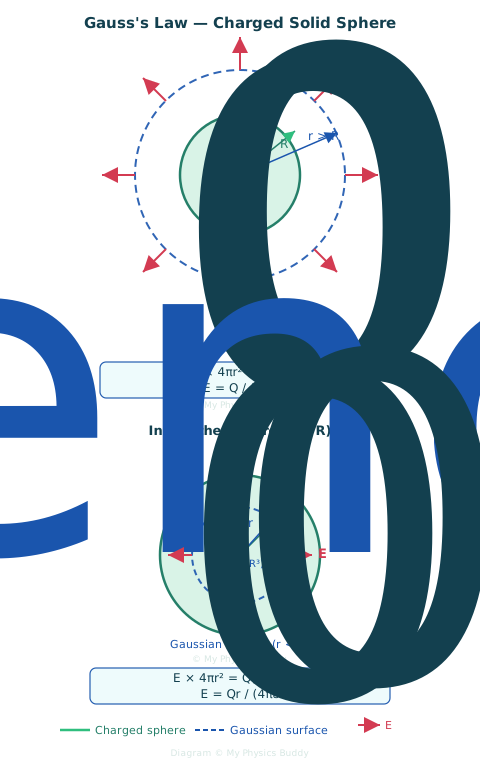
For deeper reading on the formal derivation and applications of Gauss’s law, the OpenStax University Physics II — Gauss’s Law chapter is an excellent free resource that aligns well with AP Physics 2 content.
Symmetry Types at a Glance
| Charge Distribution | Gaussian Surface | Flux Area Used |
|---|---|---|
| Point charge / charged sphere | Concentric sphere (radius r) | 4πr² |
| Long charged wire / cylindrical shell | Coaxial cylinder (radius r, length L) | 2πrL |
| Infinite charged plane | Pill-box (two faces, area A each) | 2A |
Common Mistakes with Gauss’s Law
✗ Mistake: Using Gauss’s law when the charge distribution has no clear symmetry — for example, applying it to two nearby point charges and expecting E to factor out of the flux integral.
✓ Fix: Only use Gauss’s law to find E directly when the symmetry guarantees E is constant in magnitude and direction across your chosen surface. Without that, Gauss’s law still holds, but it cannot isolate E algebraically.✗ Mistake: Including charges outside the Gaussian surface in Qenc, or forgetting that a shell of charge contributes nothing to Qenc for a surface drawn inside the shell.
✓ Fix: Qenc contains only the charge physically located inside the closed Gaussian surface. Draw your surface clearly, identify its boundary, and check each charge: is it inside or outside?✗ Mistake: For a uniformly charged solid sphere, using the full charge Q when the Gaussian surface is inside the sphere (r < R).
✓ Fix: Scale the enclosed charge by the volume ratio: Qenc = Q × (r³/R³). The field inside grows linearly with r, not as 1/r².
Exam Relevance: Gauss’s law problems appear on the AP Physics 2 exam (College Board), AP Physics C: Electricity and Magnetism, and IB Physics HL. Each exam tests symmetry selection, flux calculation, and correct identification of enclosed charge.
💡 Pro Tip from Koustubh B: Always ask yourself “what does the charge distribution look like?” before drawing anything — the symmetry answer tells you the Gaussian surface instantly.
Related Questions
How to answer 9702 Paper 5 planning questions effectively?
How does electromagnetic induction work and what is Faraday’s law?
What is the difference between nuclear fission and fusion in A Level?
How to calculate specific heat capacity from experimental data?
What is simple harmonic motion and how to derive its equations?
How to solve problems involving circular motion and centripetal force?
What are the common mistakes in 9702 Paper 2 structured questions?
How to interpret and draw electric field line diagrams?