B Simpson
asked on May 6, 2024
Impulse momentum AP exam problems
How to solve impulse and momentum problems on the AP exam?
Need Help?
Hire one of our expert Physics tutor online. 24/7 Service. Available now.
Expert Answer
Answered on May 30, 2024 by EXPERT TUTOR
Nothing Found
Dear B Simpson,
To solve impulse and momentum problems on the AP exam, always apply the impulse-momentum theorem: a net force acting over time changes an object’s momentum by exactly that impulse. According to expert tutors at AP Physics at My Physics Buddy, mastering sign conventions and system selection before calculating will earn you full marks every time.
Impulse and Momentum: Concepts, Strategy, and a Full Worked Example
Momentum (p) is the product of an object’s mass and velocity: p = mv, where m is mass in kg and v is velocity in m/s. Momentum is a vector — direction matters. Impulse (J) is the change in momentum produced by a force acting over a time interval. The impulse-momentum theorem states:
J = Fnet · Δt = Δp = mvf − mvi
Here, Fnet is the average net force in Newtons, Δt is the time interval in seconds, vf is the final velocity, and vi is the initial velocity, both in m/s. The units of impulse are N·s, which is identical to kg·m/s — the same as momentum.
Think of it this way: catching a fast cricket ball hurts more if you stop it suddenly (tiny Δt, large F) than if you let your hands give way with the ball (larger Δt, smaller F). The impulse — the total change in momentum — is identical in both cases. Your hands are simply spreading that impulse over more time to reduce the peak force. This is precisely why car crumple zones and airbags save lives.
The Four-Step Strategy for AP Exam Problems
After teaching AP Physics 1 students for years, I’ve found that students who struggle almost always skip Step 1: defining their positive direction. Follow these steps every time.
- Define a positive direction — write it down explicitly (e.g., “positive = right”).
- Write the impulse-momentum theorem — J = mvf − mvi with signs applied.
- Substitute known values with units — keep track of kg, m/s, N, and s.
- Solve and check the sign of the answer — a negative result for velocity means motion in the negative direction, not an error.
Conservation of Momentum for Collision Problems
When no external net force acts on a system of objects, total momentum is conserved:
ptotal, before = ptotal, after
m1v1i + m2v2i = m1v1f + m2v2f
For a perfectly inelastic collision (objects stick together), the right side becomes (m1 + m2)vf. For an elastic collision, both momentum and kinetic energy are conserved. The AP exam almost always tells you which type you are dealing with — read carefully.
Full Worked Example
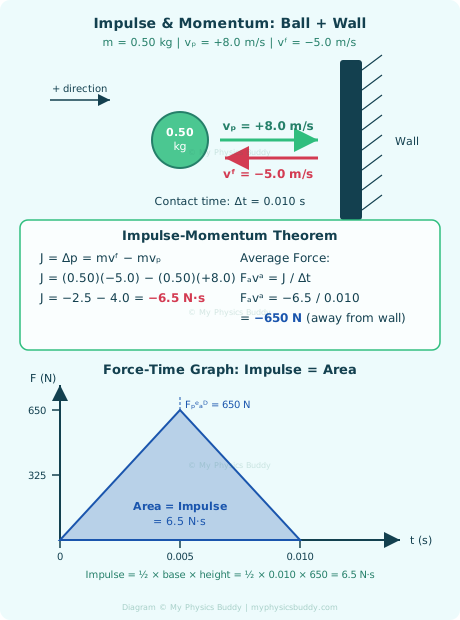
A 0.50 kg ball moving at +8.0 m/s strikes a wall and bounces back at −5.0 m/s. The ball is in contact with the wall for 0.010 s. Find (a) the impulse on the ball and (b) the average force exerted by the wall.
Step 1: Positive direction = away from wall (rightward, the initial direction of travel toward the wall is actually leftward… let me set positive = toward wall = the original direction of motion so +8.0 m/s is positive).
Positive = original direction of travel (toward wall). So vi = +8.0 m/s, vf = −5.0 m/s.
Step 2: Apply J = Δp = mvf − mvi
Step 3: Substitute:
J = (0.50 kg)(−5.0 m/s) − (0.50 kg)(+8.0 m/s)
J = −2.5 kg·m/s − 4.0 kg·m/s = −6.5 N·s
The negative sign means the impulse points away from the wall — which makes physical sense. The wall pushed the ball back.
Step 4: Average force:
Favg = J / Δt = −6.5 N·s / 0.010 s = −650 N
The magnitude is 650 N directed away from the wall. On the AP exam, always state the magnitude and direction separately for vector quantities.
For a two-object collision problem, extend the same logic. Suppose a 2.0 kg cart moving at +4.0 m/s collides and sticks with a 1.0 kg stationary cart. Using conservation of momentum:
(2.0)(4.0) + (1.0)(0) = (2.0 + 1.0)vf
8.0 = 3.0 vf → vf = +2.67 m/s
You can cross-check by confirming total momentum before (8.0 kg·m/s) equals total momentum after (3.0 × 2.67 ≈ 8.0 kg·m/s). Always do this check — the AP exam rewards systematic verification. For deeper reading on momentum and impulse, see the OpenStax University Physics treatment of linear momentum, which is well-aligned with AP-level expectations.
Impulse from a Force-Time Graph
The AP exam frequently shows a graph of force versus time and asks for impulse. The answer is simply the area under the F-t graph. If the curve is triangular, use ½ × base × height. If it is rectangular, use base × height. Always include sign based on which side of the time axis the area falls on.
Common Mistakes in Impulse and Momentum Problems
✗ Mistake: Ignoring the direction of velocity and treating all speeds as positive, leading to wrong impulse signs.
✓ Fix: Always assign a positive direction first, then substitute velocities with the correct sign before calculating anything.✗ Mistake: Confusing the impulse on object A with the impulse on the whole system, especially in two-body collision problems.
✓ Fix: Identify your system clearly. Impulse-momentum theorem applies to one object at a time; conservation of momentum applies to the closed system as a whole.✗ Mistake: Reading force-time graphs incorrectly by using the peak force value as the impulse instead of calculating the area.
✓ Fix: Impulse equals area under the F-t curve. Break irregular shapes into triangles and rectangles, compute each area, and sum with correct signs.
Exam Relevance: Impulse and momentum problems appear in AP Physics 1 (Unit 5), AP Physics C: Mechanics, and IB Physics HL/SL. The College Board tests both calculation and conceptual justification, so always explain your reasoning in free-response questions.
💡 Pro Tip from Neha A: On the AP free-response, writing J = Δp = mvf − mvi explicitly before substituting earns a method point even if your arithmetic slips.
Related Questions
How to interpret and draw electric field line diagrams?
What is the best revision strategy for CIE A Level Physics?
What is the difference between transverse and longitudinal waves?
What is the difference between series and parallel circuits?
How does Bernoulli’s principle explain airplane lift?
What is the relationship between frequency wavelength and speed of a wave?
How to calculate net force when multiple forces act on an object?
What is the work-energy theorem and how do you apply it?