H Merritt
asked on March 21, 2025
Circular motion centripetal force problems
How to solve problems involving circular motion and centripetal force?
Need Help?
Hire one of our expert Physics tutor online. 24/7 Service. Available now.
Expert Answer
Answered on April 8, 2025 by EXPERT TUTOR
Nothing Found
Dear H Merritt,
Solving problems involving circular motion and centripetal force requires identifying the net inward force acting on an object moving in a circle and setting it equal to mv²/r. According to expert tutors at My Physics Buddy, the key is always asking: what physical force is providing the centripetal force in this specific situation?
Understanding Circular Motion and Centripetal Force — A Complete Guide
When an object moves in a circle at constant speed, its velocity is constantly changing direction even though its magnitude stays the same. That change in direction means there is an acceleration — and by Newton’s Second Law, an acceleration requires a net force. This inward-pointing acceleration is called centripetal acceleration, and the force producing it is the centripetal force.
Here is the crucial insight that trips up many students in A/AS Level Physics (9702): centripetal force is not a new type of force. It is simply the name given to whichever real force (or combination of forces) is directed toward the centre of the circular path. It could be tension, gravity, friction, a normal reaction — or some combination of these.
The Core Equations
There are three closely related equations you must be comfortable with:
| Quantity | Formula | Variables |
|---|---|---|
| Centripetal acceleration | a = v²/r = ω²r | v = speed, r = radius, ω = angular velocity |
| Centripetal force | F = mv²/r = mω²r | m = mass of object |
| Angular velocity | ω = 2π/T = 2πf | T = period, f = frequency |
The direction of centripetal force and centripetal acceleration is always toward the centre of the circle — never tangential, never outward.
An Everyday Analogy
Think about swinging a ball on a string in a horizontal circle above your head. The tension in the string pulls the ball inward toward your hand. That tension is the centripetal force. If you cut the string, the inward force vanishes and the ball flies off in a straight line — not outward, but tangentially. This beautifully illustrates Newton’s First Law working alongside circular motion.
A Step-by-Step Problem-Solving Method
As a physics tutor with a Dual MS in Physics and Astronomy, I can tell you that students who struggle with these problems almost always skip Step 1 below. Follow this method every time:
- Draw a clear diagram. Mark the object, the centre of the circle, and the radius r.
- Identify all real forces acting on the object (weight, tension, normal force, friction, etc.).
- Resolve forces toward the centre. The net component of force pointing toward the centre equals mv²/r.
- Write the centripetal force equation using the actual forces you identified.
- Substitute known values and solve, keeping track of units throughout.
Worked Example — Car on a Banked Road
A car of mass 900 kg travels around a circular bend of radius 50 m banked at an angle of 15° to the horizontal. Assuming no friction, find the speed at which the car can travel without sliding.
Step 1 — Identify forces: The only forces are weight mg downward and the normal reaction N perpendicular to the banked surface.
Step 2 — Resolve vertically: The vertical component of N must balance weight:
N cos 15° = mg
N = mg / cos 15° = (900 × 9.81) / cos 15° = 9130 N (to 4 sig. fig.)
Step 3 — Resolve horizontally (toward centre): The horizontal component of N provides the centripetal force:
N sin 15° = mv²/r
Step 4 — Divide the two equations to eliminate N:
tan 15° = v²/(rg)
v² = rg tan 15° = 50 × 9.81 × tan 15°
v² = 50 × 9.81 × 0.2679 = 131.4 m²s⁻²
v = √131.4 ≈ 11.5 m s⁻¹
Notice that the mass cancelled out completely — a very common feature of these problems that can serve as a useful self-check.
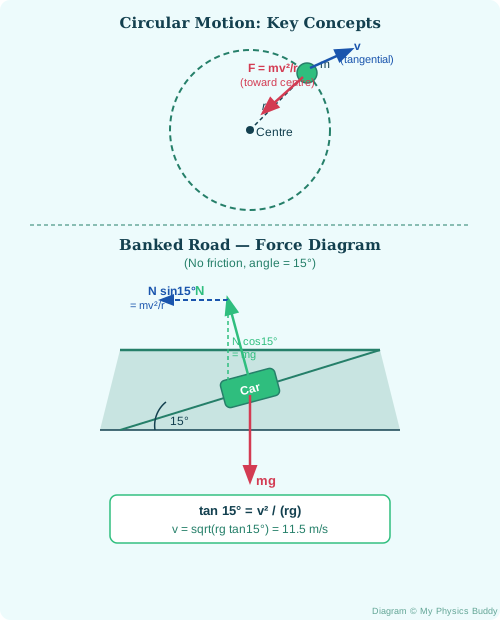
This same approach applies to objects on the inside of a loop, satellites in orbit (where gravity provides the centripetal force — a topic explored in depth in Physics at all levels), and conical pendulums. For further reading on the mathematics of circular motion, the STEM Learning resource on circular motion is an excellent reference aligned with A Level content.
Quick Reference: Common Scenarios
- Ball on a string (horizontal circle): Tension provides centripetal force → T = mv²/r
- Car on a flat road (friction): Friction provides centripetal force → f = mv²/r
- Satellite in orbit: Gravity provides centripetal force → GMm/r² = mv²/r
- Object at top of a loop: Both weight and normal force act downward toward centre → mg + N = mv²/r
- Object at bottom of a loop: Normal force acts up (toward centre), weight acts down → N − mg = mv²/r
Common Mistakes in Circular Motion Problems
✗ Mistake: Treating centripetal force as a separate real force and adding it to the free body diagram alongside tension, weight, and friction.
✓ Fix: Remember that centripetal force is the resultant of the real forces toward the centre — never draw it as an additional arrow on your diagram.✗ Mistake: Forgetting to resolve forces correctly when the circular motion is in a vertical plane or on a banked surface, and just setting a single force equal to mv²/r without checking direction.
✓ Fix: Always resolve each force into components parallel and perpendicular to the radius before writing your centripetal force equation.✗ Mistake: Confusing angular velocity ω with linear speed v, especially when the question gives the period T or frequency f instead of speed directly.
✓ Fix: Convert first using v = ωr and ω = 2π/T, then substitute into F = mv²/r or use F = mω²r directly — both forms are valid and equally accepted in Cambridge 9702 mark schemes. You can verify the official syllabus expectations at the Cambridge International AS and A Level Physics 9702 page.
Exam Relevance: Circular motion and centripetal force appear in Cambridge A/AS Level Physics 9702 (Paper 4), Edexcel A Level Physics, and IB Physics HL/SL. Questions range from definitions and derivations to multi-step banked road and vertical loop calculations.
Pro Tip from Koustubh B: At the top of every circular motion problem, write “Net force toward centre = mv²/r” — this single habit prevents nearly every direction and sign error students make.
Related Questions
How to interpret and draw electric field line diagrams?
What is the best revision strategy for CIE A Level Physics?
What is the difference between transverse and longitudinal waves?
What is the difference between series and parallel circuits?
How does Bernoulli’s principle explain airplane lift?
What is the relationship between frequency wavelength and speed of a wave?
How to calculate net force when multiple forces act on an object?
What is the work-energy theorem and how do you apply it?