B Gutierrez
asked on February 20, 2026
Inclined plane problems with friction
How to solve problems involving inclined planes with friction?
Need Help?
Hire one of our expert Physics tutor online. 24/7 Service. Available now.
Expert Answer
Answered on February 25, 2026 by EXPERT TUTOR
Nothing Found
Dear B Gutierrez,
Solving problems involving inclined planes with friction requires resolving gravity into two components along and perpendicular to the slope, then applying Newton’s second law with the friction force opposing motion. According to expert tutors at My Physics Buddy, mastering this systematic approach unlocks a large class of mechanics problems across all major physics curricula.
Understanding Inclined Planes with Friction: Forces, Methods, and a Worked Example
Think of pushing a heavy box up a ramp into a moving truck. Two things resist your push: the component of gravity pulling the box back down the slope, and the friction between the box and the ramp surface. Every inclined plane problem with friction is really just a structured version of that everyday scenario. The goal is to identify every force, resolve them into convenient directions, and apply Newton’s second law systematically.
Step 1 — Set Up a Tilted Coordinate System
The smartest move in any inclined plane problem is to tilt your coordinate axes so that the x-axis runs parallel to the slope and the y-axis runs perpendicular to the slope. This way, only gravity needs to be resolved into components; every other force already sits neatly on one of your axes. As a Physics tutor, I can tell you that the single most common source of errors I see is students keeping horizontal and vertical axes on a tilted surface — it multiplies the algebra needlessly.
Step 2 — Resolve Gravity
For a block of mass m on a slope inclined at angle θ to the horizontal, gravity mg splits into:
- Component along the slope (down the incline): mg sinθ
- Component perpendicular to the slope (into the surface): mg cosθ
These two components come directly from basic trigonometry applied to the weight vector. Always draw the full right-angled triangle with mg as the hypotenuse — it makes the angle assignments obvious and error-free.
Step 3 — Find the Normal Force and Friction Force
Normal force N acts perpendicular to the surface. Since there is no acceleration in the perpendicular direction:
N = mg cosθ
Here, N is in newtons (N), m is mass in kilograms (kg), g is gravitational acceleration (9.8 m/s²), and θ is the angle of incline.
Friction force f opposes the direction of motion (or impending motion). Its magnitude is:
f = μ N = μ mg cosθ
where μ is the coefficient of friction (dimensionless). Use μₛ (static) when the object is on the verge of moving, and μₖ (kinetic) when it is already sliding.
Step 4 — Apply Newton’s Second Law Along the Slope
Taking down the slope as positive (adjust sign conventions to suit your problem):
Net force = mg sinθ − f = ma
Substituting friction:
ma = mg sinθ − μ mg cosθ
a = g(sinθ − μ cosθ)
This single equation is the engine of almost every standard inclined plane problem. If the block is stationary and you need to check whether it stays put, compare mg sinθ with μₛ mg cosθ — if the gravitational component is smaller, the block does not slide.
Worked Example
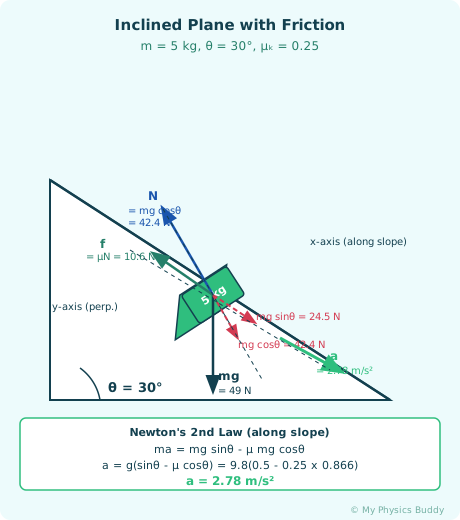
A 5 kg block slides down a 30° ramp. The coefficient of kinetic friction between the block and the ramp is 0.25. Find the acceleration of the block. Take g = 9.8 m/s².
Step 1 — Normal force:
N = mg cos30° = 5 × 9.8 × 0.866 = 42.4 N
Step 2 — Friction force (opposing motion, so acting up the slope):
f = μₖ × N = 0.25 × 42.4 = 10.6 N
Step 3 — Net force along the slope (taking down as positive):
Fₛₜₜ = mg sin30° − f = (5 × 9.8 × 0.5) − 10.6 = 24.5 − 10.6 = 13.9 N
Step 4 — Acceleration:
a = Fₛₜₜ / m = 13.9 / 5 = 2.78 m/s² down the slope
For deeper practice with Newton’s laws and free-body diagrams in a structured curriculum context, Classical (Newtonian) Mechanics resources are especially useful. You can also explore the official treatment of forces and motion in the Khan Academy inclined planes and friction guide for additional visual breakdowns.
When a block is being pushed up the slope, friction acts down the slope (it still opposes motion), so the equation becomes:
ma = Fₚₛₜₚ − mg sinθ − μ mg cosθ
Always ask yourself: “Which direction is the object moving or tending to move?” — friction always points the opposite way. Students preparing for VCE Physics should pay special attention to this sign convention, as multi-part questions on ramps are a regular feature of that exam.
Quick Reference Table
| Quantity | Formula | Direction |
|---|---|---|
| Normal force N | mg cosθ | Perpendicular to slope, away from surface |
| Gravity along slope | mg sinθ | Down the slope |
| Kinetic friction f | μₖ mg cosθ | Opposite to motion |
| Acceleration a | g(sinθ − μ cosθ) | Along slope (sliding down) |
Common Mistakes Students Make with Inclined Plane Friction Problems
✗ Mistake: Using the full weight mg as the normal force instead of the perpendicular component mg cosθ.
✓ Fix: Always project weight onto the perpendicular axis. N = mg cosθ, not mg. Using mg inflates the friction force and gives a wrong acceleration.✗ Mistake: Applying friction in the wrong direction — for example, pointing it down the slope when the block is sliding down.
✓ Fix: Friction always opposes the direction of actual or impending motion. If the block moves down, friction acts up the slope. Draw the arrow explicitly before writing any equation.✗ Mistake: Confusing static and kinetic coefficients and using μₛ when the block is already moving.
✓ Fix: Use μₛ only to determine whether the block starts to slide. Once it is in motion, switch to μₖ, which is always less than or equal to μₛ.
Exam Relevance: Inclined plane problems with friction appear in GCSE Physics, IB Physics HL/SL, AP Physics 1, and VCE Physics. They commonly involve calculating acceleration, finding the minimum force to prevent sliding, or determining whether a block moves at all.
Pro Tip from Ashish S: Draw your free-body diagram with the tilted axes before writing a single equation — students who sketch first almost never assign friction the wrong direction.
Related Questions
What is the best way to review for AP Physics 1 in two weeks?
How to apply Newton’s second law in rotational form?
How does energy transfer work in simple harmonic motion?
How to solve problems with pulleys and tension in AP Physics 1?
What is mechanical energy and when is it conserved?
How to interpret position vs time and velocity vs time graphs?
How do open and closed pipe resonance problems work?
What are the most difficult topics on AP Physics 1?