Z Hunt
asked on January 19, 2025
Pulleys and tension AP Physics 1
How to solve problems with pulleys and tension in AP Physics 1?
Need Help?
Hire one of our expert Physics tutor online. 24/7 Service. Available now.
Expert Answer
Answered on May 12, 2025 by EXPERT TUTOR

Dear Z Hunt,
To solve problems with pulleys and tension in AP Physics 1, draw a free-body diagram for each object, apply Newton’s second law to every mass separately, and use the constraint that a single rope over an ideal pulley carries the same tension throughout. According to expert tutors at My Physics Buddy, this systematic approach resolves nearly every Atwood-machine-style question on the exam.
Understanding Pulleys and Tension: The Complete Method
Think of a pulley problem like a tug-of-war where both sides of the rope are pulling on different objects at the same time. The rope connects the two masses, so whatever one mass does, the other must respond. That interconnection is the key insight, and once you feel it intuitively, the math follows naturally.
Core Concepts You Must Know
Tension (T) is the pulling force a rope exerts on an object at the point of contact. In an ideal pulley system — massless rope, frictionless pulley — the tension is identical at every point along the rope. That single tension value links the two objects together mathematically.
The constraint condition connects the accelerations. If mass 1 accelerates downward at a, mass 2 accelerates upward at exactly a (same magnitude, opposite direction). This is because the rope length is fixed. You must enforce this before writing any equations.
Step-by-Step Method for a Standard Atwood Machine
An Atwood machine is the classic AP Physics 1 setup: two masses (m1 and m2) hanging on either side of a pulley fixed to the ceiling. Here is the method every time:
- Draw free-body diagrams (FBDs). One FBD per object. Label every force: weight (mg downward) and tension T (upward along the rope).
- Choose a positive direction. Pick one consistent direction as positive for the whole system. A common choice: positive = direction of motion of the heavier mass.
- Write Newton’s second law for each mass. Sum of forces = ma for every object.
- Write the constraint. Both masses share the same magnitude of acceleration a.
- Solve the system of equations for T and a.
Worked Example with Real Numbers
Suppose m1 = 5 kg and m2 = 3 kg hang on opposite sides of a massless, frictionless pulley. Use g = 10 m/s².
Step 1 — FBDs: On m1: weight = 50 N downward, tension T upward. On m2: weight = 30 N downward, tension T upward.
Step 2 — Positive direction: Let downward for m1 (and upward for m2) be positive.
Step 3 — Newton’s second law:
For m1 (net force = m1a):
m1g − T = m1a → 50 − T = 5a …(1)
For m2 (net force = m2a):
T − m2g = m2a → T − 30 = 3a …(2)
Step 4 — Add equations (1) and (2):
50 − 30 = 5a + 3a → 20 = 8a → a = 2.5 m/s²
Step 5 — Substitute back to find T:
T − 30 = 3(2.5) = 7.5 → T = 37.5 N
Notice that T = 37.5 N is between the two weights (30 N and 50 N). That is always the case for an Atwood machine — tension is never equal to either weight, a fact that trips up many students. You can also use the compact formula a = (m1 − m2)g / (m1 + m2) as a quick check, but always derive it from FBDs on the actual exam.
As a Masters-level physics specialist, I have seen students lose full points not because they don’t know the formula, but because they skip the FBD step and then assign the wrong direction to tension. The FBD is not optional — it is the foundation. For a deeper look at Newton’s laws in context, the Khan Academy AP Physics 1 forces module offers solid additional practice. You can also explore more mechanics strategies through AP Physics tutoring resources.
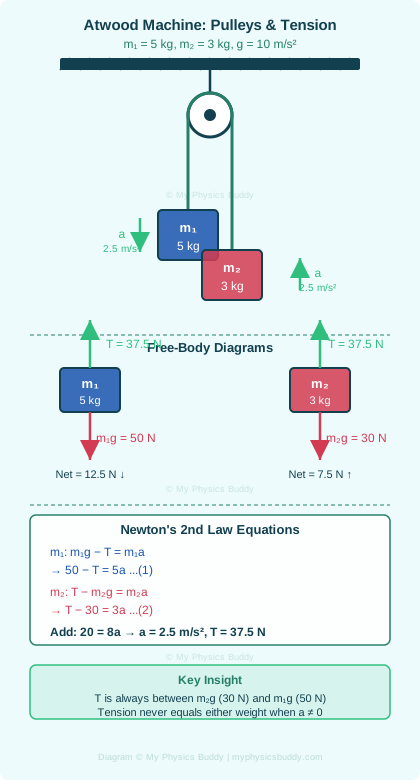
The diagram above shows the complete Atwood machine setup with correctly labelled forces, the shared tension T, and the acceleration directions consistent with the worked example.
Pulley on a Table (Horizontal Surface)
When one mass sits on a frictionless table and the other hangs off the edge over a pulley, the logic is identical. The hanging mass drives the system; the table mass resists with inertia only (no weight component along the rope since it moves horizontally). Write separate FBDs, enforce the same-acceleration constraint, and solve. The tension in this case is lower than the hanging weight — always a good sanity check.
Common Mistakes
✗ Mistake: Assuming tension equals the weight of one of the hanging masses (e.g. writing T = m1g).
✓ Fix: Tension is never equal to either weight in an accelerating system. Always solve for T algebraically using both Newton’s second law equations simultaneously.✗ Mistake: Using different acceleration values for each mass in the equations (e.g. writing a1 and a2 as if they are independent).
✓ Fix: State the constraint explicitly — a1 = a2 = a — before writing any equations, then use a single variable a throughout both equations.✗ Mistake: Assigning inconsistent positive directions between the two masses, causing sign errors in the combined equation.
✓ Fix: Before writing any equation, state your sign convention clearly (e.g. “positive = direction the system accelerates”). Apply that convention to every force in every FBD without exception.
Exam Relevance: Pulleys and tension problems appear on the AP Physics 1 exam (Unit 2: Forces and Newton’s Laws), the AP Physics C: Mechanics free-response section, and IB Physics HL/SL mechanics units. The College Board frequently tests conceptual reasoning about tension alongside calculation.
Pro Tip from Manikanta J: After solving, always verify that your tension value sits numerically between the two gravitational forces — if it doesn’t, your sign convention has an error somewhere.
Related Questions
What is the difference between AP Physics 1 and AP Physics 2?
How to solve Gauss’s law problems in AP Physics 2?
What is the right-hand rule and how to apply it for magnetic fields?
How to calculate electric potential and potential energy?
How does a capacitor work and how to solve RC circuit problems?
What is Bernoulli’s equation and how to apply it to fluid flow?
What is the relationship between period and frequency for oscillations?
How to calculate the speed of a wave on a string?