Razan A
asked on October 8, 2025
Step-by-step projectile motion solving
How to solve projectile motion problems step by step?
Need Help?
Hire one of our expert Physics tutor online. 24/7 Service. Available now.
Expert Answer
Answered on October 16, 2025 by EXPERT TUTOR
Nothing Found
Dear Razan A,
To solve projectile motion problems step by step, you split the motion into two completely independent components — horizontal and vertical — and apply the correct kinematic equations to each. According to expert tutors at My Physics Buddy, this separation is the single most powerful technique in solving any projectile problem. Once you master it, even complex multi-stage problems become straightforward.
Understanding Projectile Motion: Concepts, Method, and a Full Worked Example
Projectile motion is the curved path followed by any object launched into the air and moving only under the influence of gravity. Think of a football kicked at an angle, a ball rolling off a table, or a stone thrown horizontally from a cliff. In all these cases, the object follows a parabolic trajectory because gravity pulls it downward while its horizontal speed stays unchanged.
As a PhD Physicist, I can tell you that the single most common conceptual struggle I see students face is trying to treat the horizontal and vertical motions as connected. They are not. The key principle is that horizontal and vertical motions are completely independent of each other. Air resistance is typically neglected at this level, so no horizontal force acts on the projectile — meaning horizontal velocity stays constant throughout the flight.
The Two Components of Motion
When a projectile is launched with initial speed u at an angle θ above the horizontal, you immediately resolve it into two components:
- Horizontal component: ux = u cos θ — this stays constant throughout the flight
- Vertical component: uy = u sin θ — this changes due to gravity (g = 9.8 m/s²)
The equations you apply to each direction are the standard Kinematics equations, separated by direction:
| Direction | Acceleration | Key Equations |
|---|---|---|
| Horizontal (x) | ax = 0 | x = ux · t |
| Vertical (y) | ay = −g = −9.8 m/s² | vy = uy − gt | y = uyt − ½gt² |
The 5-Step Method for Solving Projectile Motion Problems
Here is the exact process I recommend to every student in Physics. Follow these steps consistently and you will not go wrong.
- Draw a diagram and define your sign convention. Choose upward as positive and rightward as positive. Label the launch point, peak, and landing point. This single habit prevents most sign errors.
- Resolve the initial velocity into components. Calculate ux = u cos θ and uy = u sin θ. Write them down explicitly before doing anything else.
- Identify what you know and what you need to find. List your knowns (ux, uy, g, any given time or displacement) and circle the unknown you need.
- Use the vertical equations to find time (or use time to find vertical quantities). Time is the bridge between the two directions. At maximum height, vy = 0. At landing (on the same level), vertical displacement y = 0.
- Substitute time into the horizontal equation to find range, or use it to find any remaining unknown. Always check units at the end.
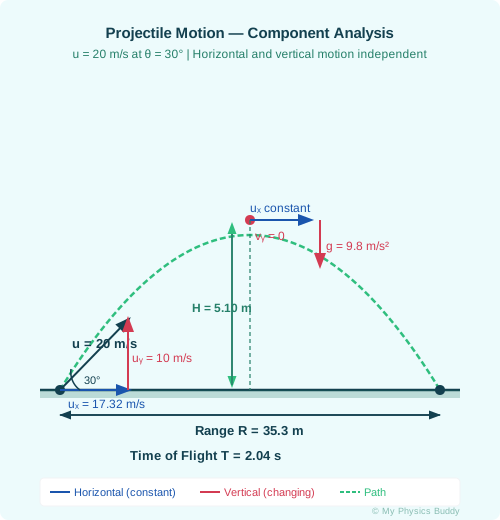
Fully Worked Example
Problem: A ball is launched from ground level at 20 m/s at an angle of 30° above the horizontal. Find (a) the maximum height, (b) the total time of flight, and (c) the horizontal range.
Step 1 — Resolve components:
- ux = 20 cos 30° = 20 × 0.866 = 17.32 m/s
- uy = 20 sin 30° = 20 × 0.5 = 10 m/s
Step 2 — Maximum height (vy = 0 at peak):
vy² = uy² − 2g·H → 0 = 10² − 2(9.8)H → H = 100 / 19.6 = 5.10 m
Step 3 — Time of flight (y = 0 at landing, same level):
0 = uy·T − ½g·T² → 0 = T(10 − 4.9T) → T = 10 / 4.9 = 2.04 s
Step 4 — Horizontal range:
R = ux · T = 17.32 × 2.04 = 35.3 m
Notice how time acted as the link between the vertical and horizontal calculations. That is always the structure of these problems. For a deeper mathematical treatment of the parabolic trajectory and range formula, Khan Academy’s projectile motion resource is a solid reference to read alongside your practice.
An everyday analogy that helps: imagine a running person dropping a ball straight down while moving forward. From their perspective the ball falls straight. From a bystander’s perspective it follows a curve. Both are right — because horizontal and vertical motions coexist independently. That mental image captures the whole physics of the problem. For students preparing through the AP Physics 1 curriculum, this analogy tends to make the independence principle click very quickly.
For a comprehensive reference on the kinematic equations and their derivations, the NIST Physics Reference Data is a reliable authoritative source for constants and definitions used in all calculations.
Common Mistakes Students Make with Projectile Motion
✗ Mistake: Using the full initial speed u in both horizontal and vertical equations without resolving into components first.
✓ Fix: Always resolve first. Write ux = u cos θ and uy = u sin θ as the very first step before touching any equation.✗ Mistake: Forgetting that at maximum height the vertical velocity is zero, not the total velocity — students sometimes set the entire speed to zero and get wrong answers.
✓ Fix: At the peak, only vy = 0. The horizontal velocity ux is still present and unchanged throughout the flight.✗ Mistake: Using g = 9.8 m/s² with an inconsistent sign — adding it in one equation and subtracting in another without a fixed sign convention.
✓ Fix: Set your sign convention at the start (upward positive) and keep g = −9.8 m/s² or write −g explicitly every single time in the vertical equations.
Exam Relevance: Projectile motion is a core topic in AP Physics 1, A/AS Level Physics (Cambridge 9702), IB Physics HL/SL, and IGCSE Physics (0625). It appears in both multiple-choice and extended response sections requiring component resolution, time of flight, and range calculations.
Pro Tip from Raminder G: Always write your two component equations side by side on paper before solving. Seeing them together makes it immediately obvious which direction to work in first.
Related Questions
How to solve impulse and momentum problems on the AP exam?
What is the best AP Physics prep book for self-study?
How to approach experimental design questions on AP Physics?
How do you calculate the moment of inertia for different shapes?
What are common AP Physics mistakes students make on the exam?
What is the difference between AP Physics 1, 2, and C?
How to calculate gravitational field strength at a distance from a planet?
What are the key differences between gravitational and electric fields 9702?