S Mohamed
asked on September 14, 2025
Torque rotational equilibrium AP Physics 1
How to solve torque and rotational equilibrium problems AP Physics 1?
Need Help?
Hire one of our expert Physics tutor online. 24/7 Service. Available now.
Expert Answer
Answered on September 26, 2025 by EXPERT TUTOR
Nothing Found
Dear S Mohamed,
To solve torque and rotational equilibrium problems in AP Physics 1, set the sum of all torques about a chosen pivot point equal to zero. Assign counterclockwise torques as positive and clockwise torques as negative. According to expert tutors at My Physics Buddy, choosing your pivot wisely can eliminate unknown forces and simplify the algebra dramatically.
Understanding Torque and Rotational Equilibrium in AP Physics 1
Torque is the rotational equivalent of force. Just as a net force causes linear acceleration, a net torque causes angular acceleration. When an object is in rotational equilibrium, it is either not rotating or rotating at a constant angular velocity — meaning the net torque acting on it is exactly zero.
Think of a seesaw. If two kids of different weights sit at different distances from the centre, you can still balance the seesaw perfectly by adjusting those distances. That balancing act is rotational equilibrium in real life, and torque is the quantity that captures how effectively each child’s weight tends to rotate the seesaw.
The Torque Formula
The magnitude of a torque is given by:
τ = r × F × sinθ
- τ = torque (measured in Newton-metres, N·m)
- r = the distance from the pivot point to the point where the force is applied (the moment arm distance, in metres)
- F = the magnitude of the applied force (in Newtons)
- θ = the angle between the force vector and the line connecting the pivot to the point of application
The term r sinθ is called the perpendicular moment arm (or lever arm), and it is the perpendicular distance from the pivot to the line of action of the force. A force applied at exactly 90° to the lever gives the maximum torque for that force magnitude.
The Two Conditions for Full Equilibrium
For a rigid body to be in complete static equilibrium, two conditions must hold simultaneously:
- Translational equilibrium: ΣF = 0 (net force is zero in every direction)
- Rotational equilibrium: Στ = 0 (net torque about any pivot is zero)
In AP Physics 1, nearly every static equilibrium problem uses both conditions together. As a PhD physicist who has worked through many student misconceptions, I can tell you that the single biggest conceptual leap students need to make is understanding that the torque equation can be written about any point — and that freedom is a powerful problem-solving tool.
Step-by-Step Problem-Solving Method
- Draw a free-body diagram. Mark every force acting on the object, including weight (acting at the centre of mass) and any support forces.
- Choose a pivot point. Pick a point where an unknown force acts — this eliminates that force from your torque equation because its moment arm is zero.
- Assign sign conventions. Define counterclockwise (CCW) torques as positive and clockwise (CW) torques as negative.
- Write the torque equation: Στ = 0. Substitute τ = r F sinθ for each force.
- Write the force equations: ΣFx = 0 and ΣFy = 0 to find remaining unknowns.
- Solve and check units. Confirm your answer makes physical sense.
Worked Example
A uniform beam of mass m = 10 kg and length L = 4.0 m is attached to a wall by a hinge at its left end. A cable is attached at the right end and makes an angle of θ = 30° above the beam. A sign of mass M = 20 kg hangs from the right end. Find the tension T in the cable.
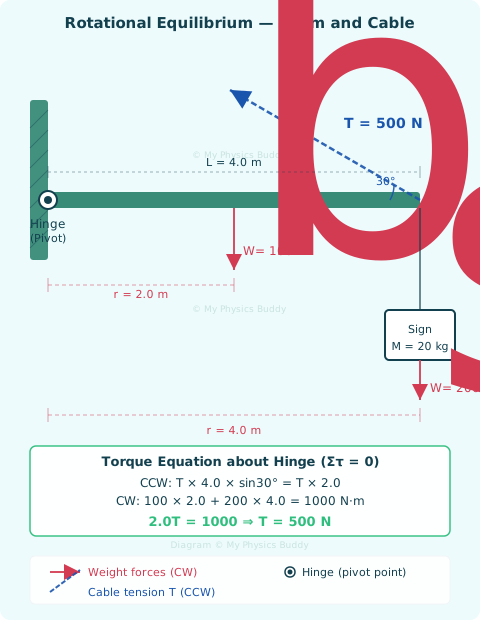
Step 1 — Free-body diagram: Forces acting are the weight of the beam (Wbeam = mg = 10 × 10 = 100 N) acting downward at the centre (2.0 m from hinge), the weight of the sign (Wsign = Mg = 20 × 10 = 200 N) acting downward at the right end (4.0 m from hinge), the tension T in the cable at 30° at the right end, and the hinge reaction force (unknown components).
Step 2 — Choose pivot at the hinge. This eliminates the unknown hinge force from the torque equation entirely.
Step 3 — Torque equation about the hinge (Στ = 0):
CCW torques (positive): T × L × sin30° = T × 4.0 × 0.5 = 2.0T
CW torques (negative): Wbeam × (L/2) + Wsign × L = 100 × 2.0 + 200 × 4.0 = 200 + 800 = 1000 N·m
Setting Στ = 0:
2.0T − 1000 = 0
T = 500 N
Notice how pivoting at the hinge meant the unknown hinge force contributed zero torque — we solved for T in one clean equation. This technique is widely applicable across AP Physics C: Mechanics problems as well, where more complex geometries arise. For deeper study of static equilibrium principles, the OpenStax University Physics — Static Equilibrium resource offers excellent additional examples.
Common Mistakes in Torque and Rotational Equilibrium Problems
✗ Mistake: Using the full distance r from pivot to force instead of the perpendicular moment arm r sinθ when the force is not perpendicular to the lever.
✓ Fix: Always multiply by sinθ, where θ is the angle between the force direction and the line from pivot to force application point.✗ Mistake: Choosing a pivot arbitrarily and then struggling with too many unknowns in one torque equation.
✓ Fix: Choose your pivot exactly where an unknown force acts — that force’s moment arm becomes zero and drops out of the torque equation automatically.✗ Mistake: Forgetting to include the weight of the beam or rod itself, treating the object as massless.
✓ Fix: A uniform beam’s weight acts at its geometric centre. Always add Wbeam = mg at L/2 from either end as a separate downward force in your torque calculation.
Exam Relevance: Torque and rotational equilibrium appear in AP Physics 1 (Unit 7), AP Physics C: Mechanics, and IB Physics HL/SL. The AP Physics 1 exam frequently tests this concept through free-response scenarios involving beams, hinges, and cables.
💡 Pro Tip from Vandna G: Always pivot at the point with the most unknown forces — it collapses those unknowns to zero torque and leaves you one clean equation to solve.
Related Questions
What is the best way to review for AP Physics 1 in two weeks?
How to apply Newton’s second law in rotational form?
How does energy transfer work in simple harmonic motion?
How to solve problems with pulleys and tension in AP Physics 1?
What is mechanical energy and when is it conserved?
How to interpret position vs time and velocity vs time graphs?
How do open and closed pipe resonance problems work?
What are the most difficult topics on AP Physics 1?