Barbara McLaughlin
asked on February 9, 2026
Radioactive decay equation usage
How to use the decay equation for radioactive decay problems?
Need Help?
Hire one of our expert Physics tutor online. 24/7 Service. Available now.
Expert Answer
Answered on March 4, 2026 by EXPERT TUTOR
Nothing Found
Dear Barbara McLaughlin,
The radioactive decay equation N = N₀ e−λt lets you calculate how many undecayed nuclei remain after any time t, given a starting amount and a decay constant. According to expert tutors at My Physics Buddy, mastering this single equation — and knowing how to switch between λ, half-life, and activity — unlocks nearly every radioactive decay problem in A/AS Level Physics (9702).
Understanding and Applying the Radioactive Decay Equation
Radioactive decay is a random but statistically predictable process. You cannot say when one particular nucleus will decay, but you can say exactly how a large population of nuclei shrinks over time. Think of it like popcorn popping in a microwave: each kernel pops at a random moment, yet the overall rate of popping follows a smooth, predictable pattern that slows as fewer unpopped kernels remain.
That pattern is exponential decay, and it gives us three closely related equations you need to know cold:
| Quantity | Equation | What it tells you |
|---|---|---|
| Number of nuclei | N = N₀ e−λt | Undecayed nuclei remaining at time t |
| Activity | A = A₀ e−λt | Decay rate (in Bq) at time t |
| Half-life link | T½ = ln 2 / λ | Converts between λ and T½ |
Variable Meanings
- N₀ — initial number of undecayed nuclei at t = 0
- N — number of undecayed nuclei remaining at time t
- λ (lambda) — the decay constant in s−1; the probability per unit time that one nucleus decays
- t — elapsed time, in seconds (must match the units of λ)
- A₀ — initial activity in becquerels (Bq); note A = λN
- T½ — half-life; the time for half the nuclei to decay
Step-by-Step Method for Any Decay Problem
Step 1 — Identify what you know and what you need. Most exam questions give you two of {N₀, N, λ, T½, t} and ask for a third. Write them down before touching a formula.
Step 2 — Convert half-life to decay constant if needed. The 9702 syllabus often gives T½ rather than λ. Use:
λ = ln 2 / T½ = 0.693 / T½
Step 3 — Check unit consistency. If T½ is in years, λ is in yr−1, so t must also be in years. This is the most common slip I see students make in exams.
Step 4 — Substitute and solve. Rearrange the decay equation algebraically before plugging in numbers. If you need to find t, take the natural logarithm of both sides:
t = −(1/λ) × ln(N/N₀)
Worked Example
A sample of iodine-131 has an initial activity of A₀ = 8.0 × 10⁵ Bq. Its half-life is T½ = 8.0 days. Calculate the activity after t = 24 days.
Step 1 — Find λ:
λ = 0.693 / 8.0 days = 0.0866 day−1
Step 2 — Apply A = A₀ e−λt:
A = 8.0 × 10⁵ × e−(0.0866 × 24)
A = 8.0 × 10⁵ × e−2.079
A = 8.0 × 10⁵ × 0.125
A = 1.0 × 10⁵ Bq
Quick sanity check: 24 days = 3 half-lives, so activity should be (½)³ = 1/8 of original. 8.0 × 10⁵ / 8 = 1.0 × 10⁵ Bq. ✓ Always do this check when the time is a neat multiple of the half-life.
As an IBDP Physics Facilitator with 22+ years of experience, I can tell you that students who sketch the exponential curve and mark where their answer sits on it almost never make arithmetic errors — the graph gives you an instant visual check. You can explore more on exponential decay from the NIST radionuclide half-life database for real isotope data to practise with.
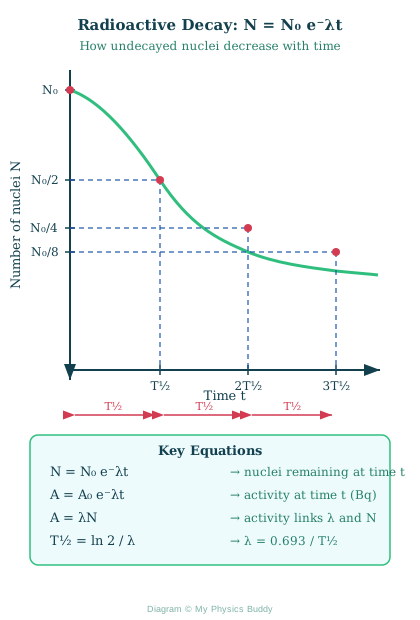
The diagram above shows how N, activity A, and the graphical half-life relationship all connect visually. Notice that each successive half-life removes exactly half of what remains — not half of the original. This is the key insight that makes the equation work. For a deeper dive into related nuclear topics, see our A/AS Level Physics (9702) resource pages and also explore how these ideas connect to broader Nuclear Physics concepts.
The CIE 9702 syllabus also expects you to handle the corrected count rate in practical questions, where you subtract background radiation from the measured count rate before using the decay equation. Always check whether a question mentions background count — if it does, subtract it first. For the official syllabus details, the Cambridge International AS and A Level Physics 9702 syllabus page is the authoritative reference.
Common Mistakes to Avoid
✗ Mistake: Using T½ directly in the exponent instead of λ, writing N = N₀ e−T½ × t.
✓ Fix: Always convert first — calculate λ = ln 2 / T½ and use that value in the exponent.✗ Mistake: Mixing time units, for example using λ in s−1 but entering t in minutes or hours.
✓ Fix: Convert t to the same unit as λ before substituting; write the unit next to every number as you work.✗ Mistake: Calculating N decayed (i.e. N₀ − N) when the question asks for N remaining, or vice versa.
✓ Fix: Re-read the question. “How many nuclei remain?” → use N. “How many have decayed?” → calculate N₀ − N after finding N.
Exam Relevance: The radioactive decay equation appears in Cambridge A/AS Level Physics (9702), Edexcel A Level Physics, and IB Physics HL/SL. All three boards require confident use of N = N₀ e−λt and the half-life relationship λT½ = ln 2.
Pro Tip from Jiya B: When solving for time t, always simplify ln(N/N₀) first as a fraction before reaching for your calculator — it keeps your working clean and examiners love it.
Related Questions
How to answer 9702 Paper 5 planning questions effectively?
How does electromagnetic induction work and what is Faraday’s law?
What is the difference between nuclear fission and fusion in A Level?
How to calculate specific heat capacity from experimental data?
What is simple harmonic motion and how to derive its equations?
How to solve problems involving circular motion and centripetal force?
What are the common mistakes in 9702 Paper 2 structured questions?
How to interpret and draw electric field line diagrams?