J Cheng
asked on November 2, 2024
AP Physics free response strategies
What are the best strategies for solving AP Physics free response questions?
Need Help?
Hire one of our expert Physics tutor online. 24/7 Service. Available now.
Expert Answer
Answered on April 22, 2025 by EXPERT TUTOR

Dear J Cheng,
The best strategies for solving AP Physics free response questions combine disciplined problem structure, clear physics reasoning, and deliberate communication of your thinking. According to expert tutors at My Physics Buddy, partial credit is always available — so showing every step, even when unsure of the final answer, is essential. A systematic approach transforms a daunting multi-part question into a series of manageable physics tasks.
How to Systematically Tackle AP Physics Free Response Questions
As a PhD in Theoretical Nuclear Physics, I’ve watched hundreds of students lose easy marks not because they lacked knowledge, but because they rushed, skipped diagrams, or wrote answers without linking them to physics principles. The AP Physics free response section rewards students who think like physicists — not just students who remember formulas.
Think of a free response question like assembling flat-pack furniture. The instructions are all there in the question. Your job isn’t to invent something new — it’s to follow the logical sequence carefully, show each step, and make sure nothing is left ambiguous for the person checking your work.
Step 1 — Read the Entire Question Before Writing Anything
Before putting pen to paper, read all parts of the question. Later parts often give you information or context that reframes earlier parts. Many students dive into part (a) only to realise in part (d) that the scenario has a constraint they missed. Spending 60–90 seconds reading fully pays enormous dividends.
Step 2 — Draw and Label a Clear Diagram
For any mechanics, circuit, or wave problem, draw a diagram immediately. This is not decoration — it is physics thinking made visible. Label all forces, directions, and known values directly on the diagram. A free-body diagram for a Newton’s Law problem, for instance, forces you to identify all forces before writing a single equation, which prevents the most common error of omitting a force.
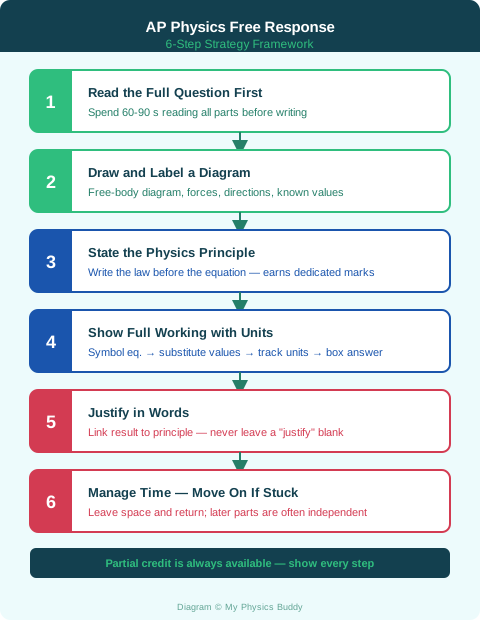
Step 3 — Identify the Relevant Physics Principle First
State the principle before writing the equation. AP Physics scorers award a dedicated mark for identifying the correct law or principle. Write something like: “Applying Newton’s Second Law in the vertical direction:” before writing ΣF = ma. This habit alone is worth multiple marks across a paper.
The core equations you’ll use most often across AP Physics free response sections include:
- Newton’s Second Law: ΣF = ma — net force equals mass times acceleration
- Kinematic equations such as v² = v₀² + 2aΔx — where v₀ is initial velocity, a is acceleration, and Δx is displacement
- Work-Energy Theorem: Wnet = ΔKE = ½mv² − ½mv₀²
- Impulse-Momentum: J = Δp = mΔv — impulse equals change in momentum
- Conservation of Energy: KEi + PEi = KEf + PEf (when no non-conservative work is done)
Step 4 — Work Through a Full Structured Example
Here is a representative AP Physics 1 style problem to demonstrate the method in action:
Problem: A 2.0 kg block slides from rest down a frictionless incline of height h = 1.8 m and then moves along a rough horizontal surface (μk = 0.30) before stopping. Find the distance d the block travels on the rough surface.
Step 1 — Identify the principle: Conservation of Energy on the incline, then Work-Energy Theorem on the horizontal surface.
Step 2 — Energy at the bottom of the incline:
KEbottom = mgh = (2.0 kg)(9.8 m/s²)(1.8 m) = 35.28 J
Step 3 — Friction force on horizontal surface:
fk = μk × mg = (0.30)(2.0)(9.8) = 5.88 N
Step 4 — Apply Work-Energy Theorem to find d:
Wfriction = −fk × d = ΔKE = 0 − 35.28 J
−5.88 × d = −35.28
d = 35.28 / 5.88 = 6.0 m
Notice how every step is visible, every variable is defined, and units are tracked throughout. This structure earns partial credit even if a numerical slip occurs.
Step 5 — Justify Your Answer in Words
AP Physics free response questions frequently include sub-parts that say “justify your answer” or “explain your reasoning.” These require a sentence connecting your result back to a physics principle — not just a number. For example: “The block travels farther because a smaller friction force means less energy is removed per metre, requiring a greater distance to dissipate the same kinetic energy.” Students who skip these justifications consistently leave 2–3 marks per question on the table.
Step 6 — Manage Your Time Strategically
The AP Physics 1 free response section gives you 90 minutes for 5 questions. That is 18 minutes per question on average. If you get stuck on one part, leave space and move to the next — later parts are often independent. A common struggle I observe is students spending 12 minutes perfecting part (a) and then rushing through four marks of easier work in parts (c) and (d). Explore the full question for AP Physics 1 and related courses to see how marks are distributed.
For deeper official guidance on question formats and scoring, the College Board AP Physics 1 assessment page provides released free response questions and full scoring guidelines — working through these with a scorer’s eye is one of the highest-value preparation activities you can do.
Common Mistakes in AP Physics Free Response
✗ Mistake: Writing only the final numerical answer without showing the equation, substitution, or unit tracking.
✓ Fix: Always write the symbolic equation first, then substitute values with units, and circle or box your final answer with its unit clearly stated.✗ Mistake: Skipping the diagram or drawing an incomplete free-body diagram that omits a key force such as normal force or tension.
✓ Fix: Draw the diagram as the very first action, label every force with both its name and direction, and count forces against the scenario before writing any equation.✗ Mistake: Answering “justify” or “explain” sub-parts with a formula alone instead of a physics argument in words.
✓ Fix: Write one or two sentences that explicitly name the physical law, state what it predicts, and connect it to the specific scenario in the question.
Exam Relevance: AP Physics free response strategies are directly tested in AP Physics 1, AP Physics 2, AP Physics C: Mechanics, and AP Physics C: Electricity and Magnetism, all administered by the College Board in the United States.
Pro Tip from Ashutosh S: Before checking your final answer, re-read the exact question wording — many marks are lost by answering what you expected rather than what was actually asked.
Related Questions
What is the difference between AP Physics 1 and AP Physics 2?
How to solve Gauss’s law problems in AP Physics 2?
What is the right-hand rule and how to apply it for magnetic fields?
How to calculate electric potential and potential energy?
How does a capacitor work and how to solve RC circuit problems?
What is Bernoulli’s equation and how to apply it to fluid flow?
What is the relationship between period and frequency for oscillations?
How to calculate the speed of a wave on a string?