Max D
asked on March 30, 2025
Common mistakes 9702 Paper 2
What are the common mistakes in 9702 Paper 2 structured questions?
Need Help?
Hire one of our expert Physics tutor online. 24/7 Service. Available now.
Expert Answer
Answered on April 18, 2025 by EXPERT TUTOR
Nothing Found
Dear Max D,
The most damaging common mistakes in 9702 Paper 2 structured questions involve imprecise definitions, missing units, and poor graph technique — errors that cost marks even when the underlying physics understanding is sound. According to expert tutors at My Physics Buddy, these patterns appear consistently across cohorts and are entirely avoidable with targeted practice.
Breaking Down the Most Costly Mistakes in 9702 Paper 2 Structured Questions
As someone with a Dual MS in Physics and Astronomy and several years teaching A/AS Level Physics (9702), I can tell you that the frustrating thing about Paper 2 is that students often understand the physics but still drop marks. The paper tests not just your knowledge but your precision — and Cambridge examiners are uncompromising about that. Let me walk you through the key areas where marks slip away, topic by topic.
1. Definitions: Every Word Is a Mark
Paper 2 almost always opens with a definition question. These are free marks if you are disciplined, but students routinely paraphrase loosely and lose them. Think of a definition like a legal contract — every word is deliberate.
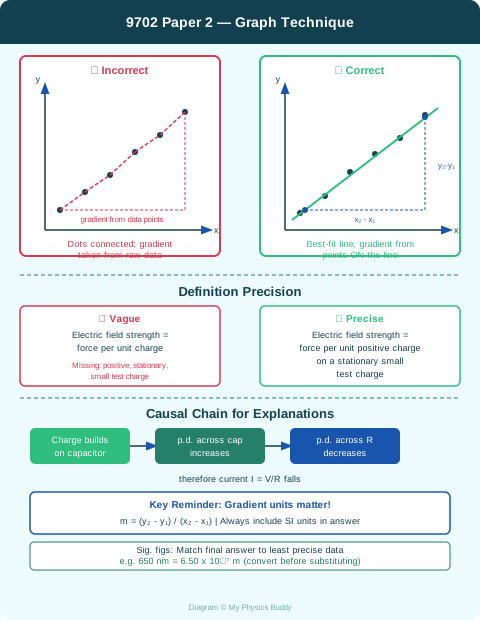
For example, the Young modulus is defined as the ratio of stress to strain within the limit of proportionality. If you write “stress over strain” without qualifying that range, you may lose a mark. Similarly, electric field strength is the force per unit positive charge acting on a stationary small test charge — omitting “positive”, “stationary”, or “small test charge” can each cost you.
A useful analogy: think of a recipe. If the recipe says “add two teaspoons of salt”, adding “some salt” will not produce the correct dish. The examiner’s mark scheme is that specific.
2. Graphs: Plotting, Drawing, and Reading
Graph questions in Paper 2 are a consistent source of avoidable errors. There are three distinct sub-skills being tested simultaneously:
- Plotting: Each point must be plotted to within half a small grid square. A misplot by one full square can cost a mark.
- Drawing the best-fit line: The line must be a single thin, continuous straight line (or smooth curve) with roughly equal numbers of points on each side. Never connect the dots. Never draw a line that passes through every point if it does not represent the best average trend.
- Gradient calculation: Use a triangle that spans at least half the drawn line. Read coordinates from the line itself, not from original data points, and always include units in your gradient answer.
The gradient formula for a straight-line graph is:
m = (y₂ − y₁) / (x₂ − x₁)
where (x₁, y₁) and (x₂, y₂) are two widely-spaced points on your best-fit line. If your y-axis is in N and your x-axis is in m, your gradient has units of N m⁻¹. Many students forget to state those units and lose the mark.
3. Show-That Questions and Significant Figures
When a question says “show that” a value is approximately equal to something (e.g., show that the time constant is approximately 0.15 s), you must present working that arrives at the given value independently. Do not just substitute the answer back in. Write out every step, quote the answer to at least 3 significant figures, and state the conclusion clearly.
Significant figures are a separate trap. A final answer given to 1 significant figure when the data supports 3 will lose the mark. A good rule: match your significant figures to the least precise piece of data given in the question, typically 2 or 3 s.f. for Paper 2 data.
4. Describing Experiments and Identifying Variables
Experiment-description questions demand a specific structure. For any investigation you must state:
- The independent variable (what you change deliberately)
- The dependent variable (what you measure as a result)
- All control variables (what you keep constant)
- How you would measure each variable, including the instrument
I have seen many students in Physics classes write excellent descriptions of the method but completely forget to mention control variables — that is typically a dedicated mark on the scheme. Think of it like a fair-test checklist.
5. Unit Conversions and Powers of Ten
Paper 2 data is frequently given in non-SI units — nanometres, milliamps, kilowatts. A single unit conversion error can cascade through an entire calculation. Always convert to SI base units (metres, amps, watts) before substituting. Write the conversion step explicitly so the examiner can award method marks even if arithmetic goes wrong downstream.
For example, if a wavelength is given as 650 nm:
λ = 650 nm = 650 × 10⁻⁹ m = 6.50 × 10⁻⁷ m
Writing that line takes five seconds and can save two marks. You can find the full Cambridge syllabus and assessment objectives on the Cambridge International 9702 specification page — it is worth reading the assessment objectives section carefully to understand exactly what precision of language is expected.
6. Written Explanations: Cause and Effect Language
Many Paper 2 questions ask you to “explain” a physical effect, and a very common mistake is listing facts without linking them causally. The examiner wants to see a chain of reasoning: A happens, therefore B, which causes C.
For example, if asked to explain why the current decreases as a capacitor charges: “The p.d. across the capacitor increases as charge builds up. This increases the back-e.m.f. opposing the source. Therefore the net p.d. across the resistor decreases, and so the current decreases.” Each step flows from the one before. Compare that to simply writing “charge builds up so current falls” — that earns one mark at best.
For mark-scheme language guidance and past papers, the PapaCambridge 9702 past paper archive is an excellent free resource to study real examiner responses.
Common Mistakes — 9702 Paper 2 Structured Questions
✗ Mistake: Writing definitions loosely or paraphrasing, missing key qualifying words like “per unit positive charge” or “within the limit of proportionality.”
✓ Fix: Memorise definitions word-for-word from the Cambridge 9702 syllabus and practise writing them out until the exact phrasing is automatic.✗ Mistake: Calculating the gradient using original data points rather than two widely-spaced points read from the best-fit line itself.
✓ Fix: Always draw a clearly marked right-angle triangle on the line, read off coordinates from the line only, and always write the gradient with correct derived units.✗ Mistake: Giving explanations as isolated facts rather than a linked causal chain, so the reasoning is implicit rather than explicit.
✓ Fix: Use connective words like “therefore”, “because”, “this means that”, and “as a result” to make every causal step visible and examinable.
Exam Relevance: These structured question skills are directly assessed in Cambridge International A/AS Level Physics 9702 Paper 2 (AS Level Structured Questions) and are also relevant to GCSE Physics and Edexcel A Level Physics examinations.
Pro Tip from Koustubh B: After each past-paper attempt, compare your definitions and gradient calculations against the mark scheme line-by-line — small wording gaps compound quickly into significant mark losses.
Related Questions
How to solve center of mass problems in AP Physics 1?
How to earn full credit on AP Physics 1 lab-based questions?
How does the AP Physics exam curve work?
What calculator is allowed on the AP Physics exam?
How to solve conservation of energy problems on AP Physics?
What formulas are given on the AP Physics equation sheet?
How to set up and solve Atwood machine problems?
How to analyze motion graphs for AP Physics?