H Roberts
asked on October 21, 2025
AP Physics FRQ scoring guidelines
What are the FRQ scoring guidelines for AP Physics?
Need Help?
Hire one of our expert Physics tutor online. 24/7 Service. Available now.
Expert Answer
Answered on January 15, 2026 by EXPERT TUTOR
Nothing Found
Dear H Roberts,
The FRQ scoring guidelines for AP Physics award points for specific, demonstrated elements of reasoning — not just a correct final answer. According to expert tutors at My Physics Buddy, each point is earned independently, so a wrong answer in one part rarely blocks you from scoring in the next. Knowing exactly what scorers look for is a genuine game-changer.
How AP Physics FRQ Scoring Guidelines Actually Work
The College Board designs AP Physics free-response questions using a point-based rubric where every scoreable element — a correct equation, a clearly labelled diagram, a unit, a logical conclusion — carries its own independent point. Think of it like a checklist your examiner runs through, ticking boxes as they read. You don’t have to be perfect across an entire multi-part question to earn most of the marks.
The Four Core Question Types and Their Point Structures
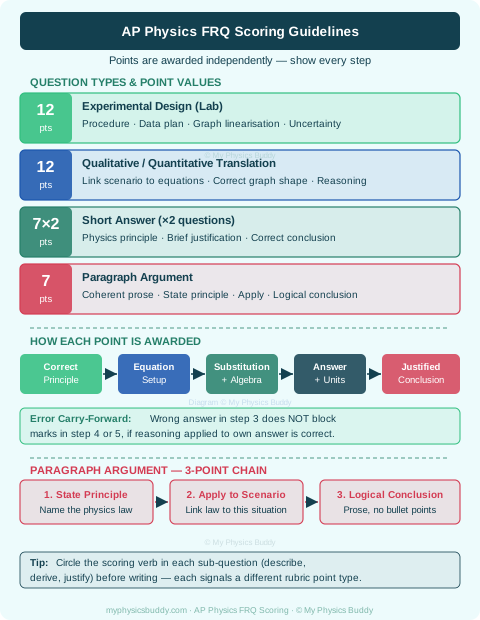
The AP Physics 1 and AP Physics 2 exams each include five FRQs worth a combined 50% of your total score. The question types and typical point allocations are:
| Question Type | Points Available | Key Scoring Focus |
|---|---|---|
| Experimental Design (Lab) | 12 pts | Procedure, data collection plan, graph linearisation, uncertainty |
| Qualitative/Quantitative Translation | 12 pts | Linking a physical scenario to equations and graphs |
| Short Answer (×2) | 7 pts each | Focused reasoning, correct physics principle, brief justification |
| Paragraph Argument | 7 pts | Coherent, connected reasoning in paragraph form |
What Scorers Are Literally Looking For
As someone with a CSIR NET All India Rank 71, I’ve worked through hundreds of past AP rubrics with students, and the pattern is always the same: scorers reward evidence of reasoning, not just answers. Each point on the rubric typically falls into one of these categories:
- Selecting the correct physics principle — naming or writing Newton’s Second Law, conservation of momentum, etc.
- Setting up the equation correctly — for example, writing ΣF = ma with the correct forces substituted in
- Correct substitution and algebra — showing your working with correct numbers and symbols
- Correct final answer with units — e.g., writing a = 3.2 m s‑², not just 3.2
- Correct graph or diagram — properly labelled axes, correct shape, correct intercept or slope
- Justified conclusion — a brief sentence connecting your result to the physics concept
A Worked Scoring Example
Suppose a question asks: “A 5 kg block is pushed along a frictionless surface by a net force of 20 N. Find the acceleration and describe how it changes if the mass doubles.” Here is how scoring would work step by step:
- Point 1 — Correct equation: Write a = Fnet / m, where Fnet is net force in newtons and m is mass in kilograms.
- Point 2 — Correct substitution: a = 20 N / 5 kg
- Point 3 — Correct answer with units: a = 4 m s‑²
- Point 4 — Correct reasoning for the second part: “If mass doubles to 10 kg, acceleration halves to 2 m s‑², because acceleration is inversely proportional to mass at constant net force.”
Notice that even if you made an arithmetic error in Point 3, you could still earn Point 4 by applying correct reasoning to your own (wrong) answer — this is called error carry-forward and it is explicitly built into AP rubrics.
The Paragraph Argument Question — A Special Case
The paragraph-argument FRQ is the one students most often lose marks on. Think of it like a legal argument: you must state your claim, cite your evidence (the relevant physics principle), and show how the evidence leads to your conclusion — all in connected prose. Bullet points or disconnected equations are not awarded full credit here. The rubric typically awards points for: stating the correct principle, applying it correctly to the specific scenario, and reaching a logically consistent conclusion.
The official scoring guidelines are published by College Board after each exam and are worth reading carefully. You can find released FRQs and their complete rubrics at the College Board AP Physics past exam questions page. Studying even two or three past rubrics will show you exactly how scorers think.
One pattern I see repeatedly in my students is that they write the correct answer but skip showing the equation or principle — and lose a point because the rubric requires the equation to be stated explicitly. Always show every step, even when it feels obvious. For deeper practice on the mechanics problems that appear in FRQs, working with a specialist in AP Physics 1 can help you build the habit of structured, point-by-point responses.
Common Mistakes on AP Physics FRQs
✗ Mistake: Writing only the final numerical answer without showing the equation or substitution.
✓ Fix: Always write the symbolic equation first, then substitute values — rubrics award separate points for the equation and the answer.✗ Mistake: Skipping units or writing inconsistent units in the final answer.
✓ Fix: Track units through every step of your working and confirm the final unit matches the physical quantity asked for (e.g., m s‑² for acceleration).✗ Mistake: Using bullet points or isolated equations for the paragraph-argument question instead of connected prose.
✓ Fix: Write in full sentences that explicitly link the physics principle to the specific scenario described, forming a logical chain from evidence to conclusion.
Exam Relevance: AP Physics FRQ scoring guidelines are directly relevant to AP Physics 1, AP Physics 2, AP Physics C: Mechanics, and AP Physics C: Electricity and Magnetism — all administered by College Board with published rubrics.
💡 Pro Tip from Neha A: Before writing your answer, circle the exact scoring verbs in the question — “describe,” “derive,” “justify” — each signals a different type of point the rubric is hunting for.
Related Questions
How to solve impulse and momentum problems on the AP exam?
What is the best AP Physics prep book for self-study?
How to approach experimental design questions on AP Physics?
How do you calculate the moment of inertia for different shapes?
What are common AP Physics mistakes students make on the exam?
What is the difference between AP Physics 1, 2, and C?
How to calculate gravitational field strength at a distance from a planet?
What are the key differences between gravitational and electric fields 9702?