H Castillo
asked on December 23, 2025
Most tested AP Physics topics
What are the most commonly tested topics on AP Physics?
Need Help?
Hire one of our expert Physics tutor online. 24/7 Service. Available now.
Expert Answer
Answered on January 29, 2026 by EXPERT TUTOR
Nothing Found
Dear H Castillo,
The most commonly tested topics on AP Physics span mechanics, energy, waves, and electricity, forming the backbone of every exam. According to expert tutors at My Physics Buddy, mastering these core areas gives you the strongest possible foundation. Knowing exactly where the marks cluster lets you study smarter, not just harder.
Breaking Down the Most Commonly Tested AP Physics Topics
As a BSc Physical Science graduate from Hansraj College, University of Delhi, and someone who has worked through 900+ physics problems on platforms like Chegg and CourseHero, I can tell you that the single biggest pattern I see in struggling students is that they spread their revision too thin. They treat every chapter equally, when in reality the AP Physics exams are heavily weighted toward a predictable set of concepts. Let me walk you through what those are, why they show up so often, and how to actually approach them.
The College Board designs AP Physics 1, AP Physics 2, and AP Physics C around a set of Big Ideas — broad physical principles that connect everything from a rolling ball to a charged capacitor. High-frequency topics almost always connect to one of these Big Ideas, which is why they repeat year after year.
AP Physics 1 — Highest-Frequency Topics
Kinematics and Newton’s Laws are the absolute core. Every single AP Physics 1 exam tests your ability to read and interpret motion graphs, apply the kinematic equations, and use Newton’s second law in both linear and rotational contexts. Think of kinematics as the grammar of mechanics — you cannot write a single mechanics sentence without it.
The kinematic equations you need cold are:
- v = v₀ + at — final velocity after time t, where v₀ is initial velocity and a is acceleration
- x = v₀t + ½at² — displacement when acceleration is constant
- v² = v₀² + 2ax — velocity–displacement relation, useful when time is unknown
Energy and Work-Energy Theorem appear in almost every free-response section. The work-energy theorem states:
Wnet = ΔKE = ½mv² − ½mv₀²
where Wnet is the net work done on an object, m is mass, v is final speed, and v₀ is initial speed. A useful everyday analogy: think of kinetic energy like a bank account — work done on an object deposits energy, and friction withdraws it.
Rotational motion and torque are heavily tested in AP Physics 1 because many students avoid them. Torque τ = rF sinθ, where r is the lever arm length, F is the applied force, and θ is the angle between force and lever arm. Rotational analogues of Newton’s laws (τ_net = Iα, where I is moment of inertia and α is angular acceleration) appear in both multiple-choice and free-response questions every year.
Simple harmonic motion (SHM), including springs and pendulums, is tested regularly. The period of a mass–spring system is T = 2π√(m/k), where m is mass and k is spring constant. For a simple pendulum, T = 2π√(L/g), where L is pendulum length and g is gravitational acceleration. Notice that the mass of the pendulum bob does not appear — a misconception that trips up many students.
Waves and sound round out AP Physics 1. You need to understand superposition, standing waves, resonance in strings and open/closed pipes, and the wave equation v = fλ, where v is wave speed, f is frequency, and λ is wavelength.
AP Physics 2 — Highest-Frequency Topics
In AP Physics 2, electrostatics and circuits dominate. Coulomb’s Law, electric fields, electric potential, and capacitors appear in multiple questions every year. For DC circuits, Ohm’s Law V = IR and Kirchhoff’s rules are non-negotiable. Thermodynamics (first and second laws, PV diagrams) and geometric optics (mirrors, lenses, Snell’s Law) are the next highest-priority areas.
AP Physics C — Highest-Frequency Topics
AP Physics C: Mechanics is calculus-based and concentrates heavily on dynamics, energy methods, and rotational mechanics. AP Physics C: Electricity and Magnetism is dominated by Gauss’s Law, Faraday’s Law, and RC/RL circuit analysis. The College Board’s AP Physics C course description provides the official topic weighting, and cross-referencing it with past free-response questions is one of the most efficient study strategies available.
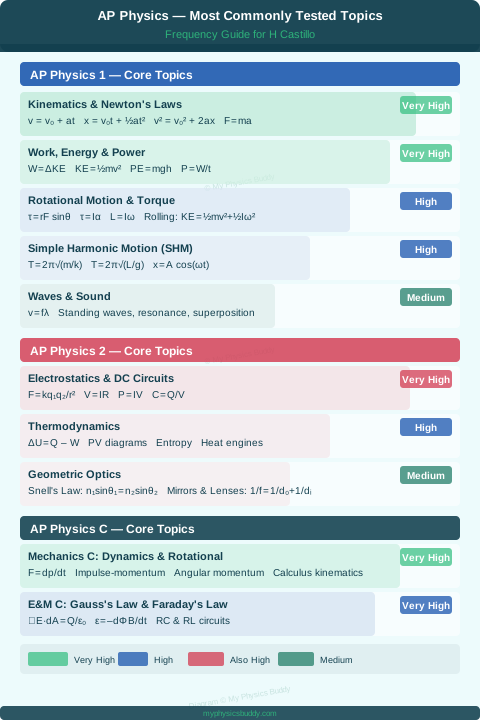
A practical strategy: go to the College Board’s AP Physics past exam questions page and tally how many free-response questions each topic has appeared in over the last five years. You will find that kinematics + Newton’s laws, energy, and circuits together account for roughly half of all scorable points across the AP Physics suite. Concentrating your deepest practice on those areas first, then filling in the remaining topics, is the most efficient path to a 5.
Common Mistakes Students Make When Preparing for AP Physics
✗ Mistake: Memorising formulas without understanding what each variable represents or when the formula applies.
✓ Fix: For every equation, write a one-sentence plain-English description of what it means physically and list the conditions under which it is valid (e.g., constant acceleration only for kinematic equations).✗ Mistake: Skipping rotational mechanics and SHM because they feel harder, then losing easy points on exam day.
✓ Fix: Spend at least two focused sessions on torque, moment of inertia, and the period formulas for springs and pendulums — these topics are predictably tested and highly learnable with targeted practice.✗ Mistake: Treating multiple-choice and free-response as the same type of question and not practising the specific skill of written justification.
✓ Fix: On free-response questions, always write a brief physics reasoning sentence before you start calculating. AP Physics graders award points for correct reasoning even when the final numerical answer contains an arithmetic error.
Exam Relevance: These high-frequency topics appear directly on AP Physics 1, AP Physics 2, AP Physics C: Mechanics, and AP Physics C: Electricity and Magnetism, all administered by the College Board to high school students seeking college credit.
💡 Pro Tip from Mohit H: Map every past free-response question to a topic, tally the frequency, and rank your revision list by that count — your study time will mirror the actual exam weight perfectly.
Related Questions
How to calculate Young modulus from a stress-strain graph?
What is the difference between progressive and stationary waves 9702?
How does a potential divider circuit work in CIE physics?
How to determine internal resistance of a cell using a graph?
What is the photoelectric effect and how to solve threshold frequency problems?
How to calculate gravitational field strength at a distance from a planet?
What are the key differences between gravitational and electric fields 9702?
How to use the decay equation for radioactive decay problems?