E Palmer
asked on March 31, 2023
Most difficult AP Physics 1 topics
What are the most difficult topics on AP Physics 1?
Need Help?
Hire one of our expert Physics tutor online. 24/7 Service. Available now.
Expert Answer
Answered on April 6, 2023 by EXPERT TUTOR
Nothing Found
Dear E Palmer,
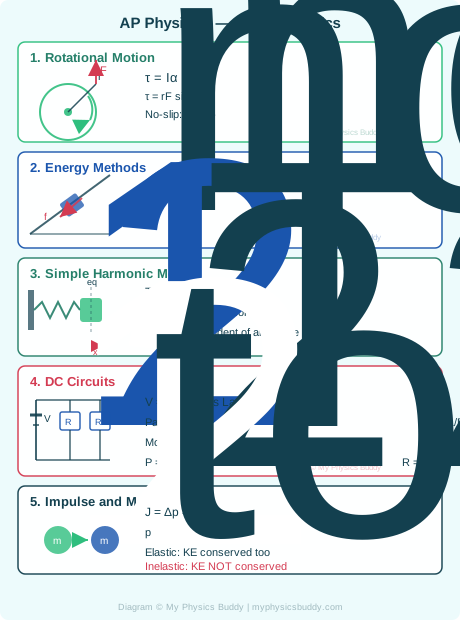
The most difficult topics on AP Physics 1 are rotational motion, energy methods, simple harmonic motion, and DC circuits. According to expert tutors at My Physics Buddy, these areas trip up even strong students because they demand both conceptual depth and multi-step reasoning under exam pressure.
Breaking Down the Hardest AP Physics 1 Topics
As a 20-year math teacher with a 100% AP Physics 1 pass rate, I can tell you that the difficulty in AP Physics 1 almost never comes from a single hard formula — it comes from being asked to connect several ideas at once in an unfamiliar scenario. Let me walk you through each high-difficulty area so you know exactly what to prepare for.
1. Rotational Motion and Torque
Rotational dynamics is consistently the topic students find hardest. The concepts mirror Newton’s laws, but in an unfamiliar rotational language. The core equation is:
τ = Iα
where τ (tau) is the net torque in N·m, I is the moment of inertia in kg·m², and α (alpha) is the angular acceleration in rad/s². Think of it as the rotational version of F = ma. Torque is like a rotational push — it depends not just on the force applied but where it is applied and at what angle: τ = rF sinθ, where r is the distance from the pivot and θ is the angle between the force vector and the lever arm.
A good everyday analogy: opening a door. You push near the handle (large r) and get it moving easily. Push near the hinge (small r) and it barely budges — same force, much less torque. The AP exam loves situations involving rolling objects, where you must apply both translational and rotational equations simultaneously. For a solid sphere rolling without slipping, I = (2/5)mr², and the no-slip condition links linear and angular quantities: v = rω.
2. Energy Methods: Work, Power, and Conservation
The work-energy theorem and conservation of energy are powerful tools, but students often misapply them by forgetting non-conservative forces. The full energy equation is:
KE₁ + PE₁ + Wnc = KE₂ + PE₂
where Wnc is the work done by non-conservative forces such as friction. When a problem involves friction on a ramp, you cannot simply set initial energy equal to final energy — friction steals energy as thermal energy, and that must be accounted for. I see students drop this term almost every time when they are rushing.
3. Simple Harmonic Motion (SHM)
Simple harmonic motion challenges students because it is heavily graphical and conceptual. The restoring force for a spring is F = −kx, where k is the spring constant in N/m and x is displacement from equilibrium. The period of a mass-spring system is:
T = 2π√(m/k)
Notice that period does not depend on amplitude — this surprises many students. For a pendulum, T = 2π√(L/g), independent of mass. On the AP exam, you are often asked to read velocity, acceleration, and energy from position-time graphs and to recognise that maximum speed occurs at equilibrium and maximum acceleration occurs at maximum displacement. Explore this further with the PhET Masses and Springs simulation to build strong visual intuition.
4. DC Circuits
DC circuits with combinations of series and resistors are where careful bookkeeping separates strong students from average ones. Key relationships are:
- Series resistors: Rtotal = R₁ + R₂ + …
- Parallel resistors: 1/Rtotal = 1/R₁ + 1/R₂ + …
- Ohm’s Law: V = IR
- Power: P = IV = I²R = V²/R
The trap is that adding a resistor in parallel decreases total resistance and increases total current drawn from the battery — students frequently get this backwards. You must also track voltage drops carefully across each branch. The AP Physics exam regularly presents multi-loop circuits and asks for the effect of changing one component on all others.
5. Impulse, Momentum, and Collisions
While slightly more approachable than the topics above, impulse-momentum questions on the AP exam often combine momentum conservation with energy analysis. Elastic collisions conserve both momentum and kinetic energy; inelastic collisions conserve only momentum. Students who try to conserve kinetic energy in an inelastic collision will get the wrong answer every time.
Common Mistakes on the Hardest AP Physics 1 Topics
✗ Mistake: Applying conservation of energy on a surface with friction without including the work done by friction (Wnc).
✓ Fix: Always check whether friction or another non-conservative force is present before writing your energy equation. If it is, add Wnc = −fkd to your equation.✗ Mistake: Assuming that adding a resistor in parallel always increases total resistance.
✓ Fix: Parallel paths give charge more routes to travel, so total resistance always decreases. Use 1/Rtotal = 1/R₁ + 1/R₂ and verify that Rtotal is smaller than the smallest individual resistor.✗ Mistake: Treating the period of a mass-spring system as dependent on amplitude, and recalculating T when amplitude changes.
✓ Fix: Period depends only on mass and spring constant: T = 2π√(m/k). If only amplitude changes, period stays exactly the same.
Exam Relevance: These topics are tested directly on the AP Physics 1 exam by College Board, with rotational motion, energy, and circuits each carrying significant weighting across multiple-choice and free-response sections. The same core ideas also appear in AP Physics C: Mechanics at a higher mathematical level.
💡 Pro Tip from Katherine H: Master one hard topic at a time by solving three varied exam-style questions on it before moving on — depth beats breadth every time.
Related Questions
How to solve center of mass problems in AP Physics 1?
How to earn full credit on AP Physics 1 lab-based questions?
How does the AP Physics exam curve work?
What calculator is allowed on the AP Physics exam?
How to solve conservation of energy problems on AP Physics?
What formulas are given on the AP Physics equation sheet?
How to set up and solve Atwood machine problems?
How to analyze motion graphs for AP Physics?