B McLaughlin
asked on May 27, 2025
AP Physics allowed calculator
What calculator is allowed on the AP Physics exam?
Need Help?
Hire one of our expert Physics tutor online. 24/7 Service. Available now.
Expert Answer
Answered on June 9, 2025 by EXPERT TUTOR
Nothing Found
Dear B McLaughlin,
The calculator allowed on the AP Physics exam is any four-function, scientific, or graphing calculator that does not have a QWERTY keyboard or CAS (Computer Algebra System) capability. According to expert tutors at My Physics Buddy, the TI-84 Plus series is the most popular and reliable choice among students.
Which Calculators Are Approved for the AP Physics Exam — And How to Use Yours Effectively
The College Board publishes a clear calculator policy for all AP Physics exams — including AP Physics 1, AP Physics 2, AP Physics C: Mechanics, and AP Physics C: Electricity and Magnetism. Understanding exactly what is and is not allowed saves you from a stressful surprise on exam day.
What the College Board Actually Allows
You may bring any four-function, scientific, or graphing calculator to the AP Physics exam, provided it meets all of the following conditions:
- It does not have a QWERTY (typewriter-style) keyboard.
- It does not have a built-in Computer Algebra System (CAS) — meaning it cannot manipulate symbolic algebra (e.g., solve equations for a variable symbolically).
- It cannot connect to the internet or communicate wirelessly.
- It cannot print or project output.
- It does not require a wall outlet to operate.
Think of it like packing for a camping trip: you can bring a multi-tool (graphing calculator), a basic pocket knife (scientific calculator), or even just a small blade (four-function calculator) — but you cannot bring power tools that do the heavy lifting for you (CAS devices). The exam is testing your physics reasoning, not your calculator’s algebra engine.
Most Commonly Used Approved Calculators
| Calculator Model | Type | Approved? | Notes |
|---|---|---|---|
| TI-84 Plus / TI-84 Plus CE | Graphing | ✓ Yes | Most popular choice; no CAS |
| TI-Nspire (non-CAS) | Graphing | ✓ Yes | Must be non-CAS version only |
| TI-Nspire CAS | Graphing + CAS | ✗ No | CAS capability — not permitted |
| Casio fx-9750GIII | Graphing | ✓ Yes | Strong budget-friendly option |
| TI-36X Pro | Scientific | ✓ Yes | Great non-graphing option |
| HP Prime | Graphing + CAS | ✗ No | Has CAS — not permitted |
Key Calculator Functions You Actually Need for AP Physics
As a BSc Physical Science graduate from Hansraj College, University of Delhi, I can tell you from tutoring experience that most students massively over-rely on their calculator in AP Physics. The real bottleneck is almost never arithmetic — it is setting up the physics correctly. That said, here are the functions genuinely useful on the exam:
- Powers and roots: You will frequently compute quantities like v = √(2gh), where v is final velocity, g = 9.8 m/s² is gravitational acceleration, and h is height in metres. Your calculator’s square root and power keys handle these instantly.
- Scientific notation: Physics quantities span enormous scales. For example, Coulomb’s constant k = 8.99 × 10⁹ N·m²/C². Being fluent with your calculator’s EE or EXP key is essential.
- Trigonometric functions: sin, cos, and tan appear in force resolution, wave problems, and electromagnetic field calculations. Always double-check whether your calculator is set to degrees or radians — this is one of the most common errors I see.
- Natural logarithm and exponential: These appear in AP Physics C problems involving RC circuits and nuclear decay: Q(t) = Q₀e⁻⁽ₜ/ⁿ⁾⁼, where Q₀ is initial charge, t is time, R is resistance, and C is capacitance.
You can verify the full current list of approved calculators directly on the College Board AP Calculator Policy page.
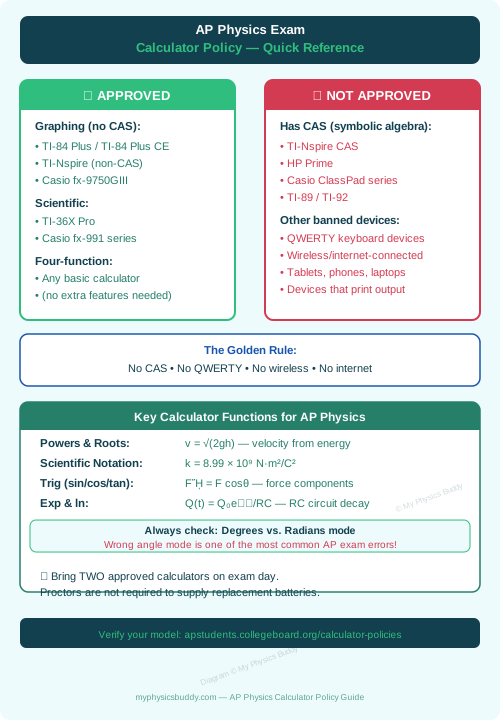
A practical habit I always recommend: bring two approved calculators on exam day — your primary graphing calculator and a backup scientific calculator. Batteries do run out, and proctors are not required to provide replacements mid-exam.
Common Mistakes
✗ Mistake: Bringing a TI-Nspire CAS or HP Prime assuming “graphing calculator” automatically means approved.
✓ Fix: Check the College Board’s approved list specifically. The rule is no CAS — verify your exact model number before exam day.✗ Mistake: Forgetting to switch the calculator from radians to degrees (or vice versa) before solving a trigonometry problem.
✓ Fix: Make it a habit to check your angle mode setting at the start of every free-response question that involves sin, cos, or tan.✗ Mistake: Relying on the calculator to confirm the physics setup instead of checking units and dimensional analysis by hand first.
✓ Fix: Write out the equation with units before punching numbers in. If the units do not cancel to the correct target unit, your setup is wrong — no calculator can fix that.
Exam Relevance: Calculator policy directly affects your performance on AP Physics 1, AP Physics 2, AP Physics C: Mechanics, and AP Physics C: Electricity and Magnetism. All four exams permit approved non-CAS calculators on both multiple-choice and free-response sections.
💡 Pro Tip from Mohit H: Label your calculator with your name on exam day. In large testing rooms, identical TI-84s get mixed up more often than you would expect.
Related Questions
How to calculate the speed of a wave on a string?
What are standing waves and how do harmonics work?
How to explain physics concepts qualitatively for AP Physics 1 FRQs?
What is the best way to review for AP Physics 1 in two weeks?
How to apply Newton’s second law in rotational form?
How does energy transfer work in simple harmonic motion?
How to solve problems with pulleys and tension in AP Physics 1?
What is mechanical energy and when is it conserved?