R Al Fahad
asked on April 4, 2025
Best AP Physics prep book self-study
What is the best AP Physics prep book for self-study?
Need Help?
Hire one of our expert Physics tutor online. 24/7 Service. Available now.
Expert Answer
Answered on May 24, 2025 by EXPERT TUTOR
Nothing Found
Dear R Al Fahad,
The best AP Physics prep book for self-study depends on which exam you are taking, but according to expert tutors at My Physics Buddy, Barron’s AP Physics and the Princeton Review series consistently top the list. Pair your book with the official College Board materials for the most complete preparation.
How to Choose the Right AP Physics Prep Book — and Use It Effectively
There are four separate AP Physics exams — AP Physics 1, AP Physics 2, AP Physics C: Mechanics, and AP Physics C: E&M — and the best prep book genuinely differs for each. The single most common mistake I see students make is buying a general “AP Physics” book without checking which exam it actually covers. Let me walk you through each option and how to get the most from your self-study.
Top Prep Books by AP Physics Course
| Course | Top Pick | Runner-Up |
|---|---|---|
| AP Physics 1 | Princeton Review AP Physics 1 | Barron’s AP Physics 1 |
| AP Physics 2 | Princeton Review AP Physics 2 | Barron’s AP Physics 2 |
| AP Physics C: Mechanics | Barron’s AP Physics C | Halliday/Resnick (reference) |
| AP Physics C: E&M | Barron’s AP Physics C | Griffiths (for deeper insight) |
What Makes a Good Prep Book?
Think of a prep book like a GPS for a road trip. A bad GPS just lists turn instructions without telling you why — you memorise the route but have no idea what to do if a road is closed. A good prep book does the opposite: it builds your conceptual map first, then layers exam strategy on top. The Princeton Review series excels at clear conceptual explanations with manageable problem sets, making it ideal if you are self-studying from scratch. Barron’s goes deeper into physics reasoning, which is a real strength for Physics C where calculus-based derivations appear directly on the exam.
As an MSc Physics graduate with CSIR NET Rank 71 (All India), I can tell you that the content gap between Physics 1 and Physics C is enormous. Physics 1 focuses on algebra-based reasoning, qualitative argumentation, and multi-step conceptual questions. Physics C requires you to be comfortable with derivatives and integrals applied directly to physical scenarios — for example, deriving velocity from a position function or calculating electric flux through a Gaussian surface.
Key Topic Areas and What to Focus On
For AP Physics 1, the highest-yield topics are kinematics, Newton’s laws, rotational motion, energy, and simple harmonic motion. A key formula to build intuition around is Newton’s second law in rotational form:
τ = Iα | τ = net torque (N·m), I = moment of inertia (kg·m²), α = angular acceleration (rad/s²)
For AP Physics C: Mechanics, you will additionally need to integrate acceleration to find velocity and use calculus-based work-energy methods. For instance, if a variable force F(x) = 3x² acts over a displacement from x = 0 to x = 2 m, the work done is:
W = ∫ F(x) dx = ∫₀² 3x² dx = [x³]₀² = 8 J
This kind of calculus integration is routine in Physics C but never appears in Physics 1 or 2. Your prep book must reflect that difference.
How to Use Any Prep Book Effectively
- Start with a diagnostic test from the book to identify your weakest units before committing to a chapter-by-chapter read.
- Always attempt free-response questions under timed conditions. The AP Physics exam heavily rewards clear, organised written reasoning — not just correct numerical answers.
- Use the official College Board AP Classroom resources and past free-response questions alongside your prep book. No commercial book replaces the real exam style.
- For Physics C, supplement with the College Board AP Physics C course page which publishes scoring guidelines that reveal exactly how partial credit is awarded.
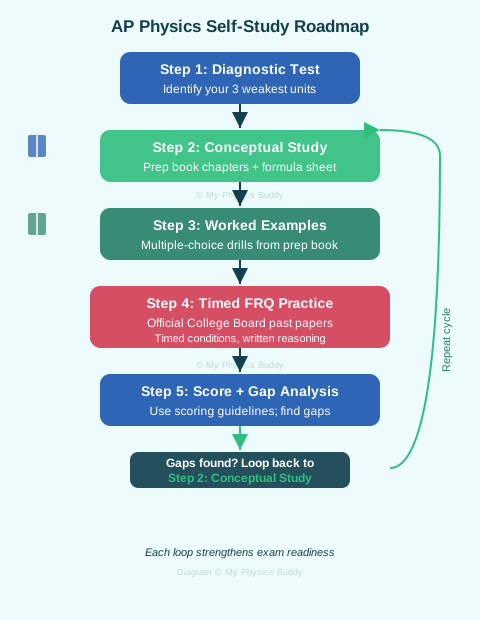
The diagram above summarises the self-study roadmap for AP Physics, showing how diagnostic testing, conceptual study, and timed practice interact in a productive revision cycle. Notice that returning to conceptual review after attempting free-response questions is not a sign of failure — it is exactly how strong students accelerate their improvement.
Common Mistakes When Choosing an AP Physics Prep Book
✗ Mistake: Buying a combined “AP Physics 1 & 2” book when you are actually sitting AP Physics C: Mechanics — the calculus content is entirely absent from such books.
✓ Fix: Check the exact exam title on the College Board website first, then match it to a book that explicitly covers that course.✗ Mistake: Reading the prep book cover-to-cover like a novel, spending too long on topics you already understand and too little on weak areas.
✓ Fix: Take the diagnostic test on page one, score it honestly, and build your study schedule around the three weakest unit scores.✗ Mistake: Relying entirely on the prep book and skipping official past papers — many books use question styles that differ subtly from the real AP exam format.
✓ Fix: Rotate between prep book practice sets and official AP free-response questions released by the College Board after every two chapters of study.
Exam Relevance: This guidance applies directly to AP Physics 1, AP Physics 2, AP Physics C: Mechanics, and AP Physics C: Electricity and Magnetism. Each exam has a distinct scope, and your prep book choice should match the specific course you are registered for.
💡 Pro Tip from Neha A: Always download the free official AP Physics formula sheet from College Board and keep it open while working through your prep book — exam day muscle memory starts now.
Related Questions
How to analyze motion graphs for AP Physics?
What is the difference between static and kinetic friction in AP Physics?
How to handle unit conversions in AP Physics problems?
What are the FRQ scoring guidelines for AP Physics?
How to solve impulse and momentum problems on the AP exam?
What is the best AP Physics prep book for self-study?
How to approach experimental design questions on AP Physics?
How do you calculate the moment of inertia for different shapes?