Maurice Stephens
asked on January 14, 2025
CIE A Level Physics revision strategy
What is the best revision strategy for CIE A Level Physics?
Need Help?
Hire one of our expert Physics tutor online. 24/7 Service. Available now.
Expert Answer
Answered on February 3, 2025 by EXPERT TUTOR
Nothing Found
Dear Maurice Stephens,
The best revision strategy for CIE A Level Physics combines topic-by-topic consolidation with targeted past paper practice under timed conditions. According to expert tutors at My Physics Buddy, students who master the syllabus structure first and then drill exam-style questions consistently outperform those who simply re-read notes.
How to Revise CIE A Level Physics Effectively
Maurice, I completely understand the challenge you are facing. As a PhD in Physics with over four years of teaching A/AS Level Physics (9702) students, I have seen one pattern repeat itself almost every cycle: students who revise passively — highlighting notes and re-reading textbooks — struggle far more in the exam hall than those who revise actively. The CIE 9702 syllabus is broad and deep, so your strategy needs to be structured, deliberate, and exam-aware from day one.
Think of your revision like training for a marathon. You would not just watch videos of other people running. You would run yourself, gradually increasing difficulty, tracking your weak spots, and simulating race conditions. CIE A Level Physics demands exactly that mindset.
Step 1 — Build Your Syllabus Map
Download the official CIE 9702 syllabus and use it as your master checklist. The syllabus is divided into clear topics — mechanics, electricity, waves, thermal physics, quantum physics, and more. Go through each learning outcome one by one and honestly rate your confidence: green (solid), amber (shaky), red (needs urgent work). This gives you a personalised revision roadmap rather than a random one.
Key syllabus areas to prioritise — based on frequency of examination:
- Kinematics and dynamics (equations of motion, Newton’s laws, momentum)
- Electricity (Ohm’s law, internal resistance, Kirchhoff’s laws)
- Waves and superposition (stationary waves, diffraction, interference)
- Thermal physics (ideal gas laws, kinetic theory)
- Quantum physics and nuclear physics (photoelectric effect, radioactive decay)
- Paper 5 experimental skills (planning, analysis, uncertainty)
Step 2 — Active Learning per Topic
For each topic, follow this three-stage active learning cycle:
- Understand the concept deeply. Do not just memorise definitions. Ask yourself why. Why does a projectile follow a parabola? Because horizontal and vertical motions are independent — one is uniform, one is uniformly accelerated. Understanding the physics means you can answer any variant of the question.
- Apply the key equations. Every topic has a small set of core equations. For example, in circular motion: centripetal acceleration is given by a = v²/r = ω²r, where v is the linear speed (m s⁻¹), r is the radius of the circular path (m), and ω is the angular velocity (rad s⁻¹). Write each equation, define every symbol with its unit, and solve at least three numerical problems before moving on.
- Test yourself without notes. Cover your notes and try to reproduce the key ideas, definitions, and a worked example from memory. This retrieval practice is far more effective than re-reading.
Step 3 — Past Paper Practice with Mark Scheme Discipline
Once you have covered a topic actively, attempt past paper questions on that topic only — not a full paper yet. CIE tends to reuse question structures, so you will quickly see patterns. After attempting each question, compare your answer to the mark scheme word-for-word. CIE mark schemes are brutally specific: they want precise terminology, correct units, and the exact physics reasoning. A common mark scheme phrase is “one mark for correct substitution, one mark for correct answer with unit.” Losing the unit alone costs marks.
After covering all topics, move to full timed paper practice — Paper 1 (MCQ), Paper 2 (AS structured), Paper 4 (A Level structured), and Paper 5 (practical planning and analysis). Time yourself strictly. The exam conditions are part of the skill.
Step 4 — Tackle Paper 5 Separately
Paper 5 is where many capable students drop marks unnecessarily. This paper tests your ability to plan an experiment, identify variables, draw conclusions, and handle uncertainties. Practise expressing percentage uncertainty:
Percentage uncertainty = (absolute uncertainty / measured value) × 100%
For example, if you measure a length as 45.0 ± 0.5 cm, the percentage uncertainty is (0.5 / 45.0) × 100% = 1.1%. When quantities are multiplied or divided, you add percentage uncertainties. This skill comes up every year in Paper 5 and also in structured questions on Paper 4.
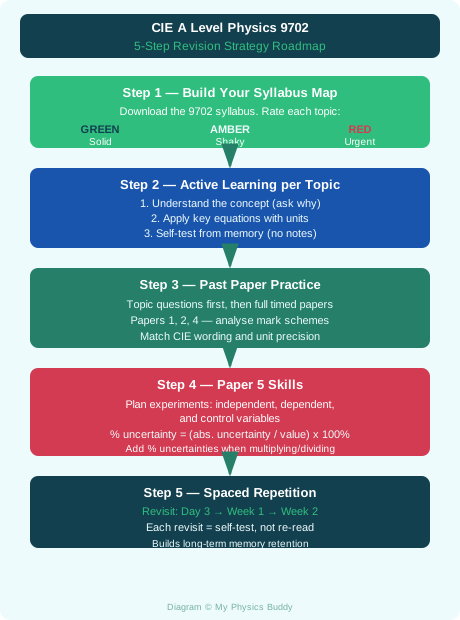
Step 5 — Use a Spaced Repetition Schedule
Do not revise a topic once and forget it. Space your reviews: revisit each topic after 3 days, then after 1 week, then after 2 weeks. Each revisit should be a self-test, not a re-read. This mimics how long-term memory actually works and dramatically reduces the “I revised this but forgot it in the exam” experience that I hear from students so often.
For additional structured support with Physics revision, working with a specialist tutor who knows the 9702 mark scheme expectations in detail can accelerate your progress significantly, especially in the final six weeks before your exam.
Common Mistakes in CIE A Level Physics Revision
✗ Mistake: Revising by re-reading textbooks and highlighting notes without testing yourself.
✓ Fix: After reading a topic, close your notes and write out key definitions, equations, and a worked example from memory — then check what you missed.✗ Mistake: Attempting past papers without carefully analysing mark scheme language and mark allocation.
✓ Fix: After every past paper answer, read the mark scheme line by line and note exactly which words and units CIE expects — then build that precision into your next attempt.✗ Mistake: Neglecting Paper 5 planning questions until the last week of revision.
✓ Fix: Practise at least one Paper 5 planning response per week from mid-revision onwards, focusing on identifying independent, dependent, and control variables, and on writing uncertainty expressions correctly.
Exam Relevance: This revision strategy applies directly to CIE A/AS Level Physics 9702 across Papers 1, 2, 4, and 5. It is also highly relevant for Edexcel A Level Physics and IB Physics HL/SL where structured exam technique and uncertainty handling are similarly assessed.
Pro Tip from Dr Shivani G: Colour-code your syllabus checklist weekly — green, amber, red — and only attempt full timed papers once every topic reaches at least amber confidence.
Related Questions
How to calculate the speed of a wave on a string?
What are standing waves and how do harmonics work?
How to explain physics concepts qualitatively for AP Physics 1 FRQs?
What is the best way to review for AP Physics 1 in two weeks?
How to apply Newton’s second law in rotational form?
How does energy transfer work in simple harmonic motion?
How to solve problems with pulleys and tension in AP Physics 1?
What is mechanical energy and when is it conserved?