F Arnold
asked on February 19, 2026
AP Physics 1 two-week review plan
What is the best way to review for AP Physics 1 in two weeks?
Need Help?
Hire one of our expert Physics tutor online. 24/7 Service. Available now.
Expert Answer
Answered on February 20, 2026 by EXPERT TUTOR
Nothing Found
Dear F Arnold,
The best way to review for AP Physics 1 in two weeks is to work through each major topic systematically, focusing on conceptual understanding first and then reinforcing with targeted problem practice. According to expert tutors at My Physics Buddy, a structured two-week sprint beats random cramming every time.
Your Two-Week AP Physics 1 Review Plan: Topics, Strategy, and What Actually Works
Two weeks is genuinely enough time to make a meaningful difference in your AP Physics 1 score — if you spend those weeks wisely. I have seen students go from barely passing practice exams to scoring 4s and 5s in exactly this window, and the key is always the same: prioritize understanding over memorization, and use past exam questions as your primary feedback tool.
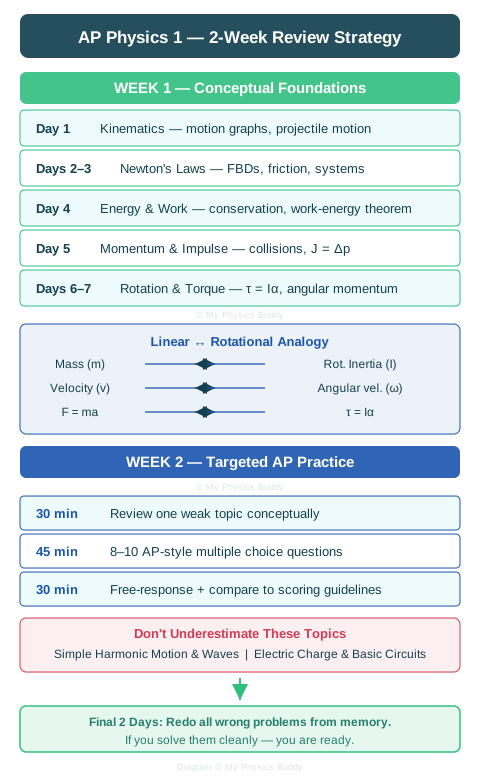
Week 1 — Rebuild Conceptual Foundations
Spend the first week revisiting core topics in this order of exam weight. The College Board clusters AP Physics 1 around a handful of Big Ideas, and understanding those conceptual pillars is far more valuable than memorizing isolated formulas.
| Topic | Key Concepts | Days |
|---|---|---|
| Kinematics | Graphs of motion, projectile motion | Day 1 |
| Newton’s Laws + Dynamics | Free body diagrams, friction, systems | Days 2–3 |
| Energy and Work | Work-energy theorem, conservation of energy | Day 4 |
| Momentum and Impulse | Collisions, conservation of momentum | Day 5 |
| Rotation and Torque | Rotational kinematics, angular momentum | Days 6–7 |
Think of each topic like a chapter in a story — they all connect. For example, the same principle that gives you Newton’s second law (F = ma, where F is net force in newtons, m is mass in kilograms, and a is acceleration in m/s²) reappears in rotational form as 𝜏 = Iα, where 𝜏 is net torque, I is rotational inertia, and α is angular acceleration. Recognizing that parallel structure makes both topics easier to retain.
A great everyday analogy: reviewing AP Physics 1 topics in isolation is like trying to assemble furniture by reading one random instruction page at a time. Instead, follow the sequence — each concept is a step that makes the next one click.
Week 2 — Targeted Practice with Real AP Questions
Shift almost entirely to free-response and multiple-choice practice using official College Board materials. The AP Physics 1 exam heavily tests reasoning and justification, not just calculation. Go to the College Board AP Physics 1 past exam questions page and work through full free-response sets under timed conditions.
As a Masters-level Physics specialist, I can tell you that the single most common mistake I see students make in Week 2 is doing problems without reviewing their errors carefully. Every wrong answer is a free lesson. Spend at least as much time analyzing your mistakes as you do solving new problems.
Week 2 daily rhythm that works well:
- 30 minutes: Review one weak topic conceptually (use your Week 1 notes)
- 45 minutes: Solve 8–10 AP-style multiple choice questions on that topic
- 30 minutes: Attempt one free-response question, then compare your justification to the scoring guidelines word by word
Also spend one full day on Simple Harmonic Motion (SHM) and Waves, and another on Electric Charge and Basic Circuits — these topics appear consistently and students often underestimate them. For deeper support on electricity topics as your studies grow, explore AP Physics resources that bridge Physics 1 and Physics 2 concepts.
How to Handle the Formula Sheet
The AP Physics 1 exam provides a reference sheet, but knowing when and why to use each equation matters far more than memorizing it. For each formula in your review, ask yourself: what physical situation does this describe? For instance, the impulse-momentum theorem:
J = Δp = mΔv
Here, J is impulse (N·s), Δp is the change in momentum (kg·m/s), m is mass (kg), and Δv is the change in velocity (m/s). Knowing this equation is not enough — you need to recognize it as the tool for collision and force-over-time problems, not energy problems.
Common Mistakes When Reviewing for AP Physics 1
✗ Mistake: Reviewing only calculation-based problems and ignoring conceptual questions.
✓ Fix: Dedicate at least 40% of your practice time to purely conceptual AP multiple choice questions where no numbers appear — these are exactly what the exam emphasizes.✗ Mistake: Skipping free-body diagrams and jumping straight to equations.
✓ Fix: Draw a complete, labeled free-body diagram for every dynamics and torque problem before writing a single equation — it eliminates sign errors and missed forces instantly.✗ Mistake: Treating rotation as an entirely separate topic from linear mechanics.
✓ Fix: Actively map each linear concept to its rotational equivalent (mass ↔ rotational inertia, velocity ↔ angular velocity, F = ma ↔ 𝜏 = Iα) so you halve the memorization load.
Exam Relevance: This two-week review strategy is directly applicable to the AP Physics 1 exam administered by the College Board, and the conceptual reasoning skills you build also translate well to the SAT Physics subject area and AP Physics C: Mechanics.
💡 Pro Tip from Manikanta J: On your final two days, redo problems you got wrong in Week 2 from memory — if you can solve them cleanly now, you are genuinely ready.
Related Questions
How to analyze motion graphs for AP Physics?
What is the difference between static and kinetic friction in AP Physics?
How to handle unit conversions in AP Physics problems?
What are the FRQ scoring guidelines for AP Physics?
How to solve impulse and momentum problems on the AP exam?
What is the best AP Physics prep book for self-study?
How to approach experimental design questions on AP Physics?
How do you calculate the moment of inertia for different shapes?