Maisie G
asked on March 6, 2025
Studying AP Physics without textbook
What is the best way to study for AP Physics without a textbook?
Need Help?
Hire one of our expert Physics tutor online. 24/7 Service. Available now.
Expert Answer
Answered on April 1, 2025 by EXPERT TUTOR
Nothing Found
Dear Maisie G,
Studying for AP Physics without a textbook is completely achievable if you use the right combination of free resources, concept-first learning, and deliberate problem practice. According to expert tutors at My Physics Buddy, the key is replacing passive reading with active retrieval using official materials, video lessons, and structured topic checklists.
How to Study AP Physics Without a Textbook — A Complete Strategy
One of the most common struggles I see as a BSc Physical Science graduate and IIT-JAM Physics aspirant is students believing they need a textbook to build strong physics understanding. The truth is, the textbook is just one delivery vehicle for concepts — and for AP Physics specifically, the College Board gives you almost everything you need for free.
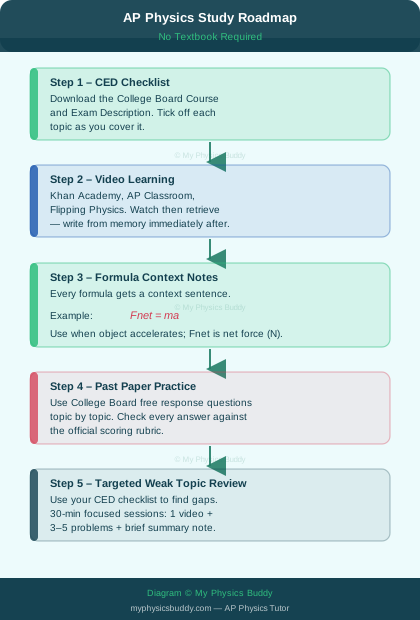
Step 1 — Start With the Official AP Physics Course and Exam Description (CED)
The Course and Exam Description (CED) is the single most important document for your preparation. It lists every topic, every skill, and every type of question that can appear on your exam. Download it directly from the College Board AP Physics page. Use it as your master checklist — tick off each topic as you cover it, and return to any gaps before your exam date.
Step 2 — Use Free Video Lessons as Your Primary Content Source
Think of high-quality video lessons as your textbook chapters, except you can pause, rewind, and watch at your own pace. The best free sources are:
- Khan Academy AP Physics — structured unit by unit, aligned directly to the AP curriculum
- Flipping Physics — excellent for mechanics intuition with real demonstrations
- Professor Dave Explains — clear and concise for concepts like energy, waves, and circuits
- AP Classroom (your school login) — official College Board videos and topic questions
Watch a video on a concept, then immediately close it and write down everything you remember in your own words. This is called the retrieval practice method, and it is far more effective than re-watching or highlighting notes.
Step 3 — Build a Formula Sheet With Context, Not Just Equations
A formula without context is nearly useless in AP Physics. For every equation you write down, also write one sentence explaining when and why it applies. Here is an example:
Newton’s Second Law:
Fnet = ma
- Fnet = net force on the object (N)
- m = mass of the object (kg)
- a = acceleration produced (m/s²)
Context note: Use this when the object is accelerating and you know or need the net force. Always check that you are using the net force, not just one force acting on the object.
Similarly, for kinematics:
v² = u² + 2as
- v = final velocity (m/s)
- u = initial velocity (m/s)
- a = acceleration (m/s²)
- s = displacement (m)
Context note: Use when time is not given and not needed.
Step 4 — Use Past Papers and Free Response Questions as Your Practice Engine
Think of AP free response questions like gym reps — each one builds a specific muscle. The College Board releases years of past free response questions for free. Work through them topic by topic rather than in exam conditions at first. After attempting each question, compare your answer to the official scoring guidelines and identify exactly where your reasoning broke down.
A useful analogy: learning AP Physics without past papers is like learning to drive only in a parking lot. You need the real road — actual exam-style questions — to build exam-ready skills.
Step 5 — Organise by AP Physics Unit, Not Random Topics
Whether you are sitting AP Physics 1 or AP Physics C, the curriculum is divided into clear units. Studying unit by unit prevents the common mistake of mixing up concepts from different areas — for example, confusing work-energy theorem problems with impulse-momentum problems just because both involve forces.
A simple study structure that works well looks like this:
| Phase | Activity | Resource |
|---|---|---|
| Learn | Watch concept video | Khan Academy / AP Classroom |
| Consolidate | Write retrieval notes | Your own notebook |
| Apply | Solve topic questions | AP Classroom / past papers |
| Review | Check against mark scheme | College Board scoring guides |
Step 6 — Cover Weak Topics With Targeted Micro-Sessions
After your first pass through all units, use your CED checklist to identify your two or three weakest areas. Spend focused 30-minute sessions on each one — watch one video, solve three to five problems, then write a brief summary. Short and targeted beats long and unfocused every time.
Common Mistakes When Studying AP Physics Without a Textbook
✗ Mistake: Watching video after video without attempting any problems in between.
✓ Fix: After every concept video, close it immediately and solve at least two AP-style questions on that topic before moving on.✗ Mistake: Building a formula sheet without understanding when each equation applies.
✓ Fix: Write a one-sentence context note next to every formula explaining the conditions under which it is valid.✗ Mistake: Only doing multiple choice practice and skipping free response questions.
✓ Fix: Free response questions test your reasoning and explanation skills, which are worth a large portion of your AP score — work through at least one per unit.
Exam Relevance: This study strategy applies directly to AP Physics 1, AP Physics 2, AP Physics C: Mechanics, and AP Physics C: Electricity and Magnetism. All four courses use the same College Board CED and free response format.
💡 Pro Tip from Mohit H: Treat the College Board’s own scoring rubrics as your secret weapon — they tell you exactly what words and reasoning earn full marks.
Related Questions
How to interpret and draw electric field line diagrams?
What is the best revision strategy for CIE A Level Physics?
What is the difference between transverse and longitudinal waves?
What is the difference between series and parallel circuits?
How does Bernoulli’s principle explain airplane lift?
What is the relationship between frequency wavelength and speed of a wave?
How to calculate net force when multiple forces act on an object?
What is the work-energy theorem and how do you apply it?