M Cobb
asked on August 24, 2025
De Broglie wavelength significance
What is the de Broglie wavelength and when does it matter?
Need Help?
Hire one of our expert Physics tutor online. 24/7 Service. Available now.
Expert Answer
Answered on September 3, 2025 by EXPERT TUTOR
Nothing Found
Dear M Cobb,
The de Broglie wavelength is the wavelength associated with a moving particle, showing that matter has wave-like properties. It is given by λ = h/p, where h is Planck’s constant and p is momentum. According to expert tutors at My Physics Buddy, it matters most when this wavelength is comparable to the size of the object or gap the particle interacts with.
Understanding the de Broglie Wavelength: Wave-Particle Duality in Action
One of the most profound ideas in modern physics is that particles are not just particles — they also behave like waves. This is the concept of wave-particle duality, and the de Broglie wavelength is how we quantify the wave nature of matter. In A/AS Level Physics (9702), this idea sits at the heart of the quantum physics unit, and I find that students often understand it much better once they see both the formula and a concrete physical picture together.
The de Broglie Equation
In 1924, Louis de Broglie proposed that any moving particle with momentum p has an associated wavelength given by:
λ = h / p
Since momentum p = mv (mass × velocity), you can also write this as:
λ = h / mv
- λ = de Broglie wavelength (metres, m)
- h = Planck’s constant = 6.63 × 10⁻³⁴ J s
- p = momentum of the particle (kg m s−1)
- m = mass of the particle (kg)
- v = speed of the particle (m s−1)
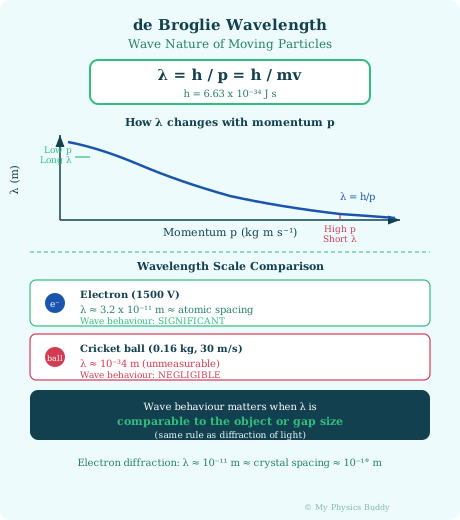
The key insight is in the relationship: larger momentum → shorter wavelength, and smaller momentum → longer wavelength. The wave character of a particle becomes more pronounced as its wavelength grows larger relative to the surroundings it is moving through.
An Everyday Analogy
Think of ripples on a pond. If you drop a tiny pebble, the ripples have a short wavelength. If you drop a large boulder, the energy is enormous and the disturbance is very different in character. Now imagine the wavelength of a football — it works out to something absurdly tiny, far smaller than an atomic nucleus. You would never notice wave behaviour from a football. But shrink the mass and speed down to the scale of an electron, and the wavelength becomes comparable to the spacing between atoms in a crystal — and suddenly, diffraction and interference patterns appear. That is exactly when wave behaviour matters.
When Does the de Broglie Wavelength Matter?
The wave nature of a particle is physically significant only when its de Broglie wavelength is comparable to the size of the object or gap it encounters. This is the same rule you already know for light: you only see diffraction clearly when the wavelength is close to the slit width. The same applies here.
- Electrons accelerated through a few kilovolts have wavelengths around 10−11 m, which is the same order as atomic spacings in crystals (~10−10 m). This is why electron diffraction is experimentally observable and provides evidence for wave-particle duality.
- Macroscopic objects (a cricket ball, a car, a person) have momenta so large that their de Broglie wavelengths are around 10−34 m or smaller — completely unmeasurable. Wave behaviour is entirely negligible.
- Neutrons and protons also exhibit diffraction when directed at crystal lattices, which is exploited in neutron diffraction experiments in materials science.
Worked Example
An electron is accelerated from rest through a potential difference of 1500 V. Calculate its de Broglie wavelength.
Step 1 — Find the kinetic energy gained:
The work done by the electric field equals the kinetic energy gained:
KE = eV = 1.6 × 10−19 × 1500 = 2.4 × 10⁻¹⁶ J
Step 2 — Find the momentum:
KE = p² / 2m, so p = √(2m × KE)
p = √(2 × 9.11 × 10−31 × 2.4 × 10−16)
p = √(4.373 × 10−46)
p = 2.09 × 10⁻²³ kg m s−1
Step 3 — Find the wavelength:
λ = h / p = 6.63 × 10⁻³⁴ / 2.09 × 10⁻²³
λ ≈ 3.17 × 10⁻¹¹ m
This is around 0.03 nm — similar to the spacing of atoms in a crystal lattice, which is why electrons accelerated through such voltages produce clear diffraction patterns. As a CSIR NET rank holder with over 8 years of teaching experience, I can tell you that this type of multi-step calculation is exactly what Cambridge 9702 examiners love to set, so practising the energy-to-momentum-to-wavelength chain is essential.
The diagram below shows how the de Broglie wavelength changes with particle speed and how it compares to relevant physical scales:
For a deeper dive into how wave-particle duality connects to atomic structure and energy levels, explore the broader world of Quantum Mechanics. You can also find the official Cambridge syllabus specification for this topic at the Cambridge International AS and A Level Physics (9702) page.
Common Mistakes with de Broglie Wavelength
✗ Mistake: Using kinetic energy directly as momentum — students write p = KE or p = mv² instead of deriving p correctly from KE = p²/2m.
✓ Fix: Always use p = √(2m × KE) when you are given a potential difference or kinetic energy, not a speed directly.✗ Mistake: Forgetting to convert the accelerating voltage into joules before calculating — using 1500 directly in the momentum formula without multiplying by the electron charge.
✓ Fix: Energy gained = charge × voltage, so always write eV with e = 1.6 × 10⁻¹⁹ C as your first step.✗ Mistake: Thinking a larger wavelength means the particle is moving faster — students mix up the inverse relationship.
✓ Fix: Remind yourself that λ = h/p, so a faster (higher momentum) particle has a shorter wavelength, not a longer one.
Exam Relevance: The de Broglie wavelength appears in Cambridge A/AS Level Physics (9702), IB Physics HL, Edexcel A Level Physics, and AP Physics Modern Physics units. Exam questions typically combine it with energy from accelerating voltage.
Pro Tip from Neha A: Memorise the chain: voltage → kinetic energy → momentum → wavelength. Every de Broglie calculation in 9702 follows exactly this four-step sequence.
Related Questions
How to calculate the speed of a wave on a string?
What are standing waves and how do harmonics work?
How to explain physics concepts qualitatively for AP Physics 1 FRQs?
What is the best way to review for AP Physics 1 in two weeks?
How to apply Newton’s second law in rotational form?
How does energy transfer work in simple harmonic motion?
How to solve problems with pulleys and tension in AP Physics 1?
What is mechanical energy and when is it conserved?