W Henderson
asked on April 1, 2025
Angular vs linear velocity difference
What is the difference between angular velocity and linear velocity?
Need Help?
Hire one of our expert Physics tutor online. 24/7 Service. Available now.
Expert Answer
Answered on May 10, 2025 by EXPERT TUTOR

Dear W Henderson,
The difference between angular velocity and linear velocity is that angular velocity (ω) measures how fast an object rotates through an angle, while linear velocity (v) measures how fast it moves along a curved path. According to expert tutors at My Physics Buddy, the two are directly linked by the radius of rotation.
Angular Velocity vs Linear Velocity: The Full Picture
Think about a spinning merry-go-round. Every single child on that merry-go-round completes one full rotation in exactly the same amount of time — they all share the same angular velocity. But the child sitting at the outer edge is clearly moving faster through space than the child near the centre. That outer child has a greater linear velocity (also called tangential velocity). This single everyday observation captures everything you need to understand about these two quantities in AP Physics 1.
Defining Each Quantity
Angular velocity (ω) describes how quickly an object sweeps through an angle. It is defined as:
ω = Δθ / Δt
where Δθ is the change in angle measured in radians and Δt is the time interval in seconds. The SI unit of angular velocity is radians per second (rad/s). Angular velocity is the same for every point on a rigidly rotating object — it does not depend on where on the object you are.
Linear velocity (v), in the context of circular motion, is the speed of a point as it travels along the circular arc — tangent to the circle at every instant. Its SI unit is metres per second (m/s). Unlike angular velocity, linear velocity does depend on the distance from the axis of rotation.
The Connecting Equation
The relationship that ties these two together is one of the most useful equations in rotational kinematics:
v = rω
where v is the linear (tangential) velocity in m/s, r is the radius of the circular path in metres, and ω is the angular velocity in rad/s. This equation tells you something physically powerful: for a given angular velocity, a point farther from the axis (larger r) moves faster in a straight-line sense.
Worked Example
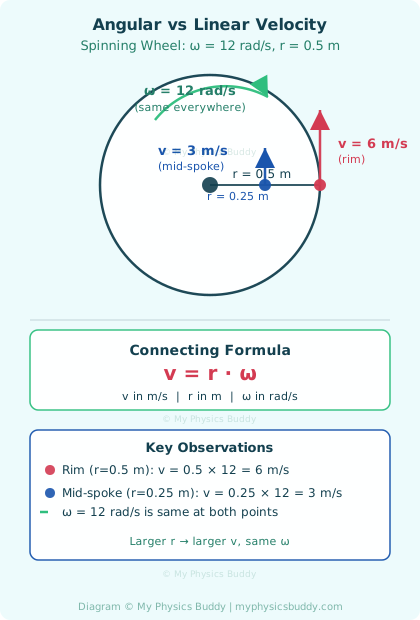
Suppose a wheel of radius r = 0.5 m spins at an angular velocity of ω = 12 rad/s. What is the linear velocity of a point on the rim?
Step 1: Write the formula: v = rω
Step 2: Substitute values: v = (0.5 m)(12 rad/s)
Step 3: Solve: v = 6 m/s
Now imagine a point halfway along the spoke at r = 0.25 m. Its linear velocity would be v = (0.25)(12) = 3 m/s — exactly half, even though it shares the same angular velocity as the rim. This is the core insight the AP Physics 1 exam loves to probe.
The diagram below shows this relationship visually for the spinning wheel example:
A Quick Comparison Table
| Property | Angular Velocity (ω) | Linear Velocity (v) |
|---|---|---|
| Symbol | ω | v |
| SI Unit | rad/s | m/s |
| Depends on radius? | No — same everywhere on rigid body | Yes — increases with r |
| Direction | Along rotation axis | Tangent to circular path |
| Formula link | v = rω | |
As a postdoctoral fellow with a background in physics, I can tell you that the most common conceptual struggle I see students face is treating angular velocity and linear velocity as interchangeable — they are not. They have different units, different physical meanings, and different spatial dependencies. Understanding this distinction is essential for mastering rotational motion, which connects directly to topics like AP Physics C: Mechanics and circular motion physics.
For more on how angular and linear quantities relate across all of rotational kinematics, the Khan Academy AP Physics 1 rotational kinematics guide is a reliable reference to supplement your study.
Common Mistakes
✗ Mistake: Using linear velocity units (m/s) when calculating or reporting angular velocity.
✓ Fix: Always check units — angular velocity must be in rad/s. If you’re given rpm or degrees/s, convert to rad/s first before applying v = rω.✗ Mistake: Assuming every point on a rotating object has the same linear velocity because they all rotate together.
✓ Fix: Remember v = rω — points farther from the axis have larger r and therefore larger v, even though ω is shared.✗ Mistake: Confusing angular velocity (ω) with angular frequency or period without checking context.
✓ Fix: Recall that ω = 2πf = 2π/T, so always identify what physical quantity is given in the problem before substituting.
Exam Relevance: The difference between angular velocity and linear velocity is directly tested in AP Physics 1 (Unit 6: Circular Motion) and AP Physics C: Mechanics. It also appears in IB Physics HL/SL and A/AS Level Physics (9702) under rotational dynamics topics.
💡 Pro Tip from Vandna G: Always write v = rω next to any circular motion problem — it instantly bridges angular and linear quantities and prevents the most common unit errors.
Related Questions
What is the difference between AP Physics 1 and AP Physics 2?
How to solve Gauss’s law problems in AP Physics 2?
What is the right-hand rule and how to apply it for magnetic fields?
How to calculate electric potential and potential energy?
How does a capacitor work and how to solve RC circuit problems?
What is Bernoulli’s equation and how to apply it to fluid flow?
What is the relationship between period and frequency for oscillations?
How to calculate the speed of a wave on a string?