Sayed A
asked on January 10, 2026
AP Physics 1 vs 2 vs C differences
What is the difference between AP Physics 1, 2, and C?
Need Help?
Hire one of our expert Physics tutor online. 24/7 Service. Available now.
Expert Answer
Answered on February 20, 2026 by EXPERT TUTOR
Nothing Found
Dear Sayed A,
The difference between AP Physics 1, 2, and C lies in their depth, math requirements, and topic coverage. AP Physics 1 and 2 are algebra-based and cover a broad range of topics, while AP Physics C uses calculus and goes deeper into mechanics and electromagnetism — making it the most rigorous of the three.
AP Physics 1, 2, and C — A Complete Breakdown
Great question, Sayed! According to expert tutors at My Physics Buddy, one of the most common points of confusion students face when planning their AP Physics journey is understanding how these three course tracks actually differ — not just in topic names, but in the kind of thinking and math each one demands.
Think of it like learning to drive. AP Physics 1 teaches you the rules of the road and how the car moves. AP Physics 2 expands your knowledge — now you’re learning about the engine, the electrical system, and optics. AP Physics C is like training to be a professional racing driver — you go much deeper, and calculus becomes your steering wheel.
AP Physics 1 — Algebra-Based Mechanics & Waves
AP Physics 1 is the recommended starting point for most students with no prior physics background. It is algebra-based, meaning the highest math you need is rearranging equations and using trigonometry. The core topics include:
- Kinematics (motion in 1D and 2D)
- Newton’s Laws of Motion
- Work, Energy, and Power
- Rotational Motion and Torque
- Simple Harmonic Motion
- Waves and Sound
- Electric charge and basic circuits (DC only)
A typical formula you’ll use here is Newton’s Second Law:
Fnet = ma
Where Fnet is the net force in Newtons (N), m is the mass in kilograms (kg), and a is the acceleration in m/s². No calculus involved — just clean algebraic reasoning.
AP Physics 2 — Algebra-Based Fluids, Thermodynamics, E&M, and Modern Physics
AP Physics 2 is the natural sequel to AP Physics 1. It continues at the algebra-based level but shifts into new territory. Topics include:
- Fluid Mechanics and Pressure
- Thermodynamics and Heat Engines
- Electrostatics and Electric Fields
- Magnetic Fields and Electromagnetic Induction
- Geometric and Wave Optics
- Atomic and Nuclear Physics
- Quantum concepts
For example, Coulomb’s Law appears here:
F = k · q1q2 / r²
Where F is the electrostatic force (N), k ≈ 9 × 10⁹ N·m²/C² is Coulomb’s constant, q1 and q2 are the two charges in Coulombs (C), and r is the distance between them in metres (m). Again, algebra handles all of this — no derivatives needed.
AP Physics C — Calculus-Based Mechanics and Electromagnetism
AP Physics C is actually two separate courses and exams:
Both are calculus-based and are intended for students who are taking or have already taken calculus. The depth here is college-level. In AP Physics C: Mechanics, for instance, you define acceleration not as a static ratio but as the derivative of velocity with respect to time:
a(t) = dv/dt = d²x/dt²
Where v is velocity (m/s), x is position (m), and t is time (s). This calculus-based definition lets you solve problems involving variable forces — something AP Physics 1 simply cannot handle. Similarly, in AP Physics C: E&M, you work with Gauss’s Law in its full integral form:
∮ E · dA = Qenc / ε₀
Where E is the electric field (N/C), dA is a differential area element (m²), Qenc is the enclosed charge (C), and ε₀ ≈ 8.85 × 10⁻¹² C²/(N·m²) is the permittivity of free space. This is real university-level physics, and it rewards students who enjoy mathematical depth.
As a BSc Physical Science student at Hansraj College, University of Delhi and an IIT-JAM Physics aspirant, I can tell you that the style of reasoning in AP Physics C closely mirrors what you encounter in first-year university physics — so it is excellent preparation if you plan to study engineering or physics at college level.
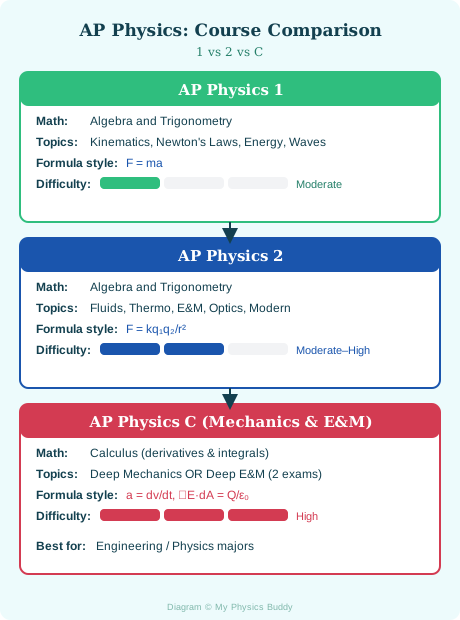
Here is a quick comparison table to make the differences crystal clear:
| Feature | AP Physics 1 | AP Physics 2 | AP Physics C |
|---|---|---|---|
| Math Level | Algebra | Algebra | Calculus |
| Prerequisite | Algebra/Trig | AP Physics 1 (recommended) | Calculus (concurrent or prior) |
| Main Topics | Mechanics, Waves, Basic Circuits | Fluids, Thermo, E&M, Modern Physics | Mechanics OR E&M (deep, calculus-based) |
| Number of Exams | 1 | 1 | 2 (separate exams) |
| Difficulty | Moderate | Moderate–High | High (college-level) |
| College Credit Potential | Yes (intro) | Yes (intro) | Yes (often replaces Phys I & II) |
For a full official breakdown of each course and what the College Board expects, you can check the College Board AP Course Index.
In my teaching experience, students who jump directly into AP Physics C without a solid mechanics foundation often struggle — not because the concepts are impossibly hard, but because they try to apply calculus tools before they have built strong physical intuition. The sequence 1 → 2 → C is the most reliable path for most learners.
Common Mistakes Students Make When Choosing AP Physics Courses
✗ Mistake: Taking AP Physics C: Mechanics without being enrolled in or having completed a calculus course, then struggling with derivatives and integrals mid-exam.
✓ Fix: Confirm you are taking calculus concurrently at minimum — ideally you should be comfortable with basic differentiation and integration before the AP Physics C course begins.✗ Mistake: Treating AP Physics 1 and AP Physics 2 as one continuous course and skipping AP Physics 1 to jump straight to AP Physics 2.
✓ Fix: AP Physics 2 assumes fluency with Newton’s Laws, energy conservation, and rotational concepts from AP Physics 1 — build that foundation first or you will find AP Physics 2 topics poorly connected.✗ Mistake: Assuming AP Physics C covers all topics that AP Physics 1 and 2 cover together — and therefore skipping 1 and 2 entirely.
✓ Fix: AP Physics C does not cover fluids, thermodynamics, optics, or modern/atomic physics — those belong to AP Physics 1 and 2. If your college requires breadth, you may need both tracks.
Exam Relevance: These course distinctions are tested directly in the AP Physics 1, AP Physics 2, AP Physics C: Mechanics, and AP Physics C: Electricity and Magnetism exams administered annually by the College Board.
Pro Tip from Mohit H: If you are aiming for engineering or physics at university, take AP Physics C — a strong score can earn you college credit and place you directly into sophomore-level courses.
Related Questions
How to calculate Young modulus from a stress-strain graph?
What is the difference between progressive and stationary waves 9702?
How does a potential divider circuit work in CIE physics?
How to determine internal resistance of a cell using a graph?
What is the photoelectric effect and how to solve threshold frequency problems?
How to calculate gravitational field strength at a distance from a planet?
What are the key differences between gravitational and electric fields 9702?
How to use the decay equation for radioactive decay problems?