E Hubbard
asked on March 1, 2025
AP Physics 1 vs 2 differences
What is the difference between AP Physics 1 and AP Physics 2?
Need Help?
Hire one of our expert Physics tutor online. 24/7 Service. Available now.
Expert Answer
Answered on March 4, 2025 by EXPERT TUTOR
Nothing Found
Dear E Hubbard,
The difference between AP Physics 1 and AP Physics 2 is essentially a matter of topic coverage: AP Physics 1 focuses on classical mechanics, waves, and introductory circuits, while AP Physics 2 covers fluid mechanics, thermodynamics, electricity and magnetism, optics, and modern physics. Both are algebra-based courses, but AP Physics 2 assumes you already have AP Physics 1 under your belt.
AP Physics 1 vs AP Physics 2: A Complete Breakdown
Think of AP Physics 1 and AP Physics 2 as two halves of a complete algebra-based physics education. AP Physics 1 is the foundation — it builds your physical intuition and problem-solving framework. AP Physics 2 then expands that foundation into more complex and abstract territory. According to expert tutors at My Physics Buddy, the most important thing to understand is that these two courses are designed to be taken sequentially, not interchangeably.
What AP Physics 1 Covers
AP Physics 1 concentrates on the mechanics of the physical world you can see and touch directly. The major topic areas are:
- Kinematics — motion in one and two dimensions, including projectile motion
- Newton’s Laws — forces, free-body diagrams, friction, and circular motion
- Energy and Work — conservation of energy, power, and the work-energy theorem
- Momentum and Impulse — collisions (elastic and inelastic), conservation of momentum
- Rotational Motion — torque, moment of inertia, angular momentum
- Simple Harmonic Motion — springs and pendulums
- Waves and Sound — wave properties, interference, standing waves
- DC Circuits (introductory) — resistance, Ohm’s Law, series and parallel resistors
A useful analogy: AP Physics 1 is like learning the grammar of a new language. You are building the sentence structure — the rules that govern how physical objects behave and interact. Almost every concept can be visualised with everyday objects like balls, ramps, springs, and swings.
What AP Physics 2 Covers
AP Physics 2 moves into territory that is less visible and often more mathematically abstract. The major topic areas are:
- Fluid Mechanics — pressure, buoyancy, Bernoulli’s equation, continuity
- Thermodynamics — thermal energy, ideal gas law, laws of thermodynamics
- Electrostatics — Coulomb’s law, electric fields, electric potential, capacitors
- DC and RC Circuits (advanced) — capacitors in circuits, charge and discharge
- Magnetism and Electromagnetic Induction — magnetic fields, forces on charges, Faraday’s law
- Geometric and Physical Optics — reflection, refraction, lenses, mirrors, diffraction
- Modern Physics — photoelectric effect, atomic models, nuclear physics, quantum concepts
Continuing the language analogy: AP Physics 2 is like learning the literature of that language. You already know the grammar from AP Physics 1, and now you are reading complex texts — topics like electromagnetic induction and quantum behaviour require deeper abstract thinking. As someone with a Dual MS in Physics and Astronomy, I find that students consistently underestimate how much the conceptual depth increases in AP Physics 2, particularly around electric fields and optics.
Key Formulas You Will Encounter
In AP Physics 1, you regularly work with equations like:
- Newton’s second law: F = ma, where F is net force (N), m is mass (kg), a is acceleration (m/s²)
- Kinetic energy: KE = ½mv², where v is speed (m/s)
- Wave speed: v = fλ, where f is frequency (Hz) and λ is wavelength (m)
In AP Physics 2, you add equations like:
- Coulomb’s law: F = kq₁q₂/r², where k = 9×10⁹ N·m²/C², q₁ and q₂ are charges (C), and r is separation (m)
- Ideal gas law: PV = nRT, where P is pressure (Pa), V is volume (m³), n is moles, R = 8.31 J/(mol·K), T is temperature (K)
- Lens/mirror equation: 1/f = 1/do + 1/di, where f is focal length, do is object distance, and di is image distance
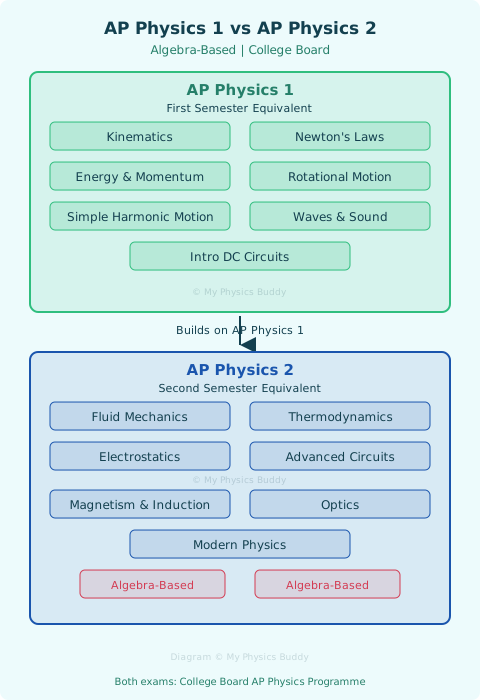
How the Two Courses Compare Side by Side
| Feature | AP Physics 1 | AP Physics 2 |
|---|---|---|
| Math level | Algebra-based | Algebra-based |
| Prerequisite | Algebra/Pre-calc | AP Physics 1 (recommended) |
| Primary focus | Mechanics, waves, basic circuits | E&M, fluids, thermo, optics, modern physics |
| Conceptual abstraction | Moderate | High |
| College equivalent | First semester intro physics | Second semester intro physics |
| Exam format | MCQ + free response | MCQ + free response |
Both exams are administered by the College Board and last approximately three hours. You can find the official course descriptions and exam details directly on the College Board AP Physics 2 page. One important teaching observation I make repeatedly: students who skip AP Physics 1 and jump straight into AP Physics 2 often struggle not because the math is harder, but because they have no physical intuition to anchor the abstract concepts.
Common Mistakes When Choosing or Transitioning Between These Courses
✗ Mistake: Treating AP Physics 1 and AP Physics 2 as interchangeable options that cover the same material at different difficulty levels.
✓ Fix: Recognise that they cover entirely different topic areas — mechanics first, then electromagnetism, thermodynamics, and modern physics second. Choose the sequence, not one or the other.✗ Mistake: Assuming AP Physics 2 is easier because AP Physics 1 has rotational motion, which many students find hard.
✓ Fix: AP Physics 2 introduces electric fields, magnetic induction, and quantum concepts that require strong visualisation skills. Prepare for a different kind of challenge, not a lighter one.✗ Mistake: Believing that strong algebra skills alone are sufficient for AP Physics 2 without reviewing AP Physics 1 concepts like energy conservation and wave behaviour.
✓ Fix: Before starting AP Physics 2, review the work-energy theorem and wave superposition from AP Physics 1 — both appear again in thermodynamics and optics.
Exam Relevance: The distinction between AP Physics 1 and AP Physics 2 is directly tested through the College Board AP Physics examinations. Similar two-course algebra-based splits appear in community college introductory physics and are mirrored by the structure of the AP Physics programme overall.
Pro Tip from Koustubh B: Master the concept of electric potential energy in AP Physics 2 early — it bridges your AP Physics 1 energy intuition directly into electrostatics and circuits.
Related Questions
How to solve impulse and momentum problems on the AP exam?
What is the best AP Physics prep book for self-study?
How to approach experimental design questions on AP Physics?
How do you calculate the moment of inertia for different shapes?
What are common AP Physics mistakes students make on the exam?
What is the difference between AP Physics 1, 2, and C?
How to calculate gravitational field strength at a distance from a planet?
What are the key differences between gravitational and electric fields 9702?