Melvin M
asked on September 25, 2025
Distance vs displacement explained
What is the difference between distance and displacement in physics?
Need Help?
Hire one of our expert Physics tutor online. 24/7 Service. Available now.
Expert Answer
Answered on October 26, 2025 by EXPERT TUTOR
Nothing Found
Dear Melvin M,
The difference between distance and displacement in physics comes down to one fundamental idea: direction. Distance is a scalar quantity that measures the total path length travelled, while displacement is a vector quantity that measures the shortest straight-line change in position from start to finish, including direction. According to expert tutors at My Physics Buddy, confusing these two is one of the most common early mistakes in Kinematics.
Distance vs Displacement: The Physics Behind the Difference
In Classical (Newtonian) Mechanics, every quantity is either a scalar (magnitude only) or a vector (magnitude plus direction). This distinction matters enormously, and the distance-displacement pair is often the first place students encounter it. Let me break both down carefully so the difference becomes permanent in your thinking, Melvin.
What Is Distance?
Distance is the total length of the path an object actually travels, regardless of direction. It is always positive (or zero) and never has a direction attached to it. Think of distance as what your car’s odometer measures — it just keeps adding up every metre you cover, whether you are going forward, backward, or in circles.
Mathematically, if you move along a path broken into segments, the total distance d is simply:
d = d₁ + d₂ + d₃ + …
where d₁, d₂, d₃ are the lengths of each individual segment of the path, all in metres (m).
What Is Displacement?
Displacement (symbol: s or Δx) is the straight-line vector from the starting point to the finishing point. It does not care how you got there — only where you started and where you ended up. Displacement can be positive, negative, or zero, and it always carries a direction.
The formula for displacement in one dimension is:
Δx = xf − xi
where xf is the final position (in metres), xi is the initial position (in metres), and Δx is the displacement (in metres). A positive value means movement in the positive direction (e.g. rightward or upward); a negative value means the opposite direction.
An Everyday Analogy
Imagine you leave your house, walk 300 m east to a shop, buy something, then walk 300 m back west to your house. Your total distance is 600 m — that is genuinely how far your feet carried you. But your displacement is 0 m, because you ended up exactly where you started. The straight-line arrow from start to finish has zero length. This single example captures the entire conceptual difference.
A Worked Example with Numbers
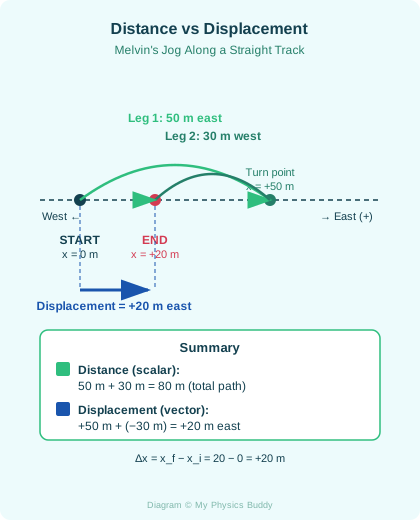
Let us say Melvin jogs along a straight track:
- Leg 1: 50 m east
- Leg 2: 30 m west
Step 1 — Calculate total distance:
d = 50 m + 30 m = 80 m
Step 2 — Calculate displacement (taking east as positive):
Δx = +50 m + (−30 m) = +20 m (east)
So even though 80 m of ground was covered, the net change in position is only 20 m to the east. The displacement arrow points directly from the start to the final position — 20 m east — and that is it.
Visualising the Concept
Key Comparison Table
| Property | Distance | Displacement |
|---|---|---|
| Type | Scalar | Vector |
| Direction included? | No | Yes |
| Can be negative? | No | Yes |
| Can equal zero when object has moved? | No | Yes |
| SI Unit | metres (m) | metres (m) |
| Symbol | d | s or Δx |
As a PhD researcher who has taught mechanics for over 8 years, I can tell you that the moment students truly internalise the scalar-versus-vector distinction, the rest of kinematics — speed vs velocity, and eventually acceleration — clicks into place much more naturally. The question of what is the difference between distance and displacement is genuinely foundational. You can find a thorough treatment of these concepts at the Khan Academy Physics guide on displacement, which pairs well with what we have covered here.
Common Mistakes Students Make
✗ Mistake: Treating displacement as always equal to distance because both are measured in metres.
✓ Fix: Always check whether the object returns toward its start. If it does, displacement is smaller than distance. If it returns fully, displacement is zero.✗ Mistake: Forgetting to assign a direction (sign or compass label) when stating displacement.
✓ Fix: Always define a positive direction first (e.g. “east is positive”), then write displacement with its sign or directional label — for example, “+20 m” or “20 m east”.✗ Mistake: Using displacement in a formula where distance is required, such as when calculating the total path length of a round trip.
✓ Fix: Read the question carefully. If it asks “how far did the object travel?”, use distance. If it asks “what is the change in position?”, use displacement.
Exam Relevance: Distance and displacement appear in IGCSE Physics (0625), GCSE Physics, AP Physics 1, and IB Physics HL/SL, typically in kinematics and motion graph questions where both scalar and vector reasoning are assessed.
Pro Tip from Nasir A.: Draw a straight arrow from start to finish — that arrow is always your displacement. Everything else the object did is distance. Keep that visual habit and you will never mix them up again.
Related Questions
How to solve center of mass problems in AP Physics 1?
How to earn full credit on AP Physics 1 lab-based questions?
How does the AP Physics exam curve work?
What calculator is allowed on the AP Physics exam?
How to solve conservation of energy problems on AP Physics?
What formulas are given on the AP Physics equation sheet?
How to set up and solve Atwood machine problems?
How to analyze motion graphs for AP Physics?