O Ali
asked on May 6, 2025
Fission vs fusion A Level physics
What is the difference between nuclear fission and fusion in A Level?
Need Help?
Hire one of our expert Physics tutor online. 24/7 Service. Available now.
Expert Answer
Answered on May 25, 2025 by EXPERT TUTOR
Nothing Found
Dear O Ali,
The difference between nuclear fission and fusion is that fission splits a heavy nucleus into smaller fragments, while fusion joins two light nuclei together — both processes release energy by converting a small amount of mass into energy via Einstein’s E = mc². According to expert tutors at My Physics Buddy, mastering this distinction is essential for A/AS Level Physics (9702).
Nuclear Fission vs Fusion — The Full Picture for A Level
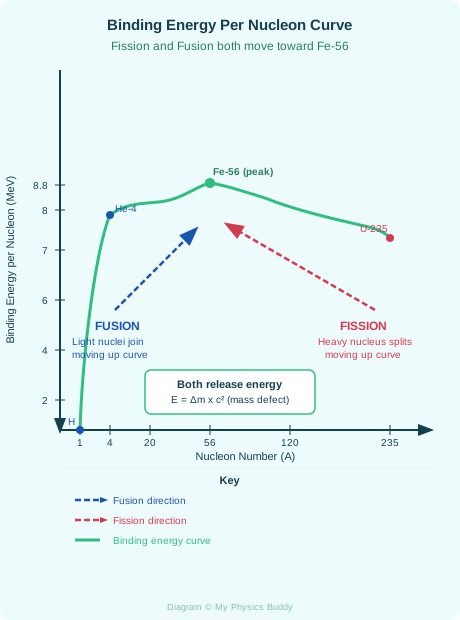
Both fission and fusion are nuclear reactions — they involve changes to the nucleus itself, not just the electrons around it. That already separates them from chemistry. The key idea connecting both is binding energy per nucleon, which is the energy needed to completely disassemble a nucleus into its individual protons and neutrons. The higher this value, the more stable the nucleus.
Think of binding energy per nucleon like the “stickiness” of the nucleus. Iron-56 sits at the peak of the binding energy per nucleon curve — it is the most stable nucleus. Any nucleus lighter than iron can release energy by fusing (moving up the curve from the left), and any nucleus heavier than iron can release energy by splitting (moving down the curve from the right). That single graph explains why both reactions release energy, even though they seem opposite.
Nuclear Fission — Splitting the Heavy
In nuclear fission, a heavy nucleus such as uranium-235 absorbs a slow (thermal) neutron and becomes unstable. It then splits into two smaller daughter nuclei, releases 2–3 fast neutrons, and emits a large amount of energy — mostly as kinetic energy of the fragments, plus gamma radiation.
A typical example you will see in A Level papers:
²³⁵U + ¹n → ¹⁴¹Ba + ⁹²Kr + 3 ¹n
Check the equation: top numbers (mass numbers) balance — 235 + 1 = 141 + 92 + 3 ✓. Bottom numbers (atomic numbers / proton numbers) balance — 92 + 0 = 56 + 36 + 0 ✓. Always verify both conservation laws.
The released neutrons can trigger further fission events — this is the chain reaction. In a nuclear reactor, control rods (usually boron) absorb excess neutrons to keep the reaction steady. In a weapon, the chain reaction is uncontrolled.
Nuclear Fusion — Joining the Light
In nuclear fusion, two light nuclei — most commonly isotopes of hydrogen — are forced close enough together that the strong nuclear force takes over and binds them into a heavier nucleus. The most studied reaction uses deuterium (²H) and tritium (³H):
²H + ³H → ⁴He + ¹n + energy
Mass numbers: 2 + 3 = 4 + 1 ✓. Atomic numbers: 1 + 1 = 2 + 0 ✓.
The challenge with fusion is temperature. To push two positively charged nuclei together, you must overcome the enormous electrostatic repulsion between them. This requires temperatures of around 10⁸ K — hotter than the core of the Sun. That is why controlled fusion on Earth (as in tokamak reactors) remains an engineering challenge, even though the fuel is abundant and the reaction produces far less radioactive waste than fission.
Mass Defect and Energy Release — The Mathematics
Both reactions release energy because the products have slightly less mass than the reactants. This missing mass is called the mass defect, Δm. It converts directly into energy according to:
E = Δm · c²
where E is the energy released in joules, Δm is the mass defect in kilograms, and c = 3.00 × 10⁸ m s⁻¹ is the speed of light in a vacuum.
Even a tiny mass defect produces enormous energy because c² ≈ 9 × 10¹⁶ m² s⁻². In A Level calculations you will often be given atomic masses in unified atomic mass units (u), where 1 u = 1.661 × 10⁻²⁷ kg, and you convert the mass defect before applying E = Δmc².
Worked example (fission): Suppose the total mass of reactants in a fission event is 390.790 u and the total mass of products is 390.781 u. Then:
Δm = 390.790 − 390.781 = 0.009 u = 0.009 × 1.661 × 10⁻²⁷ kg = 1.495 × 10⁻²⁹ kg
E = 1.495 × 10⁻²⁹ × (3.00 × 10⁸)² = 1.35 × 10⁻¹² J ≈ 8.4 MeV
This is a realistic order-of-magnitude for a single fission event. Fusion of deuterium and tritium releases around 17.6 MeV per reaction — higher per reaction, and significantly higher per unit mass of fuel, which is why fusion is considered the more powerful long-term energy source.
Side-by-Side Comparison
| Feature | Fission | Fusion |
|---|---|---|
| Process | Heavy nucleus splits | Light nuclei join |
| Typical fuel | U-235, Pu-239 | Deuterium, Tritium |
| Condition needed | Slow neutron absorption | Extremely high temperature |
| Energy per reaction | ~200 MeV | ~17.6 MeV (D-T) |
| Radioactive waste | Significant, long-lived | Much less |
| Current use | Nuclear power stations | Experimental (ITER) |
As a CSIR NET rank-holder who has taught Nuclear Physics to many A Level students, I notice the most common struggle is not with remembering which is which — it is with the binding energy curve logic. Students learn fission and fusion as separate facts, but once you see them both as movements along the same curve toward iron-56, the whole topic clicks into place instantly.
For further reading on fusion research, the ITER official page on fusion science is an excellent authoritative resource that also connects directly to the real-world application questions you may see on A Level papers.
Common Mistakes to Avoid
✗ Mistake: Saying fusion always releases more energy than fission without context.
✓ Fix: Fission releases more energy per reaction (~200 MeV vs ~17.6 MeV), but fusion releases more energy per kilogram of fuel. Specify which comparison you are making.✗ Mistake: Forgetting to check that both mass numbers and atomic numbers balance in nuclear equations.
✓ Fix: Always write out both conservation checks explicitly — examiners award marks for balanced equations, and one wrong number loses the mark entirely.✗ Mistake: Confusing mass defect with the mass of the products — students sometimes subtract the wrong way and get a negative energy release.
✓ Fix: Always calculate Δm = (mass of reactants) − (mass of products). Products are lighter, so Δm is positive and energy is released.
Exam Relevance: This topic appears in Cambridge A/AS Level Physics (9702), Edexcel A Level Physics, and IB Physics HL/SL. Questions typically ask you to balance nuclear equations, calculate energy released from mass defect, or explain fission and fusion using the binding energy per nucleon curve.
Pro Tip from Neha A: Sketch the binding energy per nucleon curve from memory in your exam — labelling iron-56 at the peak immediately tells the examiner you understand why both reactions release energy.
Related Questions
How to calculate Young modulus from a stress-strain graph?
What is the difference between progressive and stationary waves 9702?
How does a potential divider circuit work in CIE physics?
How to determine internal resistance of a cell using a graph?
What is the photoelectric effect and how to solve threshold frequency problems?
How to calculate gravitational field strength at a distance from a planet?
What are the key differences between gravitational and electric fields 9702?
How to use the decay equation for radioactive decay problems?