N Walton
asked on March 17, 2025
Progressive vs stationary waves 9702
What is the difference between progressive and stationary waves 9702?
Need Help?
Hire one of our expert Physics tutor online. 24/7 Service. Available now.
Expert Answer
Answered on August 10, 2025 by EXPERT TUTOR
Nothing Found
Dear N Walton,
The difference between progressive and stationary waves is one of the most fundamental distinctions in the waves topic of A/AS Level Physics (9702). A progressive wave transfers energy from one point to another, while a stationary (standing) wave stores energy between fixed points and transfers no net energy along its length.
Progressive vs Stationary Waves: A Full Conceptual Breakdown
According to expert tutors at My Physics Buddy, this topic trips up more students than almost any other in the waves unit — not because it is mathematically hard, but because students confuse what looks similar on paper. Both wave types have amplitude, wavelength, and frequency, but they behave in fundamentally different ways. Let me walk you through exactly what distinguishes them.
What is a Progressive Wave?
A progressive wave is a wave that moves continuously through a medium, carrying energy from the source to a receiver. Every particle in the medium oscillates, and the wave pattern physically travels forward. Think of ocean waves rolling toward a beach — energy is being delivered to the shore with every wave. The wave profile moves along the medium over time.
Key properties of a progressive wave:
- Energy is transferred in the direction of wave travel.
- All particles have the same amplitude (in an ideal, undamped medium).
- Phase varies continuously along the wave — particles at different positions are at different stages of their oscillation at any given moment.
- There are no fixed nodes or antinodes.
The equation describing a progressive wave is:
y = A sin(ωt − kx)
- y = displacement of a particle at position x and time t
- A = amplitude (maximum displacement)
- ω = angular frequency = 2πf
- k = wave number = 2π/λ
- x = position along the medium
What is a Stationary (Standing) Wave?
A stationary wave is formed when two progressive waves of equal frequency and amplitude travel in opposite directions along the same medium and superpose. The result is a wave pattern that appears to stand still — the wave profile does not travel. This happens, for example, when a wave reflects off a fixed boundary and interferes with the incoming wave.
A guitar string is a perfect everyday analogy. When you pluck it, waves travel in both directions along the string and reflect at both fixed ends. The superposition of these opposing waves creates a stationary pattern where some points (the nodes) never move and others (the antinodes) oscillate with maximum amplitude.
Key properties of a stationary wave:
- No net energy transfer — energy is stored between the nodes.
- Particles at different positions have different amplitudes — zero at nodes, maximum at antinodes.
- All particles between two adjacent nodes are in phase with each other; particles on opposite sides of a node are in antiphase (phase difference of π radians or 180°).
- Nodes are fixed points of zero displacement.
- Antinodes are points of maximum displacement.
The distance between two adjacent nodes (or two adjacent antinodes) equals λ/2, where λ is the wavelength of the original progressive waves that formed the standing wave.
The equation for a stationary wave combines two opposing progressive waves:
y = 2A cos(kx) sin(ωt)
Notice that the position part (cos kx) and the time part (sin ωt) are now separated — this is the mathematical signature of a standing wave. The amplitude at any point is 2A cos(kx), which varies with position, confirming that different points have different amplitudes.
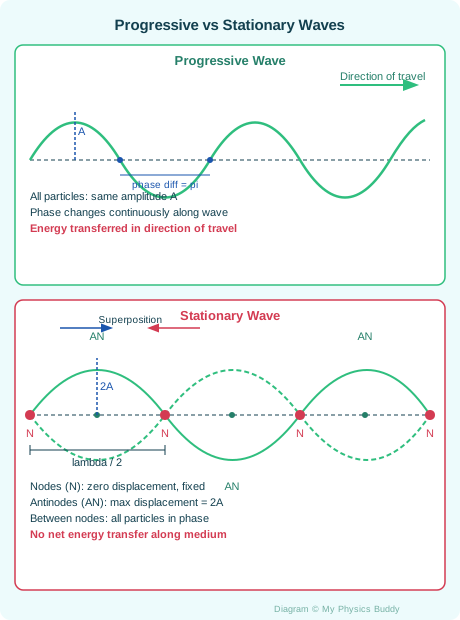
Side-by-Side Comparison Table
| Property | Progressive Wave | Stationary Wave |
|---|---|---|
| Energy transfer | Yes — in direction of travel | No net energy transfer |
| Amplitude | Same for all particles | Varies — zero at nodes, max at antinodes |
| Phase relationship | Continuous phase change along wave | In phase between nodes; antiphase across a node |
| Wave profile | Moves along the medium | Does not move — pattern is fixed |
| Nodes/Antinodes | None | Clearly defined, fixed positions |
| Formation | Single wave from a source | Superposition of two equal waves in opposite directions |
As an IBDP & A-Level Physics Specialist, I always tell my students: when an exam question asks you to compare these two wave types, the three pillars to hit are energy transfer, amplitude variation, and phase relationships. Get those three right and you will pick up the marks every time. You can read more about wave behaviour on the Waves and Optics resource page, and for a deep dive into the Cambridge syllabus requirements, the Cambridge International A Level Physics 9702 syllabus is the authoritative source.
Common Mistakes
✗ Mistake: Saying that a stationary wave has the same amplitude at all points, just like a progressive wave.
✓ Fix: Remember that amplitude varies with position in a stationary wave — it is zero at every node and reaches a maximum of 2A at every antinode.✗ Mistake: Confusing the wavelength of a stationary wave — students often say the node-to-node distance equals one full wavelength.
✓ Fix: The distance between two adjacent nodes equals λ/2, not λ. The full wavelength spans two node-to-node gaps.✗ Mistake: Stating that all particles in a stationary wave are in phase with each other.
✓ Fix: Particles between two adjacent nodes are in phase, but particles on opposite sides of a node are in antiphase — a phase difference of exactly π radians (180°).
Exam Relevance: This topic is directly tested in A/AS Level Physics (9702), Edexcel A Level Physics, IB Physics HL/SL, and AP Physics. Questions commonly ask for comparisons between the two wave types or require you to identify nodes and antinodes from a diagram.
Pro Tip from Mamatha M: In any exam question comparing wave types, always address energy transfer, amplitude variation, and phase — those three points cover the majority of available marks.
Related Questions
What is the best way to review for AP Physics 1 in two weeks?
How to apply Newton’s second law in rotational form?
How does energy transfer work in simple harmonic motion?
How to solve problems with pulleys and tension in AP Physics 1?
What is mechanical energy and when is it conserved?
How to interpret position vs time and velocity vs time graphs?
How do open and closed pipe resonance problems work?
What are the most difficult topics on AP Physics 1?