Harley Duffy
asked on August 3, 2025
Series vs parallel circuits compared
What is the difference between series and parallel circuits?
Need Help?
Hire one of our expert Physics tutor online. 24/7 Service. Available now.
Expert Answer
Answered on August 10, 2025 by EXPERT TUTOR
Nothing Found
Dear Harley Duffy,
The difference between series and parallel circuits lies in how components are connected and how current flows through them. In a series circuit, components are joined end-to-end along a single path, so the same current passes through every component. In a parallel circuit, components are connected across the same two nodes, giving current multiple independent paths to travel.
Series vs Parallel Circuits — A Deep Dive
According to expert tutors at My Physics Buddy, this is one of the most frequently misunderstood topics in introductory Physics, and the confusion almost always comes from mixing up which quantity stays the same and which one splits. Let me clear that up completely for you, Harley.
The Core Idea: What Stays the Same?
The single most powerful way to think about series and parallel circuits is to ask: what is shared, and what is divided?
- In a series circuit, current is the same through every component. Voltage is divided.
- In a parallel circuit, voltage is the same across every component. Current is divided.
A great everyday analogy: imagine water flowing through pipes. A series circuit is like a single pipe that passes through several narrow sections one after another — the same flow rate (current) must pass through each section, but pressure drops (voltage drops) at each one. A parallel circuit is like a pipe that splits into several branches — the pressure difference across each branch is the same, but the total flow is shared among the branches.
Series Circuits — Formulas and Intuition
In a series circuit with resistors R₁, R₂, and R₃ connected to a supply voltage V, the rules are:
- Total resistance: Rtotal = R₁ + R₂ + R₃
(resistances simply add up — adding more resistors always increases total resistance) - Current: I = V / Rtotal
(same current I flows through every component) - Voltage drops: V₁ = IR₁, V₂ = IR₂, V₃ = IR₃, and V₁ + V₂ + V₃ = V
(the supply voltage is shared among all components)
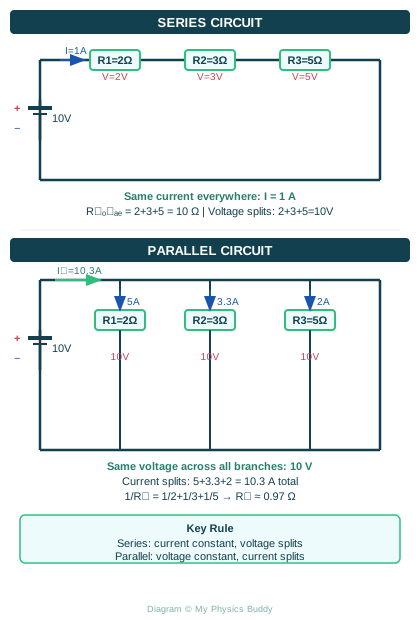
Worked Example — Series: Suppose you have R₁ = 2 Ω, R₂ = 3 Ω, and R₃ = 5 Ω connected in series to a 10 V battery.
- Rtotal = 2 + 3 + 5 = 10 Ω
- I = 10 V / 10 Ω = 1 A (same through all three)
- V₁ = 1 × 2 = 2 V, V₂ = 1 × 3 = 3 V, V₃ = 1 × 5 = 5 V
- Check: 2 + 3 + 5 = 10 V ✓
Parallel Circuits — Formulas and Intuition
In a parallel circuit with the same three resistors connected across supply voltage V:
- Total resistance: 1/Rtotal = 1/R₁ + 1/R₂ + 1/R₃
(adding more parallel paths always decreases total resistance) - Voltage: V₁ = V₂ = V₃ = V
(every branch sees the full supply voltage) - Branch currents: I₁ = V/R₁, I₂ = V/R₂, I₃ = V/R₃
- Total current: Itotal = I₁ + I₂ + I₃
(currents from each branch sum back at the node)
Worked Example — Parallel: Same resistors (2 Ω, 3 Ω, 5 Ω) now in parallel across 10 V.
- 1/Rtotal = 1/2 + 1/3 + 1/5 = 15/30 + 10/30 + 6/30 = 31/30
- Rtotal = 30/31 ≈ 0.97 Ω (much less than the smallest resistor)
- I₁ = 10/2 = 5 A, I₂ = 10/3 ≈ 3.33 A, I₃ = 10/5 = 2 A
- Itotal = 5 + 3.33 + 2 = 10.33 A
Notice how a parallel combination produces a total resistance lower than the smallest individual resistor. This surprises many students the first time they see it, but it makes perfect physical sense — you are opening more paths for current to flow. As a Condensed Matter Physics PhD tutor, I always emphasise this point because it ties directly to how real-world materials and devices behave when connected to a circuit. For a deeper look at how these principles extend to AC circuits, see this resource from Khan Academy’s AP Physics 1 circuits section.
These circuit rules are directly governed by Kirchhoff’s Current Law (KCL) — the sum of currents entering a node equals the sum leaving it — and Kirchhoff’s Voltage Law (KVL) — the sum of voltage drops around any closed loop equals zero. If you are studying for GCSE Physics or higher, you will apply both laws regularly. A practical comparison is shown below:
| Property | Series Circuit | Parallel Circuit |
|---|---|---|
| Current | Same throughout | Splits at each branch |
| Voltage | Divides across components | Same across each branch |
| Total Resistance | RT = R₁ + R₂ + … | 1/RT = 1/R₁ + 1/R₂ + … |
| Effect of removing one component | Whole circuit breaks | Other branches still work |
| Real-world use | Simple switches, fuses | Household mains wiring |
Your home wiring is a classic parallel circuit — every appliance you plug in gets the full mains voltage (230 V in the UK, 120 V in the US), and switching one off does not affect the others. Old-style Christmas fairy lights, by contrast, were wired in series — one blown bulb would cut the entire string.
Common Mistakes
✗ Mistake: Assuming that adding more resistors in parallel increases total resistance.
✓ Fix: Remember that each new parallel path gives current an additional route — total resistance always decreases. Rtotal is always less than the smallest individual resistor in the parallel group.✗ Mistake: Applying the series voltage rule to parallel branches or the parallel current rule to a series chain.
✓ Fix: Before writing any equation, identify the circuit type first. Ask yourself: are the components sharing a single wire (series) or connected between the same two nodes (parallel)? Label the topology before you calculate.✗ Mistake: Forgetting to check the answer using Kirchhoff’s laws as a verification step.
✓ Fix: After solving, confirm that all voltage drops sum to the supply voltage (KVL) and that all branch currents sum to the total current (KCL). This catches arithmetic errors before they cost you marks.
Exam Relevance: Series and parallel circuits appear in GCSE Physics, A/AS Level Physics (9702), IB Physics HL/SL, and AP Physics 1. Questions range from simple resistance calculations to multi-step Kirchhoff’s law problems requiring both circuit types.
Pro Tip from Arun K: Memorise the two golden rules — series keeps current constant, parallel keeps voltage constant. Every circuit formula follows directly from those two facts.
Related Questions
What is the best way to review for AP Physics 1 in two weeks?
How to apply Newton’s second law in rotational form?
How does energy transfer work in simple harmonic motion?
How to solve problems with pulleys and tension in AP Physics 1?
What is mechanical energy and when is it conserved?
How to interpret position vs time and velocity vs time graphs?
How do open and closed pipe resonance problems work?
What are the most difficult topics on AP Physics 1?