Dale D
asked on February 21, 2026
Static vs kinetic friction AP Physics
What is the difference between static and kinetic friction in AP Physics?
Need Help?
Hire one of our expert Physics tutor online. 24/7 Service. Available now.
Expert Answer
Answered on March 4, 2026 by EXPERT TUTOR
Nothing Found
Dear Dale D,
The difference between static and kinetic friction is one of the most tested concepts in AP Physics. Static friction acts on a stationary object and adjusts up to a maximum value before motion begins, while kinetic friction acts on a sliding object and remains roughly constant. According to expert tutors at My Physics Buddy, understanding this distinction is essential for solving Newton’s second law problems correctly.
Static vs Kinetic Friction: The Full Physics Explained
Both types of friction arise from microscopic interactions between two surfaces in contact — tiny surface irregularities and intermolecular adhesion forces that resist relative motion. The key difference lies in whether the surfaces are moving relative to each other or not.
Static Friction
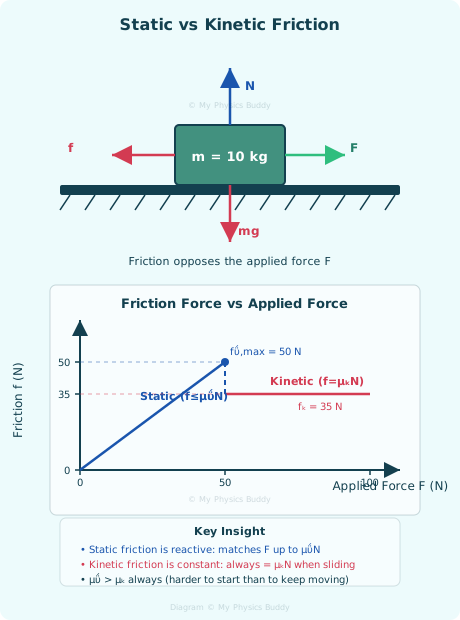
Static friction (fs) is the friction force that acts between two surfaces that are not sliding past each other. Think of trying to push a heavy sofa across a room. At first, you push gently and the sofa doesn’t move — that’s because static friction is perfectly matching and opposing your applied force. As you push harder, static friction increases to match you, right up until a maximum threshold is reached. The moment you exceed that threshold, the sofa starts to slide.
The relationship is expressed as an inequality:
fs ≤ μs N
- fs = static friction force (N)
- μs = coefficient of static friction (dimensionless)
- N = normal force (N)
The maximum static friction force is fs,max = μs N. This is the tipping point. Until that value is reached, static friction is a reactive force — it takes whatever value is needed to prevent motion.
Kinetic Friction
Kinetic friction (fk) acts once surfaces are already sliding against each other. Unlike static friction, kinetic friction does not adjust — it has a fixed value for a given pair of surfaces and a given normal force:
fk = μk N
- fk = kinetic friction force (N)
- μk = coefficient of kinetic friction (dimensionless)
- N = normal force (N)
Crucially, μk < μs for the same pair of surfaces. This is why it’s harder to get something moving than to keep it moving — a fact you experience every time you slide a heavy box across a floor.
Summary Table
| Property | Static Friction | Kinetic Friction |
|---|---|---|
| When it acts | Object is stationary | Object is sliding |
| Formula | fs ≤ μs N | fk = μk N |
| Value | Variable (reactive) | Constant |
| Coefficient | μs (larger) | μk (smaller) |
Worked Example
A 10 kg wooden block sits on a horizontal floor. The coefficients of friction are μs = 0.50 and μk = 0.35. A horizontal force F is applied. g = 10 m/s².
Step 1 — Find the normal force:
Since the surface is horizontal and there is no vertical acceleration:
N = mg = 10 × 10 = 100 N
Step 2 — Find maximum static friction:
fs,max = μs × N = 0.50 × 100 = 50 N
The block will not move unless F > 50 N.
Step 3 — Find kinetic friction once sliding begins:
fk = μk × N = 0.35 × 100 = 35 N
Once sliding, this 35 N friction force opposes motion regardless of how large F is.
Step 4 — Find acceleration if F = 70 N (block is sliding):
Net force = F − fk = 70 − 35 = 35 N
a = Fnet / m = 35 / 10 = 3.5 m/s²
Notice that if you mistakenly used fs,max = 50 N here, you would get a = 2.0 m/s² — a classic error that costs marks on AP Physics 1 free-response questions.
As a PhD physicist, I can tell you that one of the most consistent struggles I see students face is treating static friction as a fixed value rather than a reactive one. In teaching, I often explain it like this: static friction is more like a bouncer at a door — it will resist up to its limit, then let go. Kinetic friction is the sliding resistance that kicks in once the bouncer steps aside. For a deeper look at the underlying surface physics, the Khan Academy friction guide is a solid supplementary resource.
Common Mistakes Students Make with Static and Kinetic Friction
✗ Mistake: Using fs = μs N as an equation for all cases of static friction.
✓ Fix: Remember that fs ≤ μs N. Static friction only equals its maximum value at the exact moment of impending motion. For any smaller applied force, fs equals that applied force, not μs N.✗ Mistake: Assuming μs = μk because both are called “coefficients of friction.”
✓ Fix: Always check which coefficient is given. Static is always larger than kinetic for the same surfaces. Using μs in a kinetic problem — or vice versa — gives a wrong friction force and wrong acceleration.✗ Mistake: Forgetting to recalculate the normal force when the surface is tilted or an extra vertical force is present.
✓ Fix: Before writing any friction equation, always resolve forces perpendicular to the surface first and compute N from that equilibrium. Both fs and fk depend directly on N, so an incorrect N propagates through the whole problem.
Exam Relevance: The difference between static and kinetic friction appears in AP Physics 1 (Unit 2: Forces), AP Physics C: Mechanics, IB Physics HL/SL, and A-Level Physics. Free-response and multiple-choice questions frequently test whether students apply the inequality correctly for static cases.
💡 Pro Tip from Dr Shivani G: When a problem says the object is “on the verge of sliding,” that is your cue to use fs = μs N as an equality — the one moment it holds exactly.
Related Questions
What is the best way to review for AP Physics 1 in two weeks?
How to apply Newton’s second law in rotational form?
How does energy transfer work in simple harmonic motion?
How to solve problems with pulleys and tension in AP Physics 1?
What is mechanical energy and when is it conserved?
How to interpret position vs time and velocity vs time graphs?
How do open and closed pipe resonance problems work?
What are the most difficult topics on AP Physics 1?