Mckenzie G
asked on January 29, 2026
Transverse vs longitudinal wave differences
What is the difference between transverse and longitudinal waves?
Need Help?
Hire one of our expert Physics tutor online. 24/7 Service. Available now.
Expert Answer
Answered on February 18, 2026 by EXPERT TUTOR
Nothing Found
Dear Mckenzie G,
The key difference between transverse and longitudinal waves lies in the direction of particle oscillation relative to the direction of wave travel: in a transverse wave, particles vibrate perpendicular to the wave’s direction of propagation, while in a longitudinal wave, particles vibrate parallel to it. According to expert tutors at My Physics Buddy, mastering this distinction is one of the most foundational steps in understanding wave behaviour in Physics. Both wave types transfer energy without permanently displacing the medium through which they travel.
Understanding Transverse and Longitudinal Waves: The Deep Physics
Let’s build your understanding from the ground up, Mckenzie, starting with what a wave actually is before zooming in on how these two types differ physically.
What is a wave? A wave is a disturbance that transfers energy through a medium (or through a vacuum, in the case of electromagnetic waves) without causing a net displacement of matter. The particles of the medium oscillate about their equilibrium positions — they don’t travel with the wave. This is a subtle but crucial point that trips up many students.
Transverse waves — vibration at right angles: In a transverse wave, each particle of the medium moves perpendicular (at 90°) to the direction the wave travels. Picture shaking one end of a rope up and down while a friend holds the other end. The rope moves up and down, but the wave travels horizontally along the rope. The peaks of the wave are called crests and the troughs are called, well, troughs. Light (electromagnetic radiation), water surface waves, and waves on a string are all transverse. Transverse waves can be polarised — meaning their oscillation can be restricted to a single plane — which is a property exclusive to transverse waves and has enormous practical applications in sunglasses and LCD screens.
Longitudinal waves — vibration along the direction of travel: In a longitudinal wave, particles oscillate parallel to the direction of wave propagation, creating alternating regions of compression (particles pushed together, higher pressure) and rarefaction (particles pulled apart, lower pressure). Sound waves in air are the classic example. Imagine pushing and pulling a slinky spring along its length — you’ll see compressions and rarefactions travelling along it. Longitudinal waves cannot be polarised.
An everyday analogy that makes it click: Think of a crowd doing “the wave” in a stadium — people stand up and sit down as the wave passes, but they don’t move along the seats. That’s transverse. Now think of a line of dominoes falling: each one pushes the next forward in the same direction the disturbance travels. That’s closer to longitudinal motion.
The key wave equation applies to both types:
v = f λ
Where:
v = wave speed (m s⁻¹)
f = frequency (Hz) — the number of complete oscillations per second
λ (lambda) = wavelength (m) — the distance between two successive points in phase (e.g., crest to crest, or compression to compression)
For example, a sound wave travelling at 340 m s⁻¹ with a frequency of 680 Hz has a wavelength of:
λ = v / f = 340 / 680 = 0.5 m
The same formula works for a transverse light wave or a longitudinal sound wave — the physics of the wave equation is universal.
Amplitude and energy: In both wave types, the amplitude (A) is the maximum displacement of a particle from its equilibrium position. The energy carried by a wave is proportional to the square of its amplitude:
E ∝ A²
This means doubling the amplitude quadruples the energy — a relationship that holds for both transverse and longitudinal waves and is frequently tested at exam level.
Where each wave type can travel: This is a distinction that catches students out. Longitudinal waves (like sound) can travel through solids, liquids, and gases — they just need particles to push and pull. Transverse mechanical waves, however, require a medium with rigidity (shear strength), so they travel through solids but not through liquids or gases in the mechanical sense. Electromagnetic transverse waves are the exception — they need no medium at all and travel through a vacuum at c = 3 × 10⁸ m s⁻¹. As a PhD physicist, I can tell you this distinction between mechanical and electromagnetic transverse waves is where students at A/AS Level Physics (9702) level most often lose marks.
A quick comparison table:
| Feature | Transverse Wave | Longitudinal Wave |
|---|---|---|
| Particle direction | Perpendicular to wave travel | Parallel to wave travel |
| Key features | Crests and troughs | Compressions and rarefactions |
| Can be polarised? | Yes | No |
| Examples | Light, rope waves, water waves | Sound, seismic P-waves, slinky |
| Medium needed? | No (EM waves); Yes (mechanical) | Yes (mechanical medium) |
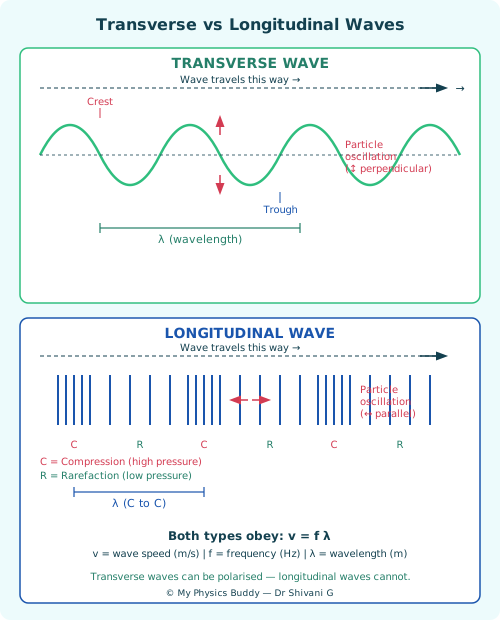
In teaching hundreds of students across multiple curricula, I’ve noticed that students who sketch both wave types side by side — labelling the direction of particle motion with arrows alongside the direction of wave propagation — retain the distinction far better than those who try to memorise it from text alone. Make that sketch your go-to revision habit.
Common Mistakes Students Make With Transverse and Longitudinal Waves
✗ Mistake: Students say that particles “travel with the wave” in the direction of propagation.
✓ Fix: Particles only oscillate about a fixed equilibrium position — they do not move along with the wave. Only energy is transferred in the direction of propagation.✗ Mistake: Students apply the concept of polarisation to longitudinal waves, stating that sound can be polarised.
✓ Fix: Polarisation only applies to transverse waves. Because longitudinal wave oscillations are along the wave direction, there is no perpendicular plane to restrict — polarisation is physically impossible for them.✗ Mistake: Confusing wavelength in a longitudinal wave — students try to measure crest-to-crest distance where none exists.
✓ Fix: In a longitudinal wave, wavelength (λ) is the distance between two successive compressions (or two successive rarefactions). Always measure between equivalent points in phase.
Exam Relevance: The difference between transverse and longitudinal waves is tested in GCSE Physics, A/AS Level Physics (9702), IB Physics HL/SL, and AP Physics 1, covering wave properties, sound, and the electromagnetic spectrum.
Pro Tip from Dr Shivani G: Always draw a small arrow showing particle motion direction alongside the wave travel direction — examiners reward this clarity and it eliminates confusion instantly.
Related Questions
How to interpret and draw electric field line diagrams?
What is the best revision strategy for CIE A Level Physics?
What is the difference between transverse and longitudinal waves?
What is the difference between series and parallel circuits?
How does Bernoulli’s principle explain airplane lift?
What is the relationship between frequency wavelength and speed of a wave?
How to calculate net force when multiple forces act on an object?
What is the work-energy theorem and how do you apply it?