Majed A
asked on January 25, 2026
Photoelectric effect threshold frequency problems
What is the photoelectric effect and how to solve threshold frequency problems?
Need Help?
Hire one of our expert Physics tutor online. 24/7 Service. Available now.
Expert Answer
Answered on March 4, 2026 by EXPERT TUTOR
Nothing Found
Dear Majed A,
The photoelectric effect is the emission of electrons from a metal surface when electromagnetic radiation of sufficiently high frequency shines on it. According to expert tutors at My Physics Buddy, this phenomenon proves that light behaves as discrete packets of energy called photons. It is a cornerstone topic in A/AS Level Physics (9702).
Understanding the Photoelectric Effect and Solving Threshold Frequency Problems
The Core Physics — What Is Really Happening?
Imagine trying to knock a ball off a shelf. If you throw very small, slow pebbles at it one by one, no matter how many you throw, the ball never moves. But throw one large enough rock with sufficient energy and it knocks the ball off immediately. This is exactly how the photoelectric effect works with electrons trapped inside a metal.
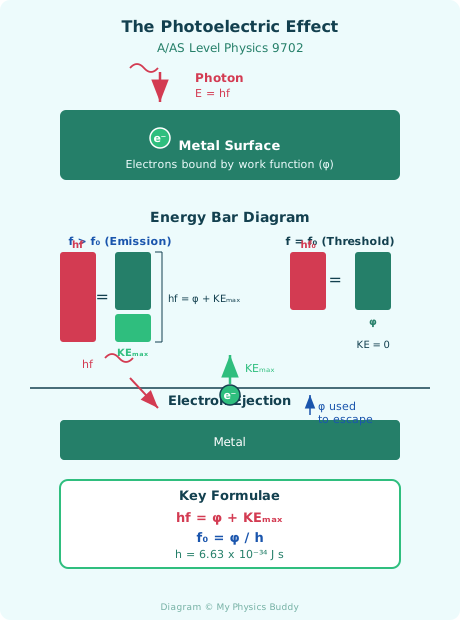
Each electron inside a metal is held in place by attractive forces from the metal lattice. To escape, an electron needs a minimum amount of energy called the work function (φ). A single photon of light either carries enough energy to liberate that electron or it does not — there is no accumulation, no waiting, no build-up. This is the quantum nature of light, and it directly contradicts the classical wave model.
The key quantities you must know are:
- Photon energy: E = hf, where h = 6.63 × 10⁻³⁴ J s (Planck’s constant) and f is the frequency of light in Hz.
- Work function (φ): The minimum energy needed to remove one electron from the metal surface (in joules or eV).
- Threshold frequency (f₀): The minimum frequency of radiation that can just eject an electron, with zero kinetic energy left over.
- Maximum kinetic energy of emitted electrons (KEmax): Any photon energy above φ becomes kinetic energy of the emitted electron.
The Key Equation
The Einstein photoelectric equation ties everything together:
hf = φ + KEmax
Where:
- hf = energy of the incoming photon (J)
- φ = work function of the metal (J)
- KEmax = maximum kinetic energy of the emitted photoelectron (J)
At the threshold frequency, the electron is just barely released with zero kinetic energy remaining, so KEmax = 0. This gives:
hf₀ = φ → f₀ = φ / h
This is the formula you reach for whenever a threshold frequency problem appears on your exam.
Worked Example — Step by Step
Question: The work function of sodium is 3.65 × 10⁻¹⁹ J. Calculate (a) the threshold frequency and (b) the maximum kinetic energy of photoelectrons when light of frequency 7.00 × 10¹⁴ Hz shines on the surface.
Step 1 — Find the threshold frequency:
f₀ = φ / h = (3.65 × 10⁻¹⁹) / (6.63 × 10⁻³⁴)
f₀ = 5.51 × 10¹⁴ Hz
Step 2 — Check whether emission occurs:
The incident frequency is 7.00 × 10¹⁴ Hz, which is greater than f₀ = 5.51 × 10¹⁴ Hz, so emission does occur.
Step 3 — Find KEmax using the Einstein equation:
KEmax = hf − φ
KEmax = (6.63 × 10⁻³⁴ × 7.00 × 10¹⁴) − 3.65 × 10⁻¹⁹
KEmax = 4.641 × 10⁻¹⁹ − 3.65 × 10⁻¹⁹
KEmax = 9.91 × 10⁻²⁰ J
Track your units at every step. h is in J s, f in Hz (= s⁻¹), so hf gives joules — consistent with φ in joules.
Energy Units — eV vs Joules
Work functions are sometimes given in electronvolts (eV). Convert using: 1 eV = 1.60 × 10⁻¹⁹ J. Always convert to joules before substituting into hf = φ + KEmax, unless your entire calculation stays in eV consistently. As an IBDP Physics Facilitator and Head of Sciences with over 22 years of experience, I can tell you that unit confusion between eV and J is one of the most common sources of lost marks in this topic.
For deeper reading on the quantum model of light and its experimental history, the Encyclopaedia Britannica article on the photoelectric effect is an excellent authoritative reference. You can also explore the broader context of this topic through our Physics resources at My Physics Buddy.
A useful summary of the relationships:
| Situation | Condition | Result |
|---|---|---|
| f < f₀ | hf < φ | No emission |
| f = f₀ | hf = φ | Emission, KEmax = 0 |
| f > f₀ | hf > φ | Emission, KEmax > 0 |
Increasing the intensity of light below the threshold frequency still produces no electrons — more photons arrive but each individual photon still lacks enough energy. Increasing intensity above threshold increases the number of emitted electrons, not their maximum kinetic energy. Increasing frequency increases KEmax. Make sure Majed, you keep intensity and frequency effects clearly separated in your mind.
Common Mistakes
✗ Mistake: Using intensity instead of frequency to determine whether emission occurs.
✓ Fix: Only frequency (or equivalently photon energy) determines whether the threshold is crossed. Intensity only affects the rate of electron emission once f > f₀.✗ Mistake: Forgetting to convert work function from eV to joules before calculating threshold frequency.
✓ Fix: Always multiply eV values by 1.60 × 10⁻¹⁹ to get joules before substituting into f₀ = φ / h.✗ Mistake: Assuming all emitted electrons have the same kinetic energy equal to KEmax.
✓ Fix: KEmax applies only to surface electrons. Electrons from deeper within the metal lose some energy escaping the lattice, so they emerge with less kinetic energy. The equation gives the maximum, not a fixed value.
Exam Relevance: The photoelectric effect and threshold frequency calculations appear in Cambridge A/AS Level Physics (9702), Edexcel A Level Physics, and IB Physics HL/SL. Cambridge 9702 tests this within the Quantum Physics topic, often combining threshold frequency with stopping potential calculations. For authoritative syllabus details, refer to the Cambridge International AS and A Level Physics 9702 syllabus page.
Pro Tip from Jiya B: Sketch a quick energy bar diagram — one bar for hf split into φ and KEmax — before writing any equation. It prevents sign errors every time.
Related Questions
How to calculate Young modulus from a stress-strain graph?
What is the difference between progressive and stationary waves 9702?
How does a potential divider circuit work in CIE physics?
How to determine internal resistance of a cell using a graph?
What is the photoelectric effect and how to solve threshold frequency problems?
How to calculate gravitational field strength at a distance from a planet?
What are the key differences between gravitational and electric fields 9702?
How to use the decay equation for radioactive decay problems?