Rashid Al-Shamari
asked on March 30, 2025
Superposition of waves A Level
What is the principle of superposition of waves in A Level physics?
Need Help?
Hire one of our expert Physics tutor online. 24/7 Service. Available now.
Expert Answer
Answered on April 27, 2025 by EXPERT TUTOR
Nothing Found
Dear Rashid Al-Shamari,
The principle of superposition of waves states that when two or more waves meet at a point, the resultant displacement at that point is the vector sum of the individual displacements of each wave. This principle is the foundation of interference and diffraction, and according to expert tutors at My Physics Buddy, it is one of the most frequently tested wave concepts in A Level physics.
Understanding the Principle of Superposition in Depth
At its heart, superposition is elegantly simple: waves pass through each other without permanently altering one another. While they overlap, their displacements add together — and once they have passed through, each wave continues exactly as before. This “passing through” behaviour is what makes waves fundamentally different from colliding particles.
The Mathematical Statement
If wave 1 produces a displacement y₁ at a point, and wave 2 produces a displacement y₂ at the same point and at the same instant, then the resultant displacement y is:
y = y₁ + y₂
where displacements are treated as signed quantities — upward displacements are positive and downward displacements are negative. This is a vector addition along the direction of oscillation.
For example, if y₁ = +3 mm and y₂ = +2 mm, the resultant displacement is y = +5 mm.
If y₁ = +4 mm and y₂ = −4 mm, the resultant displacement is y = 0 mm.
Constructive and Destructive Interference
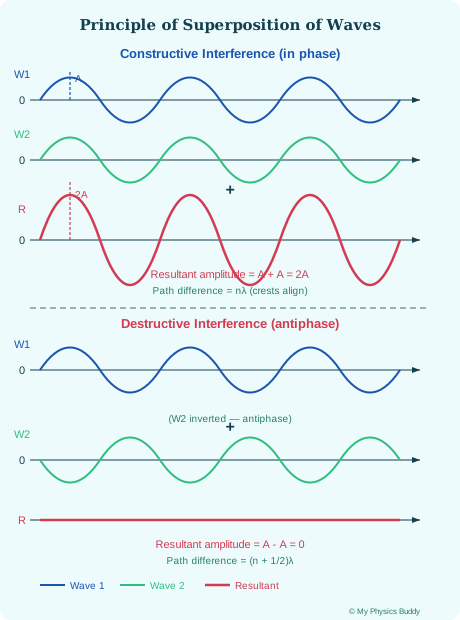
Constructive interference occurs when two waves meet in phase — their crests align and their troughs align. The resultant amplitude is the sum of the individual amplitudes. For two identical waves each of amplitude A, the resultant amplitude is 2A.
Destructive interference occurs when two waves meet completely out of phase (antiphase) — the crest of one coincides with the trough of the other. For two waves of equal amplitude A, the resultant amplitude is zero, producing a point of complete cancellation.
The condition for constructive interference (for waves from coherent sources) involves a path difference that is a whole number of wavelengths:
Path difference = nλ (n = 0, 1, 2, 3, …)
The condition for destructive interference involves a path difference that is an odd number of half-wavelengths:
Path difference = (n + ½)λ (n = 0, 1, 2, 3, …)
where λ is the wavelength of the waves and n is a non-negative integer.
An Everyday Analogy
Think about dropping two stones into a still pond at the same time but at different positions. Each stone creates circular ripples that spread outward. Where the ripples from the two stones overlap, you see some points with unusually large crests (constructive interference) and other points where the water is almost flat (destructive interference). The ripples do not bounce back — they simply pass through each other, continuing their journey undisturbed. This is superposition in action.
A Worked Example
Two sinusoidal waves of the same frequency and wavelength travel along the same string. Wave 1 has amplitude 6.0 cm and wave 2 has amplitude 4.0 cm. Calculate the maximum and minimum resultant amplitudes.
Step 1 — Maximum (constructive):
Occurs when the waves are in phase (path difference = nλ).
Resultant amplitude = 6.0 + 4.0 = 10.0 cm
Step 2 — Minimum (destructive):
Occurs when the waves are in antiphase (path difference = (n + ½)λ).
Resultant amplitude = 6.0 − 4.0 = 2.0 cm
Note that complete cancellation only occurs when both amplitudes are equal. When they differ, as in this example, destructive interference still reduces the amplitude but does not eliminate it entirely — a subtlety that many students miss in A/AS Level Physics (9702) examinations.
Why Superposition Matters
The principle of superposition underpins some of the most important phenomena in Waves and Optics — including Young’s double-slit experiment, stationary (standing) waves, diffraction grating patterns, and thin-film interference. As an IBDP and A-Level Physics Specialist, I can tell you that students who master superposition early find interference and stationary wave questions significantly more manageable when they appear in Paper 4 style contexts.
For a deeper treatment of wave behaviour and interference at the university preparatory level, the Physics Classroom — Interference of Waves resource provides clear interactive illustrations that complement your A Level studies well.
Coherence and the Superposition Principle
For a stable, observable interference pattern to form, the two sources must be coherent — meaning they must have the same frequency and a constant phase difference. Superposition itself applies to any two waves meeting at a point, but without coherence the pattern shifts so rapidly that it time-averages to a uniform intensity and becomes invisible to the eye. This is why laser light produces clear Young’s fringes but two separate light bulbs do not.
Common Mistakes Students Make
✗ Mistake: Assuming destructive interference always produces zero displacement, regardless of the amplitudes involved.
✓ Fix: Zero resultant amplitude only occurs when the two interfering waves have equal amplitudes and are perfectly in antiphase. When amplitudes differ, the minimum resultant amplitude equals the difference of the two amplitudes.✗ Mistake: Forgetting that displacements are signed quantities when applying superposition, and simply adding magnitudes.
✓ Fix: Always assign a positive sign to upward (or chosen positive direction) displacements and a negative sign to downward displacements before summing. The direction of each displacement matters.✗ Mistake: Confusing path difference with phase difference and misapplying the interference conditions.
✓ Fix: Remember that a path difference of one full wavelength λ corresponds to a phase difference of 2π radians (360°). Use path difference = nλ for constructive and path difference = (n + ½)λ for destructive interference consistently.
Exam Relevance: The principle of superposition is examined in Cambridge A/AS Level Physics (9702), Edexcel A Level Physics, IB Physics HL/SL, and AP Physics. Questions commonly target interference conditions, resultant displacement calculations, and stationary wave formation.
Pro Tip from Mamatha M: Sketch the two waves on the same axis and add displacements point by point — this visual approach eliminates sign errors and earns method marks reliably.
Related Questions
How to analyze motion graphs for AP Physics?
What is the difference between static and kinetic friction in AP Physics?
How to handle unit conversions in AP Physics problems?
What are the FRQ scoring guidelines for AP Physics?
How to solve impulse and momentum problems on the AP exam?
What is the best AP Physics prep book for self-study?
How to approach experimental design questions on AP Physics?
How do you calculate the moment of inertia for different shapes?