M Ortega
asked on March 1, 2026
Frequency wavelength speed relationship
What is the relationship between frequency wavelength and speed of a wave?
Need Help?
Hire one of our expert Physics tutor online. 24/7 Service. Available now.
Expert Answer
Answered on March 2, 2026 by EXPERT TUTOR
Nothing Found
Dear M Ortega,
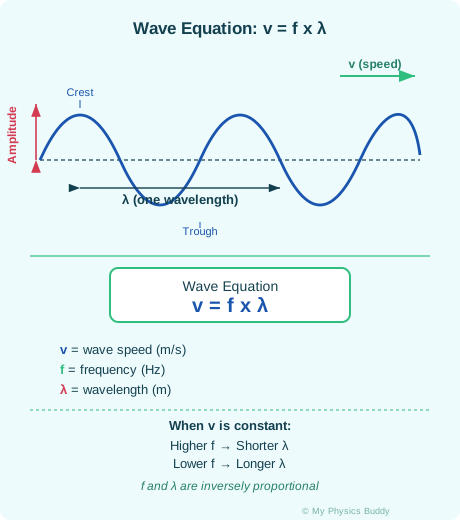
The relationship between frequency, wavelength, and speed of a wave is captured by the wave equation: v = fλ, where wave speed equals frequency multiplied by wavelength. According to expert tutors at My Physics Buddy, this single equation connects three fundamental wave properties and applies universally — from sound waves to light. Understanding it deeply unlocks much of Physics.
Understanding the Frequency, Wavelength, and Wave Speed Relationship
Every wave — whether it’s a ripple on water, a sound travelling through air, or a light beam crossing a room — is described by three core properties. Let’s build up your understanding of each one before connecting them.
The Three Key Wave Properties
- Wave speed (v): How fast the wave pattern moves through a medium. Measured in metres per second (m/s).
- Frequency (f): How many complete wave cycles pass a fixed point per second. Measured in Hertz (Hz), where 1 Hz = 1 cycle per second.
- Wavelength (λ): The length of one complete wave cycle — for example, from one crest to the next. Measured in metres (m).
The Wave Equation
The mathematical relationship between these three quantities is:
v = f × λ
Where:
- v = wave speed (m/s)
- f = frequency (Hz)
- λ (lambda) = wavelength (m)
This can be rearranged depending on what you need to find:
| Find | Rearranged Formula |
|---|---|
| Wave speed (v) | v = f × λ |
| Frequency (f) | f = v ÷ λ |
| Wavelength (λ) | λ = v ÷ f |
Building Intuition: The Marching Band Analogy
Imagine a long parade of marching band members walking past you. Each member represents one wave crest. Wavelength is the distance between two consecutive members. Frequency is how many members walk past you every second. Wave speed is simply how fast the whole parade is moving. If the parade speeds up but members stay the same distance apart, more of them pass you per second — frequency increases. This is exactly how the wave equation works.
The Inverse Relationship Between Frequency and Wavelength
Notice something powerful: when the wave speed is constant (which it is in a given medium), frequency and wavelength are inversely proportional. Double the frequency, and the wavelength halves. This is why radio waves (low frequency) have wavelengths of hundreds of metres, while visible light (very high frequency) has wavelengths of only around 400–700 nanometres. You can explore how this plays out across the electromagnetic spectrum on the NASA Science electromagnetic spectrum resource.
As a PhD researcher in Condensed Matter Physics, I can tell you that this inverse relationship appears constantly in wave-based physics — from phonons in crystals to electron matter waves in quantum mechanics. Getting it intuitive early pays dividends across every wave topic you’ll ever study.
Worked Example
A sound wave travels through air at 340 m/s and has a frequency of 850 Hz. What is its wavelength?
Step 1 — Write the formula:
λ = v ÷ f
Step 2 — Substitute the known values:
λ = 340 m/s ÷ 850 Hz
Step 3 — Calculate and include units:
λ = 0.4 m
So the wavelength of this sound wave is 0.4 metres (40 cm). Notice the unit check: m/s ÷ Hz = m/s ÷ (1/s) = m. Units always confirm whether your rearrangement is correct.
In my teaching experience, I’ve noticed that students who struggle with this topic almost always skip the unit check. That step alone catches most arithmetic and algebraic errors before they cost marks. For structured practice with wave problems, the Waves and Optics tutor page is an excellent next step.
This relationship also holds for light in a vacuum, where the speed is the universal constant c = 3 × 10⁸ m/s, giving:
c = f × λ
This version of the wave equation is central to IGCSE Physics (0625) and beyond, appearing in optics, atomic spectra, and photon energy calculations.
Common Mistakes Students Make
✗ Mistake: Assuming that a higher frequency always means a faster wave.
✓ Fix: Wave speed depends on the medium, not on frequency. In a given medium, speed stays constant — only wavelength changes when frequency changes.✗ Mistake: Forgetting to convert units before substituting into v = fλ (for example, using frequency in kHz instead of Hz).
✓ Fix: Always convert to SI base units first — Hz for frequency, metres for wavelength, m/s for speed — before substituting any values.✗ Mistake: Confusing period (T) with wavelength (λ) because both describe “one cycle”.
✓ Fix: Period is a time quantity (seconds) measuring one cycle in time; wavelength is a distance quantity (metres) measuring one cycle in space. They are related by f = 1/T, not interchangeable.
Exam Relevance: The wave equation v = fλ is a core formula tested in GCSE Physics, A/AS Level Physics (9702), IB Physics HL/SL, and AP Physics 1. All four curricula expect both recall and multi-step problem-solving using this relationship.
Pro Tip from Ayush K: Memorise v = fλ as a triangle like the speed-distance-time triangle — cover the quantity you want and read off the operation immediately. It saves valuable exam time.
Related Questions
How to analyze motion graphs for AP Physics?
What is the difference between static and kinetic friction in AP Physics?
How to handle unit conversions in AP Physics problems?
What are the FRQ scoring guidelines for AP Physics?
How to solve impulse and momentum problems on the AP exam?
What is the best AP Physics prep book for self-study?
How to approach experimental design questions on AP Physics?
How do you calculate the moment of inertia for different shapes?