A Al-Rifai
asked on August 28, 2025
Period vs frequency oscillations relationship
What is the relationship between period and frequency for oscillations?
Need Help?
Hire one of our expert Physics tutor online. 24/7 Service. Available now.
Expert Answer
Answered on October 23, 2025 by EXPERT TUTOR
Nothing Found
Dear A Al-Rifai,
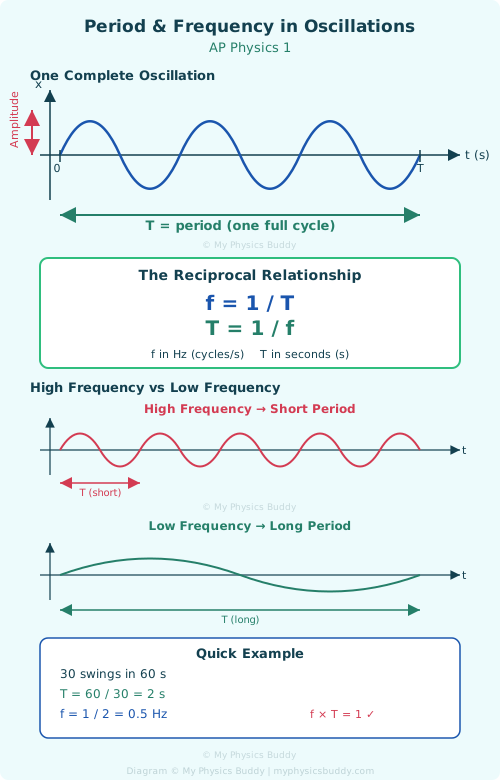
The relationship between period and frequency for oscillations is a simple reciprocal one: each quantity is exactly one divided by the other. According to expert tutors at My Physics Buddy, if you know one, you instantly know the other. Together they fully describe the timing of any repeating motion.
Understanding Period and Frequency in Oscillations
Period (T) is the time it takes for one complete oscillation — one full back-and-forth cycle. Frequency (f) is the number of complete oscillations that occur in one second. These two quantities are not independent; they are mathematical inverses of each other.
The defining relationship is:
f = 1 / T and equivalently T = 1 / f
Where:
- f = frequency, measured in hertz (Hz), where 1 Hz = 1 cycle per second
- T = period, measured in seconds (s)
This reciprocal relationship is one of the most elegant and frequently tested ideas in AP Physics 1. It seems almost too simple, but getting the intuition locked in early prevents a surprising number of errors later.
Building the Intuition
Think about a ceiling fan spinning at 2 rotations per second. Its frequency is f = 2 Hz. That means each single rotation takes exactly 0.5 seconds — so T = 0.5 s. Notice that 1 / 2 = 0.5. The faster the fan spins (higher frequency), the less time each cycle takes (smaller period). The two quantities always move in opposite directions.
A slower fan spinning at 0.25 Hz completes one rotation every 4 seconds: T = 1 / 0.25 = 4 s. This inverse relationship holds for every oscillating system — a pendulum, a mass on a spring, a vibrating guitar string, or a sound wave.
Worked Example
A student observes that a pendulum completes 30 full swings in 60 seconds. Find the frequency and the period.
Step 1 — Find the period.
The period is the time for one complete swing.
T = 60 s ÷ 30 cycles = 2 s
Step 2 — Find the frequency.
f = 1 / T = 1 / 2 s = 0.5 Hz
Step 3 — Verify the reciprocal relationship.
1 / 0.5 Hz = 2 s ✓ — the two values are perfectly consistent.
As an MSc Physics gold medalist, I can tell you that one of the most consistent mistakes I see students make is dividing instead of multiplying (or vice versa) under time pressure. Anchoring your thinking to the fan analogy before starting a problem makes this almost error-proof.
Connecting to the AP Physics 1 Oscillation Unit
In the context of AP Physics, you will often encounter this relationship paired with the formulas for a simple pendulum and a mass-spring system:
| System | Period Formula | Key Variables |
|---|---|---|
| Simple Pendulum | T = 2π √(L/g) | L = length, g = gravitational acceleration |
| Mass-Spring | T = 2π √(m/k) | m = mass, k = spring constant |
Once you find T from either formula, frequency follows immediately: f = 1 / T. For a deeper mathematical treatment of oscillatory motion, the Khan Academy AP Physics 1 oscillations module provides excellent interactive visualisations that reinforce this reciprocal link.
Common Mistakes
✗ Mistake: Writing f = T / 1 instead of f = 1 / T, flipping the reciprocal under pressure.
✓ Fix: Remember the units. Frequency is in Hz = cycles/second, so it must be cycles divided by time, never time divided by cycles.✗ Mistake: Calculating frequency by dividing total cycles by total cycles instead of total cycles by total time.
✓ Fix: Always write out f = (number of cycles) / (total time in seconds) before substituting numbers.✗ Mistake: Confusing angular frequency ω (in rad/s) with regular frequency f (in Hz) and using them interchangeably.
✓ Fix: Keep the relationship ω = 2πf visible in your notes and always check units before substituting into any formula.
Exam Relevance: The period–frequency relationship appears in AP Physics 1 (Unit 6: Oscillations), AP Physics 2, IB Physics SL/HL, and A-Level Physics 9702. All four curricula test both the reciprocal formula and its application to pendulum and spring systems.
💡 Pro Tip from Christi J: When a question gives you frequency in Hz and asks for period, just flip it. If f = 0.4 Hz, then T = 2.5 s. One step, zero mistakes.
Related Questions
How to solve impulse and momentum problems on the AP exam?
What is the best AP Physics prep book for self-study?
How to approach experimental design questions on AP Physics?
How do you calculate the moment of inertia for different shapes?
What are common AP Physics mistakes students make on the exam?
What is the difference between AP Physics 1, 2, and C?
How to calculate gravitational field strength at a distance from a planet?
What are the key differences between gravitational and electric fields 9702?