Nelson Cruz
asked on January 10, 2025
Right-hand rule magnetic fields application
What is the right-hand rule and how to apply it for magnetic fields?
Need Help?
Hire one of our expert Physics tutor online. 24/7 Service. Available now.
Expert Answer
Answered on January 23, 2025 by EXPERT TUTOR
Nothing Found
Dear Nelson Cruz,
The right-hand rule is a physical technique used in AP Physics 2 to determine the direction of a magnetic field, magnetic force, or magnetic torque by orienting your right hand in a specific way relative to current and field directions. According to expert tutors at My Physics Buddy, mastering this single tool unlocks nearly every magnetic direction problem you will encounter on the exam.
Understanding and Applying the Right-Hand Rule for Magnetic Fields
There are actually three closely related versions of the right-hand rule, and knowing which version to apply in each situation is the real skill. Students in AP Physics 2 regularly tell me they know “a” right-hand rule but then freeze when the setup looks slightly different. Let me walk you through all three clearly.
Version 1 — Magnetic Field Around a Long Straight Wire
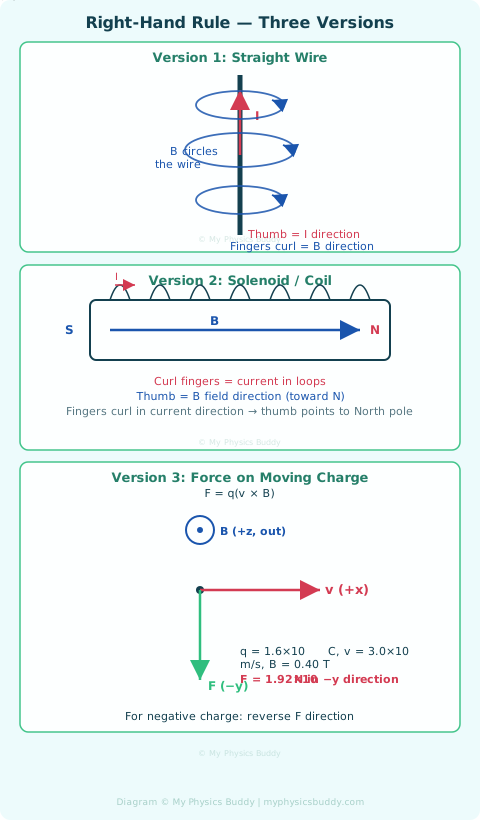
When current flows through a straight wire, it creates circular magnetic field lines wrapping around the wire. To find the direction of those field lines, use the straight-wire right-hand rule:
- Point your right thumb in the direction of conventional current flow (from + to -).
- Curl your fingers around the wire.
- Your curled fingers show the direction the magnetic field B circles around the wire.
Think of it like gripping a bicycle handlebar: your thumb points the direction you are riding (current), and your fingers wrap in the direction of the circular field. The field magnitude for an infinitely long straight wire is given by:
B = (μ0 I) / (2πr)
where B is the magnetic field strength in tesla (T), μ0 = 4π × 10−7 T·m/A is the permeability of free space, I is the current in amperes, and r is the perpendicular distance from the wire in metres.
Version 2 — Magnetic Field Inside a Solenoid or Coil
For a solenoid (a coil of wire), the curled-finger right-hand rule applies:
- Curl your right-hand fingers in the direction that conventional current flows around the loops of the coil.
- Your extended right thumb points in the direction of the magnetic field inside the solenoid — toward the north pole.
This is the reverse priority from Version 1: now your fingers represent current, and your thumb gives you the field direction.
Version 3 — Force on a Moving Charge or Current-Carrying Wire (the Cross-Product Rule)
The magnetic force on a positive charge moving through a magnetic field is given by the Lorentz force:
F = q(v × B)
where F is the magnetic force in newtons, q is the charge in coulombs, v is the velocity vector of the charge, and B is the magnetic field vector. The cross product means the force is always perpendicular to both v and B. To find its direction:
- Point your right-hand fingers in the direction of v (velocity of a positive charge, or current direction in a wire).
- Curl them toward B (the magnetic field direction).
- Your extended thumb points in the direction of F.
Critical note for negative charges: if the charge is negative (like an electron), apply the rule exactly as above for a positive charge and then reverse the resulting force direction. As someone with a dual MS in Physics and Astronomy, I can tell you this single step is the source of more lost exam points than almost anything else in magnetism.
Worked Example: Force on a Proton
A proton moves in the +x direction with speed v = 3.0 × 10⁶ m/s through a uniform magnetic field B = 0.40 T pointing in the +z direction. Find the direction and magnitude of the magnetic force.
Step 1 — Direction: Point fingers in +x (velocity). Curl toward +z (field). Your thumb points in the +y direction… wait, let us be careful. Fingers pointing in +x, curl toward +z: that sweeps from +x up toward +z, and using the standard right-hand rule, the thumb points in the −y direction. Let us verify with the unit vector cross product: x̂ × ẑ = −ŷ. So the force is in the −y direction.
Step 2 — Magnitude:
F = qvB sinθ
Since v is perpendicular to B, sin 90° = 1
F = (1.6 × 10⁻¹⁹ C)(3.0 × 10⁶ m/s)(0.40 T)
F = 1.92 × 10⁻¹³ N in the −y direction
You can read more about the foundations of this topic at the Khan Academy AP Physics 2 magnetic forces section, which pairs well with the conceptual approach described here.
For deeper practice applying these ideas to circuits and electromagnetic induction, explore how the right-hand rule connects to Faraday’s law through our AP Physics C: Electricity and Magnetism resources, which extend these concepts significantly.
One pattern I see consistently in my students: they try to use their left hand because the setup “looks” like it should go the other way. Always use your right hand for conventional current and positive charges, no exceptions. The rule is built into the mathematics of the cross product and never changes.
Common Mistakes with the Right-Hand Rule
✗ Mistake: Using the left hand for all negatively charged particles instead of applying the right-hand rule first and then reversing the result.
✓ Fix: Always start with the right-hand rule as if the charge were positive, find the force direction, and then flip it 180° for negative charges.✗ Mistake: Confusing which version of the rule to apply — using the thumb-for-current version when the problem asks about force on a charge.
✓ Fix: Before applying any rule, identify what the question gives you (current in a wire, charge velocity, or solenoid coil), then select the matching version deliberately.✗ Mistake: Forgetting that the magnetic force is zero when velocity and magnetic field are parallel (θ = 0°), and still trying to apply the right-hand rule to get a direction.
✓ Fix: Always check sinθ first. If v is parallel or anti-parallel to B, the force is zero and no direction exists — stop there.
Exam Relevance: The right-hand rule appears on the AP Physics 2 exam in free-response and multiple-choice sections covering magnetic forces and fields. It is also tested in AP Physics C: Electricity and Magnetism, A/AS Level Physics (9702), and IB Physics HL.
💡 Pro Tip from Koustubh B: Label your axes on scratch paper before every magnetic force problem. Knowing exactly where +x, +y, and +z point eliminates all ambiguity when applying the cross-product right-hand rule.
Related Questions
How to answer 9702 Paper 5 planning questions effectively?
How does electromagnetic induction work and what is Faraday’s law?
What is the difference between nuclear fission and fusion in A Level?
How to calculate specific heat capacity from experimental data?
What is simple harmonic motion and how to derive its equations?
How to solve problems involving circular motion and centripetal force?
What are the common mistakes in 9702 Paper 2 structured questions?
How to interpret and draw electric field line diagrams?